This publisher enlists 'bookfluencers' to choose its titles. Is it working?
Published in Books News
When young adult author Courtney Summers got the rights back to her backlisted titles in 2024, she initially wasn't sure what to do with them.
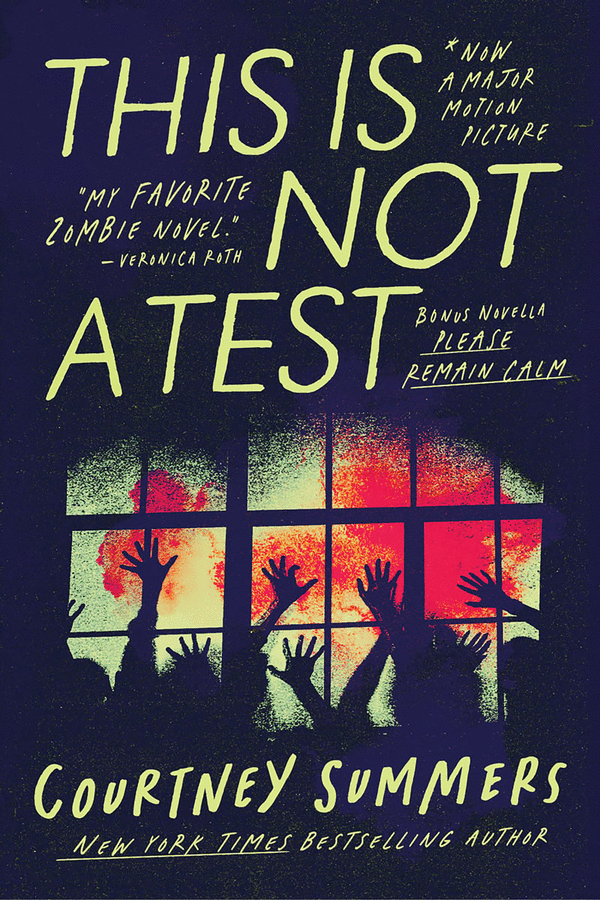
Summers' novels, the bulk of which enjoyed peak popularity in the 2010s, had by then faded into the periphery — despite a film adaptation of her 2012 zombie thriller "This Is Not a Test," which is slated to be released in theaters Feb. 20. But the Canadian author felt they still had potential.
That's how she wound up pitching a "Taylor's Version"-style rerelease of her backlist to a handful of desired publishers. Under this model, Summers would publish lightly revised versions of her old books — "make the background vocals stronger and the guitar richer," so to speak — in the hopes of reanimating her work and reaching a new generation of readers.
Her unorthodox plan had one fledgling publisher's name all over it — Bindery Books.
Co-founded by book marketing veteran Matt Kaye and former Becker&mayer! editor Meghan Harvey, Bindery Books is a publishing startup and membership platform that integrates influencer marketing into the book publication process. Unlike traditional publishing houses, Bindery operates via a handful of influencer-led imprints, designed to better serve reader interest and take the burden of book promotion off under-resourced authors.
"Bookish creators wanted to figure out how to build a career doing what they love. Authors want to reach an audience," Kaye said. So he and Harvey decided to play matchmaker.
Bindery currently houses 12 imprints helmed by book influencers, or as Kaye called them, "tastemakers." Oftentimes, these atypical acquiring editors grew their online book communities for several years before landing at Bindery.
Kathryn Budig, head of the speculative fiction imprint the Inky Phoenix, started her online book club of the same name in 2020. She published her first title with Bindery in 2024.
When Bindery's acquisitions director Shira Schindel brought her Summers' backlog last year, Budig first pulled "This Is Not a Test," the most speculative of the bunch, and was immediately hooked.
"I read it, I went back to Shira and was like, 'Give it to me. Mine. Mine,'" she said.
Since then, Budig has labored tirelessly to stoke enthusiasm for Summers' book among her Inky Phoenix community members. Her genuine pride in Summers' work, and eagerness for it to succeed, is tangible in every post and promotional video — just like Kaye and Harvey imagined.
The trust between Summers and Budig was immediate, the latter said: "We started a dev[elopmental] edit before we even inked the papers."
It was a completely different publishing experience than Summers was used to, she said. Her previous publishers had been either too overworked or unbothered to treat her and her work with the respect she felt she deserved.
Under Budig's wing, Summers said she was cared for and included in editorial decision-making, in part thanks to a project manager — a role typically not seen at legacy publishing houses. The author added that for the first time in the 14 years after its publication, "This Is Not a Test" is a Kids Indie Next pick.
For the Bindery team to make that happen, she said, "they pulled levers I can't imagine would be possible in a more traditional model."
Few of Bindery's authors have Summers' high profile or sizable backlog. Instead, nearly all of its titles are debuts, and about a third of its authors are unagented, Kaye said. Last year, several Bindery books hit bestseller and year-end lists.
Kaye attributed Bindery's success to its nontraditional model, which by leveraging so-called "bookfluencer" reach integrates reader sentiment into the publication process rather than attempting to anticipate it — as many publishing houses still do.
"Part of what we're trying to do is have that immediacy, like, you're not many, many steps removed from the reader," he said. "You're actually in conversation with them every day."
Nina Haines, the tastemaker behind Bindery's Sapph-Lit imprint, said that she solicited member input on the imprint's prospective debut titles before she'd even read the manuscripts. The synopsis that won by a landslide was Kim Narby's "Saturn Returning," expected in May.
Given traditional publishing has historically sidelined queer authors and refused them marketing budgets, Haines said she hopes to be "that person that gets it and fights for it."
Jananie Velu, who heads Bindery's Boundless Press imprint, has similarly aimed to enfranchise underrepresented authors — in her case, authors of color — whom she felt the publishers she formerly worked for never truly gave a chance.
"I spent years butting my head against the wall, like, 'Why can't I get more budget for this author?'" Velu said, adding that her past employers heavily devalued the influence of BookTok and "bookfluencing" on publishing.
"So the idea that I would get to choose the books and really be a champion for those books from day one, I felt was just really exciting," she said.
Jane Friedman, a book industry veteran and author of "The Bottom Line" publishing industry newsletter, views the Bindery model as an effective "middle ground" between traditional book marketing and online influencing.
While the analyst said she was unsure of how scalable it is, she said the publisher's tastemaker strategy "reads as very Gen Z and maybe an indicator of where the industry needs to go to stay fresh and relevant."
Bindery is not yet profitable, Harvey said. But that's on the horizon.
In the meantime, she said, the startup plans to grow — "slowly ... so that every author's needs are taken care of" — and keep pinpointing publishing "blind spots."
"We as an industry tend to go for the surest bets," Harvey said.
"But it's very interesting to me to think about how you could find these really engaged communities around either underexposed or emerging genre interests, [where] readers are there but publishers aren't."
©2026 Los Angeles Times. Visit at latimes.com. Distributed by Tribune Content Agency, LLC.










Comments