How his hometown shaped David Romero's supernatural thriller 'The Enemy Sleeps'
Published in Books News
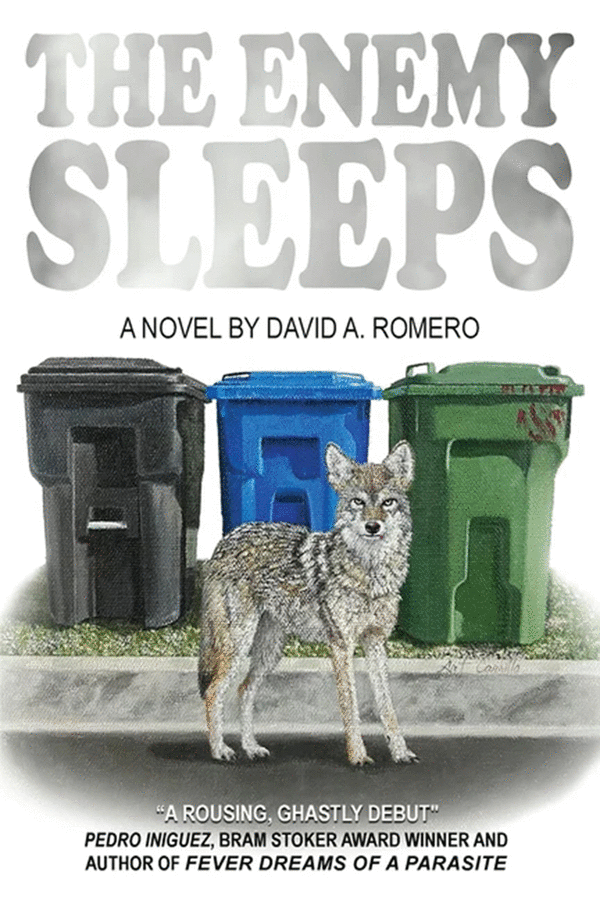
David Romero had been thinking about writing a book when he got inspiration from an unlikely place: the Green Day album “Dookie.” While scanning the song titles, Romero misread the track “Emenius Sleepus” and it sparked something in his imagination.
“I read ‘Enemy Sleeps’ and thought, ‘Wow, that’s so fascinating. What does that mean?” Romero said during a recent interview. “I thought that it sounded really cool.”
Shortly after, the book began to take shape, with new elements often arriving in vivid daydreams and eerie nightmares.
Romera said one of those elements came from the Bible’s Ten Commandments (don’t murder, be nice to your neighbor, etc.), and another from growing up in Diamond Bar, California. The result is his debut novel, “The Enemy Sleeps,” a supernatural thriller set in a fictional Southern Californian town.
The neo-noir tells the story of a Mexican American family who moves from the L.A. neighborhood of Boyle Heights to the fictional, sleepy suburban town of Harper, where they face suspicion because of their race. If moving into a new community isn’t stressful enough, there is also a killer on the loose, dubbed the “Harper Murderer,” and a list of racist, xenophobic locals who seem like prime suspects for the killing of a young Salvadorian girl.
“A lot of the characters in this book, and the way that religion shapes community and challenges hypocrisies in suburbia, was inspired by ‘To Kill a Mockingbird,‘ including the town’s name, Harper, a nod to the author Harper Lee,” he said.
In the book, a 16-year-old character named Edward is coming of age and beginning to understand what it means to be seen as Mexican American by the world at large. Edward’s journey was partly inspired by Romero and his friends’ upbringing, as they tried to navigate their identities with little understanding of what society had ascribed to them based on their ethnicity and race.
As Romero grew older and went to college, he took a sociocultural course that began to open his eyes to his Mexican American background. Though he had Mexican lineage, Romero passed as White. He said he felt disconnected from his culture and ignorant about a lot of things relating to his racial background, despite being the nephew of Frank Romero, one of the most influential pioneers of the Chicano Art Movement. He said his only reference to that culture was visiting his grandparents’ house in Boyle Heights.
“What I did with this book, over time, is that I started to develop a counterhistory of a family that would be like an alternate version of my own,” he said, adding that his dad had left Boyle Heights and often regretted it. Romero wanted to tell a story of a family that didn’t leave their community while exploring pressures of assimilation, such as speaking and dressing “White,” all of which he experienced in his own life.
Romero also researched the communities that made up his hometown of Diamond Bar after coming across a plaque at his hometown’s supermarket that recounted its history. It told the story of how the town had been a ranch where Indigenous communities lived before Spanish settlers arrived, and of its existence in Mexico before that.
He was also inspired by Southern California ghost stories and urban legends, including the tales of Carbon Canyon, which is said to be a hotspot for ghost sightings and to have a mysterious, eerie atmosphere. In the book, a canyon serves as a supernatural focal point, suggesting that the ghosts haunting the town were murdered there.
“Whether you believe in them or not, ghosts are a fascinating way to explore history,” Romero said. “It remains such a great way of learning about history, and it’s interesting that without this kind of fascination with the dead and with ghosts, people may not be interested in history at all.”
Other folklore subjects include the coyote, which appears on the book’s cover. Coyotes symbolize many things, including the term for smugglers of migrants across the U.S.-Mexico border and a spiritual guide or trickster. “The Enemy Sleeps” also features a prologue focused on the coyote, an animal the town is trying to get rid of, even though it was native to the land before humans arrived.
He hopes that his book, which centers on a Mexican American family’s experience fused with supernatural elements, will inspire readers to champion their own cultures and stories, including the influences of their hometowns.
“I’d appreciate it if people read the book and developed curiosity and look into the history of where they live and contemplate how it might influence the present,” he said. “Ultimately, at the end, I want it to make the case for greater empathy for others.”
©2026 MediaNews Group, Inc. Visit ocregister.com. Distributed by Tribune Content Agency, LLC.










Comments