Why this 3rd beaver attack in Maryland is much different than the others
Published in News & Features
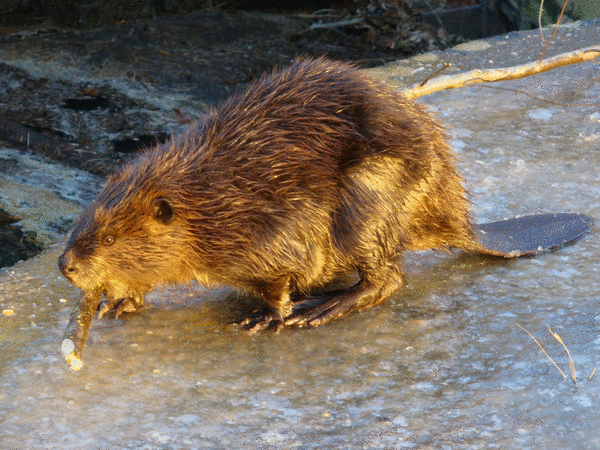
BALTIMORE — Maryland’s third beaver attack this summer was different than the others — as of Monday, officials still haven’t been able to capture a live animal to test it for rabies.
In Montgomery County’s Seneca Creek State Park, where a beaver attacked a 10-year-old girl at summer camp, the environment contains “a stream that is just various degrees unnavigable,” Joshua Tabora, a biologist specializing in fur-bearing mammals, told The Baltimore Sun.
It’s a stark contrast to where the first two incidents took place in Frederick County’s Cunningham Falls State Park. The attacks took place about 250 yards away from each other inside a contained reservoir, and in both cases, officials were able to capture and euthanize the beavers for rabies testing.
Unlike hunting for a potentially rabid animal by motorboat in Cunningham Falls, officials must go out on foot to capture a live and potentially dangerous beaver in Seneca Creek. Using thermal surveys and traps, officials hunted over the past few days — albeit nothing alive has been captured, and parts of Montgomery park are still shut down as a result.
“We’re pulling out a lot of the same tools that were pulled out at Cunningham in order to try to resolve this as quickly as possible,” Tabora told The Sun on Monday. “It’s a different environment, and it’s definitely going to take longer to ensure the safety of the public.
Despite the surge in attacks over the past month, rabid incidents with the normally shy mammal are rare in Maryland. The last two incidents took place in Maryland during 2021 and 2015, according to DNR.
“These are cute animals, but not for cuddling these days,” Dr. Cheyenne Falat, an emergency medicine physician at the University of Maryland Medical Center who specializes in environmental medicine, told The Sun.
The first two rodent-related incidents occurred in Frederick County, both of which Tabora previously called a “maintained” outbreak.
The first beaver attack left a 13-year-old boy, Dominick Cebula, “traumatized” after the rodent attached itself to his chest and required him to be airlifted, his father told The Sun. In the second, a 19-year-old fisherman was standing on the shoreline and, according to footage, got too close to the animal, which was acting erratically, Tabora said.
“The response probably should have been to back up rather than to record,” Tabora said about the second incident. “But hindsight’s 2020.”
The third incident, which occurred 36 miles from the others, involves a different population, Tabora said, where the Cunningham Falls beavers could have potentially been partners.
Beavers appear regularly at Seneca Creek, where Tabora said he grew up paddling with friends. But at a managed swimming hole, a 10-year-old summer camper was bitten on her leg by one.
After consulting with other experts, Tabora and other officials are still looking for answers as to the exact cause of the rise in beaver attacks. Nothing concrete came up.
“There just weren’t any trends that seemed to hold steady for both sites that we could potentially, even circumstantially, try to use to explain this,” Tabora said.
_____
©2026 Baltimore Sun. Visit baltimoresun.com. Distributed by Tribune Content Agency, LLC.






Comments