US-Iran peace prospects dim as Trump rejects truce extension
Published in News & Features
WASHINGTON — The prospects for peace in the Middle East suffered a fresh setback, with President Donald Trump saying he’s not interested in extending the expiring agreement with Iran and fighting flaring anew in Lebanon.
Asked whether he would seek an extension of the memorandum of understanding signed in June — which technically expires Monday — Trump told reporters, “No.” That truce was meant to give Washington and Tehran a window to reach a more lasting peace deal within 60 days.
Two months after the pact’s signing at the Palace of Versailles outside of Paris, with Trump flanked by world leaders and business titans and celebrating renewed flows of oil, both sides have said the agreement is defunct. Tensions over the Strait of Hormuz have sparked flare-ups in hostilities, multiple fronts have created a tinderbox across the Middle East, and there’s been no movement on addressing Iran’s nuclear capabilities that remain Trump’s stated primary objective for the strikes from late February.
Still, Trump insisted on Monday that the U.S. had leverage over Iran, citing the naval blockade of Iranian ports. He repeated his idea of declaring the waterway an American territory, insisting the U.S. retained total control — remarks directly at odds with Iranian officials who insist on managing flows through the strait.
Brent crude rose to end the session near $91 a barrel Monday on fresh concerns about an escalation of the war that’s jolted global energy markets. The global benchmark has gained about 8% since the start of last week as the prospects further dimmed for a swift reopening of Hormuz, through which a fifth of the world’s oil and gas transited before the war.
Any renewed fighting would likely complicate efforts to revive the deadlocked negotiations between the U.S. and Iran. Trump has struggled to find an off-ramp to a war that’s increasingly unpopular in the U.S. and threatens to penalize Republicans in November’s midterm elections. Last week, Treasury Secretary Scott Bessent said the U.S. is preparing to announce new economic measures on Tehran “like have never been seen.”
Oman is negotiating with Iran on how the Strait of Hormuz should be managed, but the U.S. isn’t part of those discussions. In a phone interview earlier with Fox News, Trump warned that if “Oman gets in the way we’ll bomb the s--- out of them,” without give any further details. He made a similar threat in May. Oman is not a formal U.S. military ally but has served as a close U.S. security partner.
Iran said a “shipping map” has been finalized as part of a broader agreement for the governance of traffic in the strait, but intensive talks are continuing and a deal won’t necessarily translate into a reopening.
A deal has been elusive due to security complexities and the “obstructionist behavior of destructive elements,” Iran’s Foreign Ministry spokesman Esmail Baghaei told reporters on Monday. Tehran has said the U.S. must remove its blockade.
Earlier on Fox News, Energy Secretary Chris Wright claimed the U.S. military is “bringing out eight or nine million barrels of oil per day” from the region compared to “zero barrels of oil per day” in Iranian exports.
Trump told Fox News that back channels with officials from the Islamic Revolutionary Guard Corps remain open, something a spokesman later denied as a “delusion,” according to the state-run IRNA.
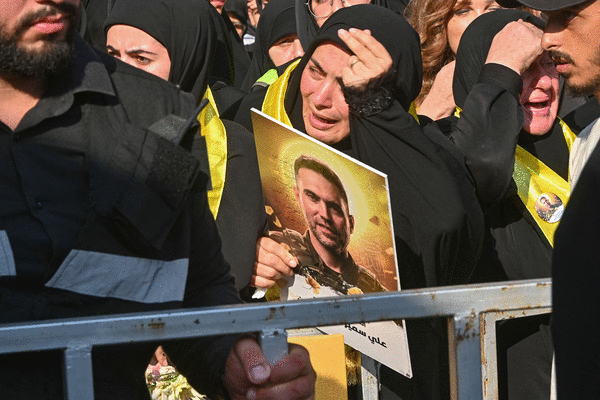
Tensions in the Middle East were already on the rise over the weekend, when Israel’s military said it killed senior Hezbollah commander Abu Hassan Alaa in southern Lebanon. Eleven people died in the Israeli strikes on Saturday, which Prime Minister Benjamin Netanyahu said were in retaliation for an attack by the militant group that seriously injured three soldiers.
In recent days, Israel has also struck Iran-backed Hamas in Gaza, the Yemen-based Houthis have attacked ships in the Red Sea, and several vessels have been hit by projectiles in the Strait of Hormuz. Israeli settlers have meanwhile laid siege to Palestinian homes, drawing international condemnation. Netanyahu has downplayed that violence and blamed a small number of radicals.
While much of Iran’s industrial capacity has been damaged and crude exports severely curtailed by the U.S. blockade, decades of sanctions have failed to force it to bend on its nuclear program or relinquish control over Hormuz.
Iran has used the relative lull in fighting to prepare for a potentially broader confrontation, the Wall Street Journal reported, citing Iranian and Arab officials. Tehran has installed hard-line veterans in key security posts and accelerated missile and drone production, it said.
Meanwhile, Trump’s son-in-law and peace envoy Jared Kushner is visiting the Middle East this week to try and accelerate a U.S.-brokered ceasefire in Gaza. He, along with former U.K. Prime Minister Tony Blair and Nickolay Mladenov, the Board of Peace’s top envoy, were holding talks with Netanyahu in Jerusalem on Monday.
Kushner met with Hamas chief Khalil al-Hayya in Egypt on Sunday, the Associated Press said, citing a regional official and a Hamas official.
In a statement, Hamas called on mediators and the U.S.-created Board of Peace overseeing the ceasefire to “compel” Israel to approve a road map setting out the next steps in the truce, the news agency said.
_____
(With assistance from Dan Williams, Patrick Sykes, Magan Crane, Mike Cohen, Carla Canivete and Devika Krishna Kumar.)
_____
©2026 Bloomberg L.P. Visit bloomberg.com. Distributed by Tribune Content Agency, LLC.





Comments