San Diego County to consider ending deals allowing ICE, CBP use of county-owned gun range
Published in News & Features
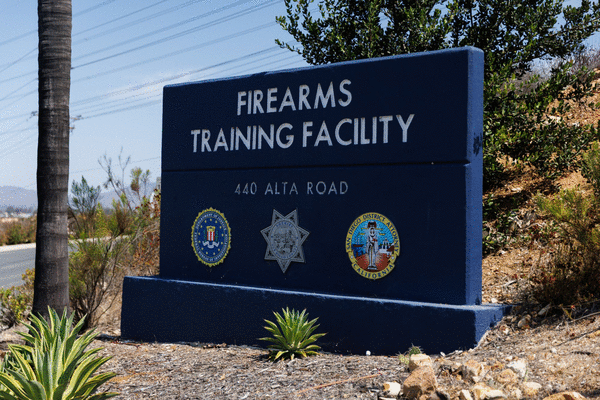
SAN DIEGO — The San Diego County Board of Supervisors is expected to vote Tuesday on whether to terminate three agreements the county has in place that allow federal immigration agents and other federal law enforcement personnel to train at two firing ranges that are either owned or leased by the county.
Board Chair Terra Lawson-Remer and Chair Pro Tem Paloma Aguirre wrote in a letter to the board that the agreements with U.S. Immigration and Customs Enforcement and U.S. Customs and Border Protection contradict the board’s efforts to distance the county from the Trump administration’s immigration crackdown. Lawson-Remer and Aguirre wrote that local residents lose trust in the county and its services when they believe “County resources prop up the same agencies inciting fear throughout our neighborhoods.”
CBP Commissioner Rodney Scott said in a lengthy statement that his agency was “very disappointed” that the board appears “poised to put politics and personal opinions over the economic security and public safety of the region.”
Scott said roughly 1,700 CBP officers work at ports of entry in San Diego County, and the county-owned San Diego Regional Firearms Training Center in Otay Mesa is the only facility they use for mandatory firearms training and qualifications. He said if the supervisors terminate CBP’s agreement to use the Otay Mesa range, it would force local CBP officers to complete their required training and certification outside the region, resulting in “an immediate reduction in deployable staffing” at local ports of entry that would in turn result in increased wait times at border crossings, as well as at the San Diego International Airport.
“The San Diego County Board of Supervisors’ reckless, irresponsible, and ignorant proposal to limit the preparedness of frontline CBP personnel endangers lives and will cause immediate economic harm,” Scott said. “International ports of entry are economic engines. The San Diego County Board of Supervisors is poised to slam on the brakes at all San Diego County ports for political reasons.”
Aguirre countered that CBP personnel have other local training options, including the U.S. Border Patrol’s firing range located near the airport. She said the Trump administration is using fear of long border lines to try to strong-arm the county.
“Internal federal records show that roughly 2,000 CBP personnel were diverted away from ports and the border to run enforcement raids in interior American cities,” Aguirre said in a statement, citing Wall Street Journal reporting. “If federal officials are concerned about border staffing, they can start by sending those agents back to the border.”
Two of the three agreements at issue allow ICE and CBP personnel to use the San Diego Regional Firearms Training Center, which was built 30 years ago through a partnership between the county and FBI. The facility is operated jointly by the county Sheriff’s Office, District Attorney’s Office and FBI. The county signed an agreement in 2017 to allow CBP personnel to train at the facility and a separate agreement in 2021 to allow ICE personnel to use the training center.
The third agreement at issue was signed in 2022 to allow ICE personnel to use the Miramar Training Facility, a firing range located on Marine Corps Air Station Miramar. The range is owned by the U.S. Navy and leased to the county. The Sheriff’s Office has operated the facility for more than two decades.
Lawson-Remer and Aguirre said all three agreements, which were brought to light in April by investigative news outlet inewsource, fell below the monetary threshold requiring approval by the board. They said the agreements were executed administratively without public input or consideration by the board.
The two supervisors wrote that while the license agreements don’t technically violate county policy, they “are fundamentally at odds with the public commitments and policy direction this board has advanced.”
“Terminating these agreements reaffirms that County assets exist to serve all residents and supports the County’s broader commitment to ensuring that fear of immigration enforcement does not become a barrier to accessing public services,” the supervisors wrote.
A spokesperson for the Sheriff’s Office said Thursday that Sheriff Kelly Martinez is aware of the proposal and “continues to have conversations with the Board of Supervisors, the affected federal partners, and the community. She is evaluating the impacts of these decisions based on all stakeholder input.”
In response to inewsource in April, Martinez took a more forceful stance in favor of keeping the agreements. She said at the time that while her office does not assist in immigration enforcement, federal law enforcement personnel would be better trained and could more effectively prevent harm by using the Regional Firearms Training Center.
“I cannot afford to make decisions based on politics,” Martinez told inewsource. “I must focus on the greater good and what keeps our communities safe.”
In response to questions about the board’s proposal and Tuesday’s expected vote, an ICE spokesperson provided general information about ICE’s training policies while saying the agency does not comment on pending local government actions.
“ICE officers receive training necessary to support officer safety, public safety, and mission readiness, and any training is conducted in accordance with applicable laws, policies, and professional standards,” the spokesperson said. “We are always evaluating our procedures and training to keep our officers safe and will not disclose or discuss law enforcement tactics. ICE remains committed to carrying out its federal law enforcement mission safely, responsibly, and in accordance with the law.”
Scott, who oversaw the Border Patrol’s San Diego Sector from 2017 to 2020 and was appointed by President Donald Trump last year as CBP commissioner, said staffing issues and longer wait times at the border for both people and cargo would rest squarely on the board’s decision.
“If the San Diego County Board of Supervisors terminates the license agreement, the (San Diego Field Office) will be forced to send CBP Officers outside the region to complete this mandatory training and certification,” Scott said. “Local ports will experience an immediate reduction in deployable staffing. This will result in increased wait times at San Ysidro, Otay Mesa, Tecate, CBX, and the San Diego International Airport and Seaport. Operational impacts will include, but are not limited to, lane closures, the closure of SENTRI enrollment offices, the San Ysidro Pedestrian West facility, pilot programs, technology testing, and permit offices that service tourist visas, deferred and special cases.”
Commerce leaders in San Diego and Otay Mesa agreed with Scott.
“Any policy that limits the required training or affects operational readiness of CBP officers is going to have real consequences for our economy and our communities that rely on an efficient border,” Chris Cate, president and CEO of the San Diego Regional Chamber of Commerce, said in a statement.
Alejandra Mier y Terán, executive director of the Otay Mesa Chamber of Commerce, said her organization was “greatly concerned about any measure that would increase wait times at our ports of entry.”
For years, the Otay Mesa Chamber of Commerce has worked with CBP to improve wait times at ports of entry, she said. Mier y Terán fears that the county’s proposed policy will hinder those efforts.
She specified that the chamber’s concerns relate only to the county’s proposal to terminate the license agreement with CBP. “The current policies of the administration have nothing to do with the support and collaboration we’ve had with CBP at the local level.”
Aguirre said long border wait lines are the result of an administration “that treats our border region as a threat rather than a community,” and that any increases in wait times would be the federal government’s responsibility.
“I have spent my career fighting for our cross-border economy, and I share our business community’s commitment to short lines and a thriving border,” Aguirre said. “The real threat to that economy is a federal government that pulls CBP officers off the lanes to run raids in American neighborhoods.”
The Escondido City Council rejected a similar proposal earlier this year that would have canceled a contract allowing ICE personnel to train at a city-owned gun range.
_____
(Staff writer Alexandra Mendoza contributed to this report.)
_____
©2026 The San Diego Union-Tribune. Visit sandiegouniontribune.com. Distributed by Tribune Content Agency, LLC.






Comments