Bay Area downtowns aren't dying – they're changing
Published in Business News
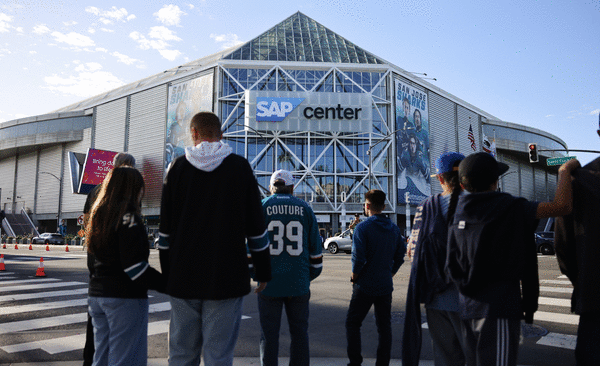
For years, headlines have warned of downtown “doom loops” and “death spirals,” focusing on the office vacancies that have piled up since the pandemic. Take a walk through downtown San Jose, for instance, and you’ll see many once-bustling buildings quiet and mostly empty.
But while they’ve been slow to recover, the streets below them are humming with resurgent energy. Lowriders blast música regional out of LED-lit speakers and trail fluttering Mexican flags. Twenty-something tech workers stumble in and out of barcades and fans clad in Sharks jerseys stride arm-in-arm through the balmy evening air. Where pre-2020 San Jose might have seen packed lunch spots and ho-hum nightlife, that cycle has now flipped.
For American downtowns, this kind of change is nothing new. For more than a century, they have evolved with technological advancements and shifting public policy. The COVID-19 pandemic and the rise of remote work presents the latest challenge, but for many experts on urban design, it’s not so much a crisis as an opportunity to redefine the future of downtown in the Bay Area and beyond.
“It’s a very dynamic time, and it’s been dynamic for the last couple hundred years,” says Mitchell Schwarzer, a historian of urbanism and professor emeritus at California College of the Arts in San Francisco. There hasn’t ever been a “long, stable period” for downtowns, he says.
Made in the USA
The very idea of “downtown” is almost uniquely American.
City centers across Europe and Asia were anchored for centuries by ancient seats of royalty and religion, and delineated by walls. But modern U.S. cities were especially malleable to the new technologies that came with the Industrial Revolution, which shaped the myth of the “classic” downtown.
The first was transportation. By the turn of the 20th century, new modes of transportation like the cable car, the street car and the trolley allowed people to live further away from their work and at the same time created an incentive for businesses to locate at the downtown stations where the lines merged, says Schwarzer.
Meanwhile, the skyscraper allowed downtowns to grow denser and denser, fitting a growing number of workers into tighter spaces.
Together, taller buildings and faster transit transformed places that were once a mix of residential, business, religion and society to almost exclusively hubs of commerce and government. Glass and steel edifices sprang up in cities around the country, and brought with them the heyday of downtowns. They were the sites of movie palaces that sat thousands, massive hotels and ballrooms, and department stores that dominated retail. In some cities, half or more of the population would go downtown every day.
Only a few decades after downtowns rose into prominence, they faced their first great threat: the highway.
In the decades after the second World War, the federal government began pouring billions into building an interstate highway system that stretched across the nation’s breadth. While the project connected the nation, it changed the face of cities, razing vulnerable neighborhoods to make way for roads and – most importantly for downtowns – creating arteries that allowed people to flow beyond the heart of the city to new commercial hubs throughout the region.
With the rise of shopping malls, the department stores that were the mainstays of downtowns began to flag, move or eventually close. Most of cities’ growth began taking place not in downtowns, but in suburbs and exurbs, says Joel Kotkin, a fellow at Chapman University who studies urban development.
In 2020, another disruption came along, this time on a global scale.
The COVID-19 pandemic brought with it wide-scale quarantine orders that left many shuttered in their homes: away from a deadly virus – and away from offices, retail and restaurants. Pandemic restrictions took a heavy toll on downtowns.
Over months of quarantine, city-dwellers and others grew accustomed to online shopping, ordering food in, and working from home, creating a “tremendous accelerant” for technologies that had been slowly growing for years, says Schwarzer, the urban historian.
These latest challenges have brought with them headlines that warn of “urban doom loops” that could spell the end of downtown. Though all experts interviewed by this news organization agreed that the old downtown of white-collar offices is gone, they also believe something new can rise in its wake.
“It’s a big opportunity,” says Randy Howder, an architect and strategist at the San Francisco-based Design and Architecture firm Gensler. “With any disruption, there’s always an opportunity for change.”
The downtown of the future
So what does that change look like?
First, fewer offices and more people.
“Hybrid and remote work are here to stay,” says Tracy Hadden Loh, a fellow at the Brookings Institution who has conducted extensive research on downtowns. “What the pandemic did was make extremely obvious something that was always inevitable: the nature of office work itself is changing, and so offices have to adapt.”
That means that some offices could have to downsize, others could be converted to apartments and others replaced by buildings that more readily serve the needs of a changing downtown.
“I think they’re going to become like mega-neighborhoods,” says Schwarzer, the urban historian, of Bay Area downtowns, pointing to San Jose’s Japantown as an example of what a future blend of shops and housing might look like. “It won’t be what it was.”
Bringing more people downtown could kickstart what Howder calls a “virtuous cycle of good things”: as more people live in a neighborhood, they support the shops and restaurants where they live, and help make that place more attractive for others to come visit the places they frequent.
A thriving community, in turn, attracts more people to then want to work there. Here, Howder points to the Jackson Square neighborhood in San Francisco, which has become one of the hottest office markets in the Bay Area in part because of its proximity to a neighborhood with successful shops and restaurants.
“The crazy thing is that this all loops back around on itself,” said Loh. “The more attractive downtowns are a place to live and play, that will also make them more attractive as places to work.”
That work would go beyond white-collar jobs. Experts suggest that downtown could become more of a destination for recreation, with arts, entertainment, bars, restaurants, and shops helping anchor it as a mainstay for weekends, evenings and tourism. Hospitals and schools could help fill in as well.
Loh imagines education could play a key role, creating “knowledge worker factories” that could act as a pipeline for upward social mobility, a conduit for developing the workforce that would be employed downtown and a place for workers to adapt and retrain in a changing market.
Howder places emphasis on the physical space, arguing for more parks, transit and narrower, safer streets that favor pedestrians. Together, future downtowns could create a more human experience with street vendors, nooks and little parks where you could steal away and read a book, and architecture that is less stark and more approachable. “You don’t have speeding cars or giant parking lots or faceless facades of giant buildings,” he says.
Kotkin thinks downtowns are likely to be just one hub in a network of city spaces that allow people to gather. While he agrees that bringing people downtown will inject more life into city centers, that also requires making downtown more attractive for those who want to live there, he says — ensuring public safety, addressing homelessness in city centers, and providing strong public schools. And even though “what would really make downtowns successful is transit,” he notes that public transit is struggling in the Bay Area and elsewhere.
Despite the challenges they face, downtowns have advantages that can help them move to a better future.
“There’s a little bit of magic that happens,” when people gather together to work, says Loh, who notes that places that concentrate their economies into hubs become more productive. “It’s bigger than something that we would just measure in dollars or productivity: There’s a creative effect, there’s a democracy-building effect, there’s a connection effect.”
Already, Oakland and San Jose have begun creating spaces and moments where their downtowns can thrive. Downtown Oakland has done a particularly good job of drawing more residential development downtown, and Lake Merritt has become a draw in its own right.
San Jose has San Pedro Square, The Sharks and San Jose State, and companies like Adobe that call it home, all of which draw life to downtown and could plant the seeds for future growth.
“We have, I think, a lot to celebrate,” says Howder.
Imagine a walk through downtown San Jose 20 years from now.
Step out of your apartment, take the elevator down past your neighbors who are getting ready for work. Open the door to streets lined with trees and flecked with benches, where the bell of the light rail dings its warning as cyclists zip by on narrow roads. Join the intermittent flow of foot traffic that passes by the apartments, the satellite campuses, the cafes, restaurants, the hospitals and the corner grocers. Key in to your new office building – smaller, but big enough for the regulars who come in – and settle at your desk to drink in the view from your window: downtown.
Different, yes.
But as alive as ever.
©2026 MediaNews Group, Inc. Visit at mercurynews.com. Distributed by Tribune Content Agency, LLC.









Comments