Has Palo Alto unlocked the secret to downtown vibrancy?
Published in Business News
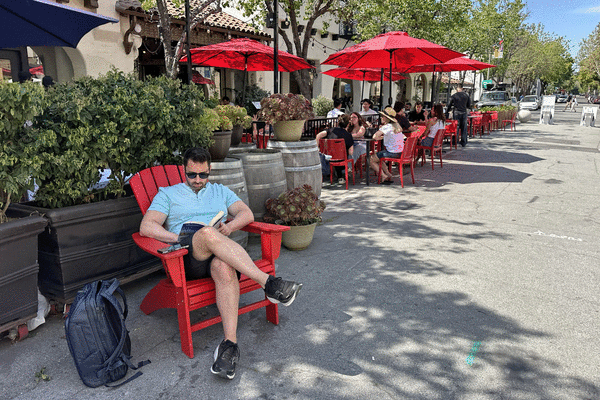
On a stroll down University Avenue in Palo Alto, California, on a spring Saturday evening, one can see parklets that were once parking spaces packed with well-heeled diners elegantly swirling wine glasses or digging into their meals inspired by culinary traditions from around the world.
Families line up down the block to order ice cream at Salt & Straw, while students chatter over their laptops at Coupa Cafe. The marquee at the Stanford Theater announces the night’s classic films, all for $7 a ticket.
Less than two miles away, a similarly bustling scene plays out on California Avenue, often considered Palo Alto’s second downtown. A stretch of road between El Camino Real and Birch Street is fully closed off to cars, and diners at restaurants like Terun, La Bodeguita del Medio, Joanie’s and Zareen’s fill the street, while indoors, patrons work their way through the tasting menu at Protege and or sip craft cocktails at newcomer bar Underdog.
It’s the kind of downtown city planners dream of, but it hasn’t been smooth sailing getting here. In fact, every step has been fiercely contested — particularly the parklets, which many Bay Area cities quickly abandoned after they were born out of necessity in a pandemic era of social distancing and outdoor dining. But Palo Alto let many businesses keep their parklets, and the fierce public debate over the past half-decade may have helped the city land on a setup that works for most residents, restaurants and retailers – and feels practically idyllic to visitors.
“It’s been a real policy struggle,” says Palo Alto Vice Mayor Greer Stone, a longtime champion of the city’s parklet programs. “Through community engagement with residents, customers and businesses, I think we’ve found a nice middle ground that is going to activate Palo Alto in ways we haven’t seen in the past.”
The saga started back in 2020, when the COVID-19 lockdowns appeared to spell disaster for many local businesses — especially restaurants, since eating indoors around other people increased the risk of contracting the virus. Outdoor dining was substantially less risky, and dining tables were soon moved into the streets.
To help local businesses during a public health crisis, the city even closed down portions of University Avenue and California Avenue for the summer of 2020.
The University Avenue closure was short-lived, as it created challenges for commuters and, according to Stone, emergency responders. The street reopened to cars in October 2021.
In the interim, though, some of the restaurants in Palo Alto’s downtown had invested heavily in creating their own parklets. Official rules for downtown parklets were approved in September 2023 as the council tried to bring cohesion to the new dining spaces.
By contrast, California Avenue remained closed to cars. After several short-term extensions to the car-free program, the council agreed to permanently close it to cars last March, and enhanced the strip with additional infrastructure like planters, bollards, colored pavement and bike lane markings.
“I think we’ve learned some of those hard lessons over the last few years,” Stone said.
To be fair, not everyone in Palo Alto is happy with how things have shaken out. Some retailers and landlords have been particularly vocal opponents to the parklet program. For instance, there is ongoing litigation between downtown property owner Elizabeth Wong and the city over the downtown parklet operated by Coupa Cafe on Ramona Street, where a half-block has been similarly closed to cars. Wong is seeking over $600,000 in damages and a nullification of the parklet, according to Palo Alto Online, alleging that the parklet resulted in her being unable to finalize a lease.
Additionally, the past few years have not been easy for many brick-and-mortar shops as business has pivoted toward online shopping and rapid-delivery services, and some shopkeepers oppose the incursion of the parklets into their storefronts and street parking.
However, overall, it seems that what the city has been doing is working to lower vacancy rates in the zones where parklets and street closures have taken root. On University Avenue, the city’s retail vacancy rate was down to 13.4% in 2025 from the decade-high rate of 17.4% at the start of 2024, while on California Avenue, the retail vacancy rate was down to 5.4% in 2025 from 10% a year ago, according to Palo Alto spokesperson Meghan Horrigan-Taylor. Additional upcoming openings include high-end bakeries Arsicault and Croissanté on California Avenue and Auntea, La Corneta and Zhangling Malatang on University Avenue, according to Horrigan-Taylor.
Pavel Sirotin, owner at the Georgian restaurant Bevri, is a fan of Palo Alto’s parklet program. His restaurant shares a parklet with neighboring restaurant Khazana. He says the items from his kitchen — which include orange Georgian wines and magnificently cheesy and eggy khachapuri adjaruli bread boats — take on an additional aesthetic quality when they’re lit with the natural sunshine in Palo Alto.
“We live in California, where the weather is almost always perfect,” he says.
Today, there are plans in the works to make these downtown areas even more appealing to visitors and locals alike. The city is looking to take a page out of the New Orleans playbook, à la Bourbon Street, to allow open alcohol beverage containers within the closed-to-cars areas on California Avenue and Ramona Street for special events. If the proposal is approved by the City Council, it could be in effect as early as this summer, according to Stone.
Business owners, for their part, are continuing to invest in their parklet spaces. For instance, at Zola and BarZola on Bryant Street on a recent Friday, workers were installing state-of-the-art overhead heaters at the restaurants’ parklet. The installation was being led by Daniel Goodman, who explained that the heaters, by San Francisco-based robotic heating company Focal, are designed to be energy-efficient by focusing on heating people rather than spaces, and are controllable by app for restaurant visitors.
The installation is intended to “make it so that people can eat outside year-round,” says Goodman.
And while Palo Alto’s 3rdThursday concert series on California Avenue was halted this past October, additional programs could be on the way.
“The city is working on additional opportunities to activate California Avenue with various entertainment options,” Stone says.
The streetscape may also see additional changes. The city is now working on a plan to create pre-approved parklet designs on California Avenue, improve bike amenities and implement other changes that would make the outdoor dining areas feel more permanent.
“It’s going to be an exciting future for Palo Alto,” says Stone.
©2026 MediaNews Group, Inc. Visit at mercurynews.com. Distributed by Tribune Content Agency, LLC.








Comments