Minnesota corn farmers withstood a trade war. The war in Iran is the next cost challenge
Published in Business News
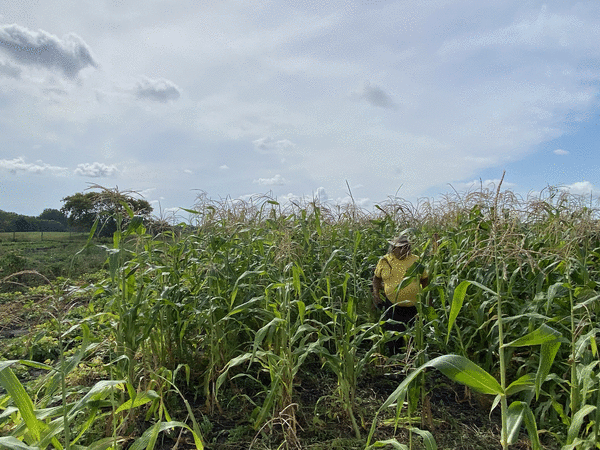
The U.S. war with Iran is wreaking havoc on the global fertilizer market and stressing Minnesota corn farmers who are already managing tense balance sheets.
Corn prices remain much lower than 2022’s peak of roughly $348 per ton because of big harvests and lower demand. Meanwhile, the price of a widely used fertilizer, one of farmers’ main expenses, has shot up in the past few weeks.
Those two elements could spell a difficult growing season, even though many farmers purchased most of their fertilizer before the price increase. If fertilizer is more expensive, and farmers can’t afford to buy as much as demand increases during the season, there could be a smaller yield of crop that results in higher prices for consumers.
Blair Hoseth, a northern Minnesota farmer who plants 700 acres each of corn and soybeans, said with seed prices and land costs not letting up, the 2026 season will be “a huge challenge.” This comes after the upending of global trade when President Donald Trump’s tariffs ignited farmer anxiety last year.
“Right now, we need to have some kind of relief,” Hoseth said.
Manufacturers use natural gas to make nitrogen, a key component of the synthetic fertilizer used for more than 100 years. The Strait of Hormuz off the coast of Iran is a major trade route and thus a target during the ongoing conflict. Iran has threatened ships carrying natural gas and other fertilizer materials, which has caused the price of the urea fertilizer to rise by more than a quarter since the war’s start in late February. It’s up from $463 to $594 a ton on the commodity level, with farmers likely paying even more.
Corn prices, now down to about $203 a ton, haven’t increased similarly to make up for the greater expense. The commodity is trading more than 40% lower in price than during spring 2022.
Brad Carlson, an educator with the University of Minnesota extension, said he’d heard from a fertilizer salesman who’d seen prices nearing 85 cents per pound for nitrogen-heavy urea fertilizer at a farm supply store near Sauk Rapids.
“I’ve never seen anything remotely that expensive,” Carlson said. “I’m a soil scientist, not an economist, but obviously I’m concerned.”
Wesley Beck, the president of the Minnesota Corn Growers Association, said farmers are facing the widest spread they have “ever had” between the price of corn and cost of fertilizer.
“It takes more bushels of corn at today’s prices to buy the same amount of fertilizer we always have,” Beck said.
Beck, who raises corn, soybeans and hogs on a farm outside of St. James, Minn., will plant about 1,400 acres worth of crops this year.
Like many farmers, Beck uses three fertilizers. Employees apply potash — salts containing potassium — from Canada and phosphorus from Eastern Europe to the soil in the fall. They then apply liquid nitrogen fertilizer in mid-April and again in early June.
In the span of two years, fertilizer spread to increase the yields of these crops makes up about a quarter of expenses, Beck said. Fertilizer costs hundreds of dollars an acre, and increasing prices could dramatically lift the farm’s total expenses.
Beck — along with many other Minnesota farmers — prepays for most of his fertilizer from local cooperatives months ahead of growing season, so the war has not suddenly inflated his fertilizer costs.
But Beck said he typically buys fertilizer for up to only 90% of the anticipated need and waits to purchase the final supply toward June once he knows he will need it. The price could be significantly more expensive than the supply he already bought if the current trend continues.
Jeff Coulter, a professor and extension agronomist at the University of Minnesota, said farmers will assess if they can “cut back a little” on fertilizer or “do things a little differently.” Skipping fertilizer completely is not an option.
“You’re going to need some nitrogen fertilizer if you want to grow a profitable crop,” Coulter said.
Hoseth, in northern Minnesota, said he’s considering changing the way he farms. He might switch between corn and soybeans — since the latter is less dependent on fertilizer — instead of planting corn on top of soil that also previously grew corn. He suggested farmers cut down on buying new machines and instead use the equipment they already have to reduce overall expenses.
Beck said some farmers are speculating growers might plant less corn this season to control costs.
Jeffrey Sorenson grows up to 500 acres of corn and soybeans in southwest Minnesota, where he purchases fertilizer a few months before he applies it in late fall. Even with a few months still to go before he has to buy supplies, he worries the price increase.
“Even if we solve the fertilizer problem tomorrow,” Sorenson said, “... there’s still is going to be some impacts that’s going to dwindle into what I’m going to purchase going into next year.”
(Minnesota Star Tribune staff writer Christopher Vondracek contributed to this story.)
©2026 The Minnesota Star Tribune. Visit at startribune.com. Distributed by Tribune Content Agency, LLC.










Comments