Chicago tipped worker raises hold after Mayor Brandon Johnson wins veto fight
Published in Business News
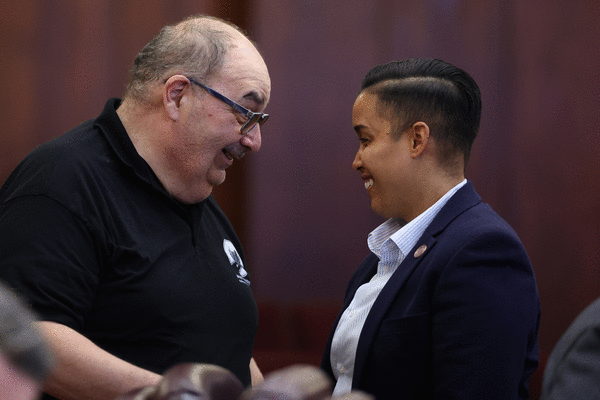
A City Council majority failed Wednesday to override Mayor Brandon Johnson’s veto of their earlier measure freezing raises set to eliminate Chicago’s subminimum wage for waiters and other tipped workers.
Aldermen voted 30 to 19, short of the 34 needed to beat Johnson’s veto and keep current wages in place. The outcome secures ongoing annual raises for tipped workers — and preserves, for now, a key victory for Johnson.
The so-called “One Fair Wage” ordinance passed 36 to 10 in 2023, establishing incremental pay increases designed to eventually bring tipped workers to parity with other hourly Chicago workers. Two raises have since been implemented, taking subminimum wage earners from $9.48 an hour to $12.62. The Chicago minimum wage for other workers is currently $16.60 an hour.
The ordinance sets three more annual July pay bumps, which would eliminate Chicago’s subminimum wage starting in July 2028.
But following relentless restaurant industry lobbying, aldermen sharply changed their tunes last month when a City Council majority voted 30 to 18 to freeze One Fair Wage. Opponents argue the policy is shrinking the city’s restaurant workforce by forcing belt-tightening and putting establishments out of business.
Johnson, the self-dubbed “most pro-worker mayor in the country,” quickly vetoed the freeze, teeing up Wednesday’s vote.
Two Johnson allies, South Side Ald. Jeanette Taylor and West Side Ald. Jason Ervin, decried both sides during council debate for failing to find a compromise. Both admitted to “taking a walk” during the March vote, leaving council chambers so they did not have to pick a side. Taylor, 20th, voted for the freeze Wednesday, while Ervin, 28th, voted against it.
“There’s been no real conversation. There’s been no negotiation,” Ervin said. “It was a one-sided conversation. And we have the ability, we have the bandwidth to take up issues.”
Northwest Side Ald. Gilbert Villegas pointed out restaurants are required to make up the difference between the lower rate and the city’s minimum wage when tips do not bridge that gap. The city has piled “unfunded mandates” on restaurants in recent years, including property tax hikes, laws requiring advance notice of work schedules and new time off requirements, he added.
“We’re not going back to the $9 figure that was there, but really a pause,” Villegas, 36th, said. “Downtown is going to do okay. We’re talking about the neighborhood [restaurants].”
Before he sat down ahead of the vote, Villegas promised there would be a “round two” if his side lost.
Northwest Side Ald. Jessie Fuentes, the chief council backer of the pay hikes, argued the raises are essential for Chicago workers struggling with an affordability crisis.
“It is not a moment to take away pay raises from people when everything around them is more expensive, when the cost of living is going up and when people are struggling,” said Fuentes, 26th. “If we told any other workforce that we were taking away their raises, we would not be having this conversation.”
Restaurant workers for and against the freeze cheered and booed throughout the debate.
Emails obtained by the Tribune showed Illinois Restaurant Association leaders offered to pay workers $30 per hour to attend the hearing. “We need bodies to wear a t-shirt so our presence at city council is large,” the email said.
After the meeting, around two dozen people, many wearing green shirts that read, “Save Our Jobs,” appeared to clock out by signing their names and the time on a clipboard in City Hall’s lobby.
Illinois Restaurant Association President Sam Toia defended the use of paid activists, describing the payment as a way to cover missed shifts, childcare costs and transportation. “We should pay our people,” he said.
Toia decried Johnson’s veto and argued the fight against ending the subminimum wage was one to defend neighborhood restaurants.
“I’ve always wanted to make sure we’re protecting our independent, family owned restaurants from Portage Park to Little Village to Chatham to Chinatown,” he said.
Asked about how he will continue to push against the ongoing raises, he did not share specific plans, but raised the possibility of pursuing another freeze.
“I can’t predict the future. If I could predict the future, ask me about the Middle East, ask me about D.C.,” he said. “All I can do is communicate.”
After the vote, Raeghn Draper, a bartender at Avondale’s Consignment Lounge and a One Fair Wage organizer, criticized the use of paid activists and argued the move showed which side was backed by power and money.
Johnson’s winning veto shows he “supports working class people,” Draper said while turning attention to potential compromises with the freeze fight poised to continue.
“There are solutions that are not worker wages,” Draper said. “I’m definitely interested in having those conversations that are not involving dipping our hands into the pockets of workers.”
Aldermen also approved a plan supported by Mayor Brandon Johnson to hike taxi fares, as well as fees for cab drivers who do not follow city regulations. The fares for price-fixed rides and distance-based rates rose by around 20% under the plan.
The City Council then approved the appointment of longtime city bureaucrat Kenya Merritt as commissioner of the Department of Cultural Affairs and Special Events.
Separately Wednesday, Inspector General Deborah Witzburg released a quarterly report announcing a series of investigation conclusions, including several instances of fraud involving federal funds by city employees and the illegal removal by an alderman of a term-protected city staffer.
Witzburg’s office also determined a former senior staff member for a mayor used their city title to solicit a job for their child from a city contractor. The contractor had submitted $9.6 million in invoices that “contained false claims and intentional and negligent billing irregularities,” the report said.
Witzburg, who is set to leave office later this month as her term expires, declined to identify the staffer or the mayoral administration that employed them.
“This is exactly the sort of thing that feeds the deficit of legitimacy at which Chicago operates,” Witzburg said. “The investigative work we’ve done this quarter demonstrates all that we are trying to do in this office to pay that deficit down.”
©2026 Chicago Tribune. Visit at chicagotribune.com. Distributed by Tribune Content Agency, LLC.






Comments