Canada races for deal before Trump's 50% tariff inflames feud
Published in News & Features
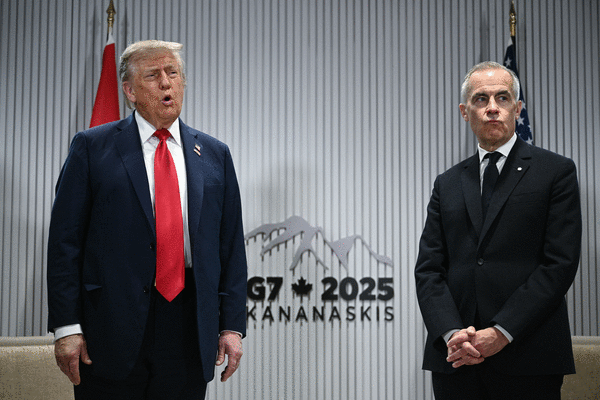
Canadian negotiators are trying to secure a deal with the United States before 50% tariffs on a wide range of goods threatened by President Donald Trump kick in on Aug. 19, while warning of an ugly new phase of the trade dispute if the levies are imposed.
After months with little progress, a flurry of high-level meetings has given some Canadian officials optimism for reaching an interim agreement to ease trade across the U.S.-Canada border. That would effectively be a side deal before more substantial and permanent talks on the future of the North American trade relationship.
But Canadian officials have told their U.S. counterparts that if Trump carries out his 50% tariff threat this month, it would severely damage relations. Prime Minister Mark Carney would face strong domestic pressure to retaliate and that may set off a new cycle of escalation, according to people who have been briefed on the talks.
The U.S. promised 50% tariffs against nearly $20 billion of goods such as beer, plywood, milk, and hockey sticks from its northern neighbor unless Carney acts to end Canada’s countertariffs on U.S.-made autos, trade controls on dairy, and most provinces’ decision to take U.S. alcohol off their shelves.
The new duties would see the White House use an unprecedented power, Section 338 of the Depression-era Tariff Act, and would not include exemptions for goods traded under the U.S.-Mexico-Canada Agreement that Trump signed in his first term.
Carney’s government aims to use the coming days to finally get to an agreement to lower the Section 232 tariffs Trump has put on foreign-made steel, aluminum, autos and lumber, according to the people with knowledge of the discussions, who spoke on condition of anonymity due to the sensitive negotiations.
Canadian officials, led by chief negotiator Janice Charette and Canada-U.S. Trade Minister Dominic LeBlanc, have told US Trade Representative Jamieson Greer and his team they can address the main U.S. irritants if there is meaningful relief on the 232 tariffs, said the people familiar with the talks.
But Charette and LeBlanc also warned their U.S. counterparts that Carney will be politically boxed in if Trump goes ahead with the 50% tariffs, and unable to control the reactions from provincial leaders and the Canadian public. Many Canadians have spurned U.S. goods and travel after Trump won the 2024 election, imposed tariffs and began talking about making Canada a 51st U.S. state.
Imposing more U.S. tariffs may torpedo Canada’s ability to make future concessions to reach a deal, the people said.
It is unclear whether Trump is willing to offer significant enough tariff relief to satisfy the leaders of Canadian provinces, who have control over the liquor bans along with other measures such as anti-U.S. procurement rules. That includes Ontario Premier Doug Ford, Quebec Premier Christine Frechette, and British Columbia Premier David Eby.
Although the 232 tariffs are global, they disproportionately hit Canada, whose economy has oriented around trading those goods and commodities with its larger neighbor to the south.
Charette, LeBlanc and Canada’s U.S. Ambassador Mark Wiseman briefed provincial and business leaders on Thursday about the state of the talks, which have intensified since the 50% tariff deadline was announced on July 20.
“The core message and what we were super happy to hear is that really good progress had been made indicating a path forward for an interim deal,” said Candace Laing, president of the Canadian Chamber of Commerce, who was at one of the briefings.
Laing said the Canadian team is prioritizing a deal before Aug. 19, not simply a delay before the 338 tariffs kick in.
“There’s a decent level of confidence in the pathway to an interim deal, yet some hesitancy because it has to be approved ultimately in the Oval Office,” Laing said.
“If the 338 tariffs actually come into effect, it will reset the trade relationship negotiations in a significant way,” Laing said.
Carney said publicly this week that he’s only interested in a broad deal with the U.S. that provides relief on all of the sectoral tariffs Trump has in place, not just one or two.
He set out the logic of a win-win deal to lower costs for American businesses, pointing to aluminum prices, which have soared by more than 50% for U.S. buyers since Trump hiked tariffs on the metal to 50% in June 2025, because the U.S. still relies heavily on Canadian exports.
©2026 Bloomberg L.P. Visit bloomberg.com. Distributed by Tribune Content Agency, LLC.






Comments