86 years later, artwork stolen by Nazis is returned to Minnesota descendants of Holocaust victim
Published in News & Features
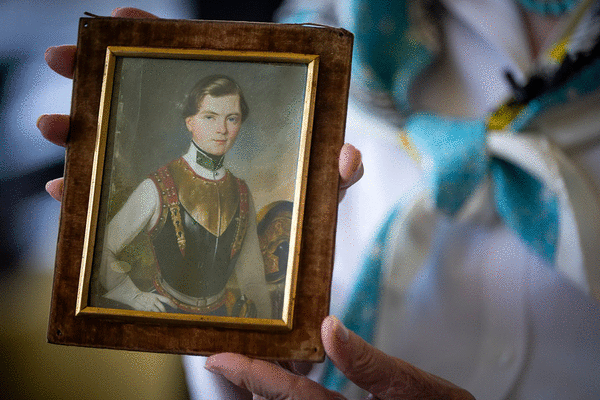
MINNEAPOLIS — The Austrian deputy consul general, in the Twin Cities from his posting in New York, lifted the top off a cardboard box and pulled out a tiny piece of art.
The handful of people gathered Wednesday afternoon in a dining room at Oak Ridge Country Club in Hopkins leaned closer and squinted.
The 1847 watercolor miniature, just 3 inches tall and 2 inches wide, showed a nobleman who was an officer in the Austrian Empire’s army. It is of no particular monetary value. It was painted by Albert Theer, an Austrian painter whose name doesn’t turn art historians’ heads. For years the miniature had been overlooked at the Museum of Military History in Vienna.
Then the Austrian diplomat handed the painting over to its rightful heir, Jackie Sondell, a retired real estate agent who lives in Wayzata.
It was as if he were reaching across 86 years of history with this small gesture to help redress one of the gravest tragedies in human history.
“I see it as a symbol of hope,” Sondell said.
The Austrian government had tracked down the 77-year-old Sondell and her brother, Jeff Lieb, after officials learned the siblings were the heirs of Eduard Epstein.
Epstein had been a successful Jewish merchant in the Viennese textile industry in the early 1900s and an enthusiastic art collector.
But when the Nazis took control of Austria in 1938, Epstein’s circumstances dramatically changed. His company was liquidated. His valuables — jewelry, coin collections, silver — were requisitioned. He attempted to sell his art collection to finance an escape from the widening grasp of the Nazis, but he was caught and sent to prison for 10 months.
He managed to flee to America in 1941 with his wife and daughter. Weakened by prison, he died two years later at 62. Epstein’s family never saw his art collection again, lost to the Nazis and to history.
Until 2013, when the miniature watercolor of the Austrian nobleman was identified in the Vienna military museum. It was submitted to an art restitution board, part of a broad effort across Austria in recent decades to return art stolen by the Nazis.
Tracking down heirs to a painting stolen nearly a century ago can be difficult, explained the Austrian diplomat, Johannes Gassner. But last year a government representative tracked down Sondell and told her about the painting. Sondell called Dorotheum, one of the world’s oldest auction houses in Vienna, to learn about the miniature’s history. Researchers told her Epstein had been arrested when he tried to sell the art, which Nazis seized on March 28, 1940.
“Austria took a while to accept responsibility for its role in the crimes and atrocities committed by the Nazi regime,” Gassner said. “Of course you cannot undo what happened, and you cannot restore the lives of all those who were murdered. But nevertheless today’s restitution is an important gesture in the context of Austria’s efforts to live up to its historical responsibility. It’s never too late to accept responsibility.”
Growing up, Sondell and her brother were close to their Aunt Helen and Uncle Ernest. Helen was the only daughter of Epstein and his wife, Margarete; Helen was not a blood relative of Sondell’s, having married into her family when she married Sondell’s Uncle Ernest. Since Helen and Ernest didn’t have children, they treated Sondell and her brother like their own, spoiling them with summer trips to the Adirondacks or adventures in New York City. When Helen died in 2000, Sondell and her brother became heirs to her estate.
Before the diplomat traveled to Minnesota to return the painting, Sondell was feeling emotional. She thought about her aunt; if Helen were alive, Sondell wasn’t sure if Helen would react with joy or sadness at receiving the stolen art.
And Sondell thought about how the Holocaust formed her family’s history. She lost three grandparents in the Holocaust: one in Dachau, two at the Sobibór extermination camp in Poland.
“May their memories be a blessing,” Sondell said.
Sondell’s mother escaped to London before making her way to the United States, but the Holocaust was never far from Sondell’s mother’s mind.
However belated it was for Austria to recognize its responsibility, Sondell appreciated it.
The miniature was just one piece of Epstein’s large art collection, more a symbolic gesture than a full accounting of what was stolen. The whereabouts of the rest of his art are not known.
Sondell hopes the return of the painting illuminates individual Jewish lives brutally affected by the Holocaust. Six million Jews dead is a soul-numbing statistic, but Eduard Epstein’s story is a tragedy.
“No matter what size the picture is, at least they are making the effort of returning it,” Sondell said. “You have to give somebody a second chance. If you stop and forgive, maybe the world will see things a different way. Maybe there is hope for peace in the world.”
She peered down at the painting. She already has a place picked out to display it in her well-appointed Wayzata home, where she has her own impressive, eclectic art collection.
Standing in the back of the room, Steve Hunegs, executive director of the Jewish Community Relations Council of Minnesota and the Dakotas, smiled. He thought about part of the Passover liturgy where a piece of matzah is broken in half then put back together, and people say, “What was once lost is now found.”
“All these years later, this beautiful, small piece of art is a window into that world,” Hunegs said. “There’s no statute of limitations on historical reckoning.”
_____
©2026 The Minnesota Star Tribune. Visit at startribune.com. Distributed by Tribune Content Agency, LLC.






Comments