Bessent hails 'very successful' China talks on AI, trade
Published in News & Features
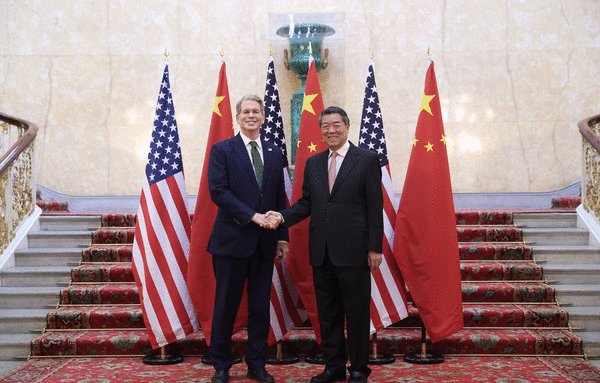
U.S. Treasury Secretary Scott Bessent lauded “very successful” talks with his Chinese counterparts that spanned artificial intelligence, trade and investment ahead of this week’s summit between leaders Donald Trump and Xi Jinping.
Bessent, speaking to reporters after hours of talks in New York with China’s Vice Premier He Lifeng and other officials, said the two sides agreed to set up a dialogue on AI aimed at reaching a common understanding on goals and threats. They plan to meet again, with top Chinese trade negotiator Li Chenggang saying the talks were held in a good atmosphere and a working group would continue discussions on Monday.
“The U.S. has proposed that we have a notification mechanism between the two countries, and we want a shared vision of common goals and common threats,” Bessent said, adding that it would be called the “U.S.-China AI dialogue.” Later this week, Trump is scheduled to host Xi at the White House in the Chinese leader’s first state visit to Washington in more than a decade.
U.S. Trade Representative Jamieson Greer said the two sides are “preparing the groundwork” for a successful meeting between leaders of the world’s biggest economies, noting that the two sides “operationalized” a Board of Trade that can “create a kind of ballast for the relationship.” The list of “non-sensitive” items would likely include consumer and low-tech goods from China, and energy, agricultural and medical products from the U.S., he said.
“There is a world where you have a relatively small subset of American and Chinese goods that can be traded in a balanced way, that are non-sensitive, that in the future, as trade actions come up, we can consider them as a class unto themselves,” Greer said.
The U.S. and China have been working to reduce levies on American energy and agricultural products, Bloomberg reported earlier, part of a broader initiative to ease barriers on $30 billion worth of products from each side under the Board of Trade mechanism launched earlier this year. Since the two leaders last met in May, AI has emerged as a new flashpoint between the U.S. and China.
‘More transparency’
Bessent said the notification mechanism would be for national security incidents, adding that the U.S. thinks moving toward “more transparency between the number one and the number two AI powers in the world is very important.” Greer noted that U.S. export controls weren’t on the agenda when discussing AI.
Bessent and He last met face-to-face near Seoul roughly four months ago, just days before Trump visited Beijing in May. A trade truce agreed in October saw both sides lower tariffs and export restrictions, which is set to expire in November.
Neither side publicly mentioned anything on Sunday about extending the truce. An announcement of new U.S. tariffs over allegations of trading partners’ excess manufacturing capacity has been delayed until after the meeting, according to people familiar with the matter.
Trump administration officials, U.S. security agencies and Silicon Valley’s AI giants alike have accused Chinese firms of systematically distilling from American models to build their own products, which are fast narrowing the gap with the U.S. frontier. Beijing has rejected such accusations as groundless and vowed to retaliate if Washington moves to target Chinese AI companies.
Chinese officials have also pushed back on calls from U.S. tech leaders to pace AI development in the interest of safety, with the country’s Foreign Ministry dismissing such moves as “fear-mongering.”
Bessent, who recently warned that “there is no day after tomorrow” if China wins the AI race, said in a statement to Axios last week that “we are open to discussions on avoiding shared risks and avoiding bifurcation of our two systems.”
Michael Kratsios, Trump’s science and technology adviser at the White House, said on Fox News Sunday that “the key thing that we want to talk to them about is avoiding shared risks, and that’s something that I think we can have a fruitful conversation on.”
_____
©2026 Bloomberg L.P. Visit bloomberg.com. Distributed by Tribune Content Agency, LLC.






Comments