What it takes to celebrate a last birthday
Published in Parenting News


ST. LOUIS — I showed up at the airport at 5 a.m. with a birthday wish.
One of my sisters has worked for an airline for nearly 30 years. A perk of the job allows her to share a buddy pass with a family member or friend willing to try for a standby seat on a flight. It costs a fraction of what I normally pay for an advance purchase fare.
I don't like to wake up at 4 a.m. on a Saturday to risk spending hours at St. Louis Lambert International Airport in vain. But on that day in late April, I was on a mission.
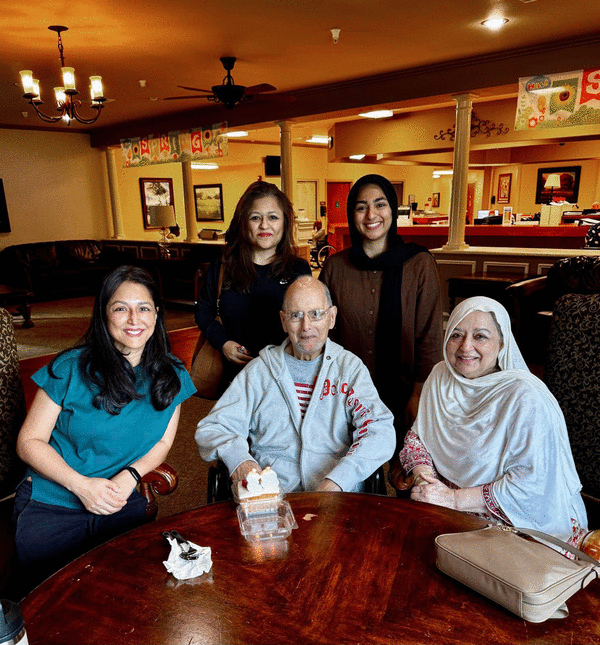
It was my father's 83rd birthday. He's been receiving hospice care for Parkinson's, cancer and dementia, and I knew this was most likely his last birthday with us. I felt compelled to see him, hug him and wish him happiness in person.
I also had an ironclad commitment coming up in St. Louis, so I planned to attempt a same-day turnaround — taking the first flight of the day into Houston, then taking the last flight back to St. Louis. In a worst-case scenario, I figured I could dump a ton of frequent flyer miles for a confirmed seat back home.
I arrived at the airport with a light carry-on and a heavy lump in my throat.
I know I'm lucky to have time for these "last moments" — last holiday season, last Eid, last birthday — but helplessly watching the slow decline of the strongest figure in your life is its own indescribable pain.
Each week, when I hear how much weight he's lost from the week prior, I am hit with a wave of grief all over again.
The past year has me thinking more deeply about how America treats its elderly, its dying and the families who love them. A few years ago, I visited my father's eldest brother in London. He is in his 90s and lives in a lovely nursing home with a dedicated, full-time aide. His daughter, my cousin, lives a short distance from him and visits frequently. She took me to see him. Although my uncle can no longer speak much, his eyes filled with tears of recognition when he saw me. The facility was an actual home, busy with caregivers and completely subsidized by the government.
It's tricky to compare the U.K. and U.S. tax burdens because how much you pay depends on how much you earn, where you live and whether you factor in healthcare costs. It might be surprising to learn that some Americans pay more in taxes, with fewer social benefits, than the Brits.
My cousin mentioned how England's system, which her father had paid into his entire career, gave him more dignity and better care than what many can afford in America.
"It seems more humane," she said, "the way we treat the elderly."
I was struck by her words, and this was long before I saw end-of-life care firsthand for my own father. My father has some wonderful caregivers, but like most in this country, they are overworked and their facilities understaffed. Either my mom or a sibling shows up nearly every day to check on him.
On his birthday, I found myself wishing for all the things: an easy transition with no more pain or suffering for him, more time to spend with him, attentive and loving care for all the elderly and sick, better resources for those carrying heavy caregiving responsibilities, and grace for those with a loved one in similar circumstances.
I've always dreamed big.
Early this morning, I kept refreshing the airline app to see how many standby passengers had checked in and how many seats remained. I was near the bottom of the list. The passengers began boarding, and still no seat assignment.
At the last minute, an alert popped up. I had a seat!
During the two-hour flight, I wondered if my father would recognize me right away. I carried a small box of mithai, traditional South Asian sweets, including his favorite ladoos: round balls made of gram flour, ghee, sugar and nuts.
After we landed, I took a Lyft to my mom's house. She made my father's lunch, and we headed to the facility.
"Did you tell him I was coming?" I asked. I was hoping to surprise him. She gently reminded me that even if she had told him, he would have forgotten soon after.
I spotted him dozing in his wheelchair in the hallway near the nurse's station.
As I walked up to him, wrapped my arms around his bony, thin shoulders and said, "Happy birthday, Abu," I saw his eyes light up.
"What a beautiful surprise," he said.
©2026 STLtoday.com. Distributed by Tribune Content Agency, LLC.



Comments