From Ohio EV Hub to Indy 500, how Honda plans to right the ship
Published in Automotive News




INDIANAPOLIS — It’s been a rough start to 2026 for Honda Motor Co. with its first financial loss in 70 years, an electric vehicle strategy in shambles, and its Formula One team mired at the back of the grid with engine issues.
The Indianapolis 500 is a great place to reset.
The brand is retooling its flexible Ohio factory to produce gas-electric hybrid automobiles and has debuted dramatic-looking concepts to accelerate its hybrid lineup already pregnant with hybrid versions of its best-selling CR-V, Civic and Accord products. Now comes this weekend’s Indianapolis 500, the Super Bowl of North American motorsports, in the nick of time to showcase proven Honda hybrid tech at America’s greatest race.
On pole? Honda driver and 2025 Indy 500 winner Alex Palou.
“Racing has always been a proving ground for Honda technologies,” said Vice President for Sales of Honda America Lance Woelfer in an interview ahead of the Memorial Day weekend. “Our commitment to racing series that employ hybrid power units gives us a visible, credible way to demonstrate the link between road and track, particularly as we advance electrified technologies.”
Honda has coordinated the racing weekend with the launch of a multi-channel “Relentless Spirit” a campaign starring Honda’s hybrid lineup — Civic, Accord, CR-V and Prelude — sharing the road alongside winning race machines, including hybrid IndyCars.
“Honda applies race-proven engineering across its lineup of production vehicles, including its advanced hybrid models that benefit from technologies developed in the company’s championship-winning IndyCar and Formula 1 powertrains,” Honda said with the release of the ad campaign.
With 40% of its global sales in the United States (Honda holds 14% of its home market), Honda is the fourth best-selling brand here (8% of market) after Toyota, Ford and Chevrolet. It invests heavily in American sport, including as the official auto sponsor of the U.S. Olympic Team, the National Hockey League — and IndyCar. Honda and Chevrolet are the exclusive hybrid powertrain sources for the series, meaning a three-hour infomercial in front of the 500’s 7 million TV viewers.
Honda is also a manufacturing colossus in Ohio, Indiana and Alabama, where it produces over 1.5 million vehicles a year (including its luxury Acura brand), employing 30,000 people with a total U.S. investment of over $25 billion.
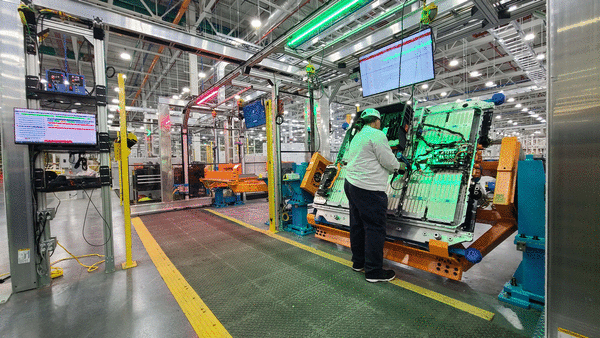
So central is the U.S. to Honda’s global success that it invested $5 billion in its so-called EV Hub sprawling across multiple mid-Ohio manufacturing facilities in what was to be an international showcase for the brand’s electric vehicle transformation.
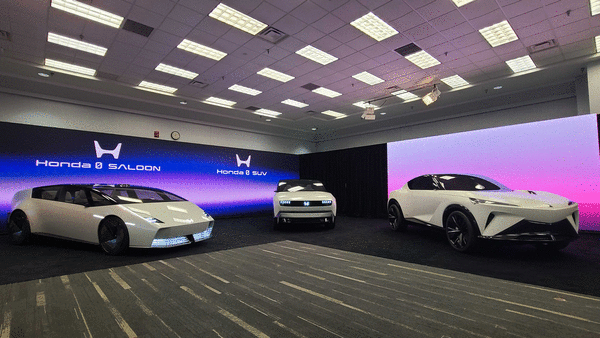
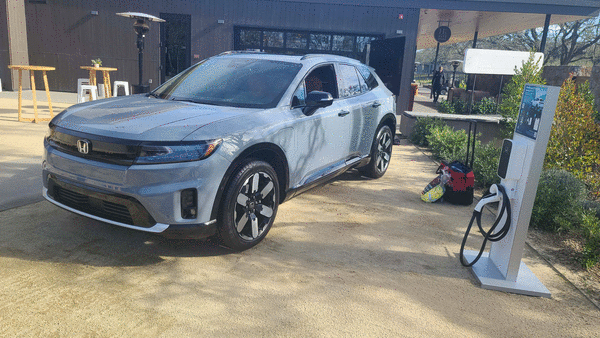
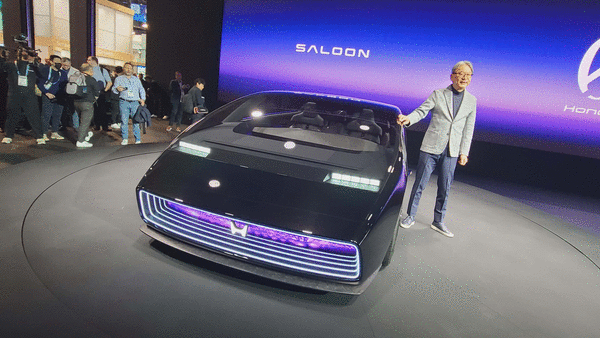
Building momentum like a Beethoven crescendo, Honda introduced its radical 0 Series (0 for zero carbon dioxide emissions) vehicles across two Consumer Electronics Shows in Las Vegas and the Japan Mobility Show in Tokyo only to see consumer and government support dry up — extinguishing the EV dreams of Honda, internally referred to as the company’s Second Founding, with it.
And extinguishing Honda’s hard-earned reputation as a profit engine. The $15 billion EV write-off echoed other industry titans like Ford Motor Co. and Stellantis NV, but it caused Honda's first annual loss since the company went public in 1957.
Honda is pivoting quickly to hybrids (the latest trend in gasoline powertrains using electric motors to assist the gas engine like turbochargers), in part thanks to the EV Hub’s flexible, nonunion assembly lines.
“We created the EV Hub in Ohio with flexibility in mind and the ability to respond to the needs of our customers,” said Woelfer. “We retooled our production facilities to build internal combustion, hybrid and battery-electric vehicles on the same line, giving us the ability to adjust quickly to changes in customer needs and market conditions.”
Scrap the EVs, plug in the hybrids.
“Car companies need to be nimble than ever before,” said veteran iSeeCars.com analyst Karl Brauer. “We’ve just seen how quickly market forces and regulatory requirements can shift. Any aspect of vehicle production that slows an automaker’s response time is a competitive disadvantage, and this includes union plants with contracts that hamper an automaker’s ability to pivot quickly.”
So instead of an electric 0 Series SUV, Saloon sedan, and Acura RSX, Honda rolled out prototypes for next-gen Honda Accord and Acura RDX hybrids on May 13. The concepts preview 15 new hybrid models by 2030, most of them targeted for the U.S. market. Not as radically-designed as their EV brethren, they represent a slower evolution to what Honda is still convinced is an all-EV future.
“Our dealers have expressed appreciation for how we built flexibility into our production plans, which future-proofs our ultimate transition to battery-electric vehicles,” said Woelfer. “That feedback has reinforced our decision to accelerate hybrid production and sales.”
Core to the brand is affordability. While U.S. domestic automakers have abandoned entry-level, affordable sedans, Honda has doubled down with its compact Civic and midsize Accord sedans both starting at under $30,000. They are key to attracting first-time buyers to the brand.
The “Relentless Spirit” hybrid racing ad campaign also leans into Honda’s claim as the most fuel-efficient full-line automaker in the U.S., according to the Environmental Protection Agency. Honda gas-electric hybrid sales set a company record for the third straight year in 2025, topping 400,000 units.
“As customers face economic pressure, they’re looking for brands that provide real value for money,” said Woelfer. “Offering well-equipped, fuel-efficient sedans at accessible price points is central to our customer-focused approach to business.”
Racing is the antithesis of affordability, but it is also core to Honda’s performance-oriented brand.
The Japanese company has gain outsized renown in global motorsports for its success in everything from motorcross to Formula One. Which is why the 2026 season has been so jarring for Honda.
On paper, F1’s new 50-50 hybrid powertrain aligned perfectly with Honda’s brand, but it has been a flop in reality, with the Honda-powered Aston Martin team mired at the back of the pack.
"It's a disaster,” said long-time F1 commentator Will Buxton. “This is the year that was supposed to be the one. The Adrian (Newey-designed) car, the Honda engine, (team owners) pinned everything on the regulation change this year. This was the year that they came to fight, and they're not."
Analyst Brauer is skeptical about the need to make race cars — which run exotic, carbon-fiber chassis, high-downforce wings, and slick tires — relevant to road cars.
“I don’t think ‘green’ technology in pro racing helps sell cars. Most consumers are oblivious to professional racing activity, especially hybrid-buying consumers who are more concerned with fuel efficiency,” he said. “For the small number of car buyers who are into racing, most just want the best performance possible, without compromise.”
While Honda tries to right the F1 ship, it will welcome this weekend’s focus on the Indy 500. The brand’s powertrains have excelled here, winning 16 times.
“Racing series like IndyCar and IMSA allow us to connect with passionate fans and reinforce key attributes —performance, reliability and innovation,” said Woelfer.
IndyCar racer Palou has dominated IndyCar the last three years, pulling Honda onto the top podium step with him.
Honda hopes that success is a harbinger for sunnier skies ahead.
____
©2026 www.detroitnews.com. Visit at detroitnews.com. Distributed by Tribune Content Agency, LLC.







Comments