Stellantis bets $70 billion on reshaped lineup to fuel turnaround
Published in Automotive News
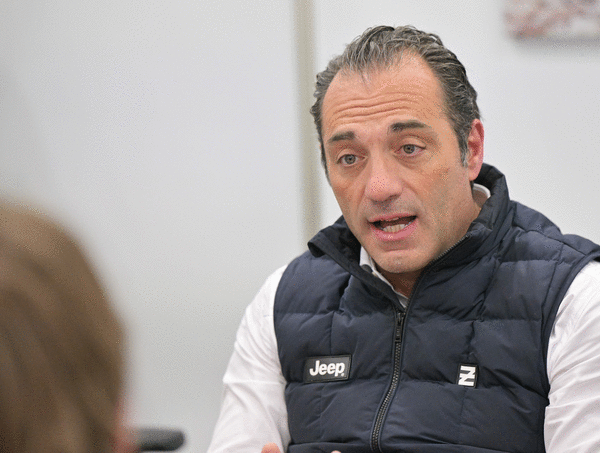
AUBURN HILLS, Michigan — Stellantis NV's five-year, nearly $70 billion business turnaround plans, which include new products for all four of its North American brands, could be a boon to its under-utilized U.S. plants, according to experts.
Antonio Filosa, CEO of the maker of Chrysler, Jeep, Dodge and Ram, detailed the plans to investors on Thursday. The planned restocking includes a small pickup for Ram and a new, powerful off-road Jeep SUV. Dodge gets a performance-focused hatchback, and three crossovers are coming to Chrysler, providing new product for the automaker's two diminished U.S. legacy brands.
In North America, its largest and most profitable region, the company is targeting 25% revenue growth as it launches 11 new vehicles in the next five years.
"It all begins with product," Filosa said of the new strategic plan, dubbed FaSTLAne 2030.
That's bound to benefit the company's U.S. plants, even if Filosa didn’t specify which plants any of the new products would be allocated to, experts said. Stellantis has an idled plant in Belvidere, Illinois. In addition, Warren Truck Assembly Plant is projected to have a 28% capacity utilization this year, well below the healthy 80%, and the plant in Toledo, Ohio, is also underutilized, said Sam Fiorani, vice president of vehicle forecasting for consulting firm AutoForecast Solutions LLC.
“The anticipation that they will have 80% capacity by the end of the decade does mean that some higher-volume products will be filling plants like Belvidere and Toledo,” he said.
The automaker is also addressing affordability, including concerns from dealers that much of its current lineup is too costly for budget-strapped buyers. Stellantis pledges seven new vehicles under $40,000 and two under $30,000 by 2030.
Filosa said the automaker will channel a bulk of its brand and product resources to four of the company's 14 nameplates: Jeep, Ram, Peugeot and Fiat, which the company believes have the greatest potential for scale and profitability. He and other executives also outlined a strategy to grow its commercial vehicle business segment, called Pro One.
The updated strategy said the Chrysler, Dodge, Citroen, Opel and Alfa Romeo brands will be positioned as smaller, regional players, receiving less funding and also adapting various models that will launch first with the four priority brands. It wasn't immediately clear which countries those brands would be confined to. Additional European-focused nameplates DS and Lancia will now be managed by Citroen and Fiat as "specialty brands," and Maserati will continue as a "pure luxury" brand, the automaker said in an announcement.
Filosa and other executives detailed the new business plan to investors at a gathering in Auburn Hills. Attendees were also shown a range of the automaker's all-new vehicles, but couldn't take pictures.
The plans are ambitious, said Ivan Drury, director of insight at auto information website Edmunds.com Inc., but Stellantis needs to replace its aging lineup: "They desperately need new product."
Plan calls for investments, cost cuts
In all, Stellantis executives said about $42 billion in investments over the next five years would be focused on brands and products, with about $28 billion on platforms, powertrains and technology, including artificial intelligence.
The refreshed strategy also includes increased partnerships with Chinese automakers and others, some of which were already announced in recent days. They include an agreement with Jaguar Land Rover to work together on U.S. vehicle development, a European partnership with Chinese automaker Dongfeng, and deepening ties with existing Chinese partner Leapmotor in Europe. Executives made clear that Leapmotor is critical to the company's future growth in multiple sales regions, including in Europe, South America and the Asia Pacific area.
There is "no opportunity" in the United States for Leapmotor vehicles, or the "fruits" of partnerships with other Chinese companies, though there is potential in both Mexico and Canada, Filosa said.
Despite the brand restructuring and focus on regionalization, Alfa Romeo would continue to be sold in the United States, Filosa said.
"We will have a special focus on North America," he said.
The new strategic plan claims nearly $7 billion in annual cost cuts and says that Stellantis will reach positive cash flow by 2027.
It sets a goal of growing revenue from less than $180 billion last year to more than $220 billion by 2030, and growing a profit margin that was negative last year to 7% by 2030, promising "significant improvements in the near term."
Fiorani called that forecast "highly optimistic," requiring all of these plans to be well-executed and successful.
"All of the stars have to align in order for that to occur," he said.
Details on new North American vehicles
Stellantis plans to bring a small pickup to North America in 2028, executives said. The automaker's truck brand, Ram, has already laid out a plan to bring back its midsize truck model, Dakota. Currently, the automaker only sells full-size pickups in the U.S., but it wants to compete with other truck makers in other segments. Ford Motor Co., notably, has found success selling its small pickup, the Maverick, in the last few years.
The new compact Ram pickup will be a version of the Rampage model, which is already sold in South America. And Tim Kuniskis, Ram CEO and chief of North American brands, confirmed that Ram's first full-size SUV, which Stellantis confirmed will be called the Ramcharger, is also coming. The company has previously said that the SUV would arrive for 2028 and be built at the Warren Truck Assembly Plant.
For the Chrysler brand, three new crossovers are planned by 2030, expanding the lineup beyond the Pacifica minivan. The two smaller crossovers, Arrow and Arrow Cross, are set to start at about $25,000. The midsize crossover will be named the Airflow and start in the $30,000s, executives said.
Taking advantage of that price range has been effective for other brands, such as Chevrolet and Buick, Fiorani said.
"The new products they’re adding seem to be targeting entry-level buyers," he said. "If Chrysler products starting under $29,000 can be added, it will lure new people in the dealership and potentially save Chrysler."
If not, Chrysler will be relegated to selling minivans for as long as they're profitable, he added.
The key question for selling two crossovers under $30,000 from the same brand, however, is: How will they be different?
"They must make the case for why there are two vehicles in the same segment," Drury said.
At Dodge, the refresh of the three-row Durango SUV is confirmed to be on the way. And the brand will bring to market what Kuniskis describes as a midsize, affordable performance vehicle: "The gateway into the Brotherhood of Muscle."
He acknowledged the Hornet was a mistake and said this new model will improve on it. "Think of it as the next generation of Hornet, but the way we should have done it the first time," Kuniskis said.
A muscle car version would make more sense than applying the decades-old Hornet name to an SUV to which it has no relation, Drury said.
"No one is buying Stellantis vehicles for their reliability or because they have the best fuel economy," he said. "If it's a sporty vehicle, at least it will satisfy somebody."
Jeep plans to bring a gas-powered version of the Recon, which is launching first as an EV in the coming months, next year.
By 2030, Jeep will also launch the next-generation compact Compass, and once again refresh both the Grand Cherokee and the Grand Wagoneer. It also plans to redesign both the off-roading-focused Wrangler SUV and Gladiator pickup. Kuniskis didn't provide specifics on timing.
Among the four American brands, models starting under $40,000 will grow from two to nine in the next four years.
Also revealed: two high-end new SRT performance vehicles the automaker is bringing to market before 2030. They are the Dodge Copperhead, a super high-powered, expensive, sleek sports car, and the Jeep Rampage, which has been a concept in the past. It’s a beefy, capable, two-door, open-air off-roader that shares styling cues with the Wrangler.
Plan aims to 'refresh' North American lineup
"By 2030, we will fully refresh our North America showroom," Filosa said, with 11 all-new products and 12 refreshes.
Investors and other stakeholders have been eager to hear more details about how Stellantis can rebuild its profitability and sales over the next five years. The automaker's New York-listed shares are down by more than a third this year, hit especially hard by massive costs associated with unwinding its electric vehicle investments.
The automaker already, earlier this week, notably announced new Ram "muscle trucks" that executives hope can boost that brand's American sales turnaround.
Despite all the new North America product, questions remain for Brampton Assembly Plant outside of Toronto. While the United States-Mexico-Canada trade agreement remains up for discussion, there are challenges for investing in Canadian plants, Fiorani said.
The plant has been idle since December 2023 when Chrysler 300 and Dodge Charger and Challenger production ended. It was then supposed to build the next-generation Jeep Compass, but Stellantis moved production plans to the United States following the introduction of President Donald Trump’s tariffs.
“There are quite a few pieces that require USMCA to be updated before they are made public,” Fiorani said. “It’s very unlikely that Mexico and Canada will be part of this plan, as it’s difficult for any company to make big investments like this that include new products outside of the U.S. until USMCA is signed. Brampton competes with U.S. plants on a lot of levels, and Mexico typically gets the lower-profit products. Announcing a new product for Brampton before the signing of USMCA could potentially derail the negotiations.”
©2026 www.detroitnews.com. Visit at detroitnews.com. Distributed by Tribune Content Agency, LLC.







Comments