Tired of waiting? $40 million project at UCSD aims to accelerate healthcare
Published in Health & Fitness
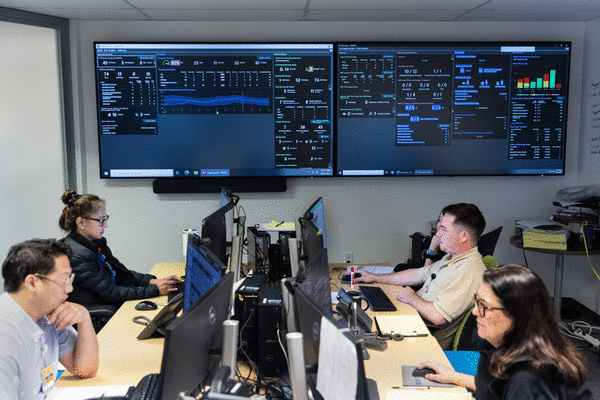
On a recent morning, medical professionals huddled around banks of computer monitors like weather forecasters tracking a developing hurricane, though bed occupancy rates over 90% were the pressing threat rather than rising atmospheric pressure over the Pacific.
Opened in June, the new mission control center at UC San Diego Health pulls together real-time data generated by the university’s three medical campuses, giving analysts an unprecedented ability to see trends unfolding in real time. Having all of the information in one place provides endless opportunities to make nimble patient transfers from one hospital to another, operating room schedule adjustments and other just-in-time tweaks that can help manage the flood of patients that has only increased since the COVID-19 pandemic.
But some believe that this level of technology-enabled management is just the beginning. A new, six-year, $40 million “accelerator” initiative from San Diego’s West Health will attempt to build on existing digital infrastructure with emerging AI-enabled tools that its proponents predict can dissolve the bottlenecks that keep patients waiting longer than they should, sidelining resources that are desperately needed to serve an ever-growing number of complex medical needs.
No one, notes Dr. Zia Agha, West’s chief medical officer, has trouble identifying the problem that this initiative seeks to solve.
“Whether it’s an eight-hour wait time in the ER or medications that get mixed up on discharge, everybody has a story,” Agha said.
Artificial intelligence algorithms, he noted, are already being used to improve some tedious aspects of healthcare. A trial at UCSD that monitors patient vital signs for the markers of sepsis, alerting clinicians that they should consider administering preventive medications before symptoms appear, is a good example of what is already possible.
But West, which has already revolutionized care by promoting geriatric emergency departments, believes that it’s time to go much bigger. It took a decade, he noted, for the industry to fully adopt electronic medical records and barcode scanners at the bedside to make sure that patients were receiving the correct medications. But the system, facing increased demand from an aging population, cannot afford to wait 10 years to reap the full benefits of intelligent systems.
“This is not about bleeding-edge basic research,” Agha said. “This is about taking some of the technologies and tools that we already know work and using them in a living, breathing health care system to drive outcomes rapidly.”
What makes West think finding ways to accelerate care at UCSD hospitals can translate to action in other places?
The nonprofit’s geriatric emergency department initiative serves as a proof of concept. These senior-focused spaces are separate from a hospital’s main ER and are kept quieter, featuring anti-slip surfaces and high-contrast interior design elements. And, these units are staffed with workers who have special training in matters that seniors experience, especially the management of multiple medications.
After building an initial unit at UCSD, the idea has spread nationwide.
“Today, there are 600 geriatric EDs in the nation, and that started in San Diego,” Agha said.
That number includes every emergency department in San Diego County.
West, with its own policy center in Washington, D.C., learned a lot about how to scale a local initiative in the ED initiative, and Agha said that UCSD’s leadership showed a willingness to try new ideas that stood it in good stead when it came time to find an acceleration partner.
“To break a bottleneck, you have to disrupt how you practice today, and they’re willing to do that,” Agha said. “They’re taking on battles with their own staff, some of their own leaders, because people just like to do things the way they’ve always done it.”
The nation’s demographic reality makes finding and eliminating every inefficiency a matter of survival, not convenience. Pew Research Center estimates that there are nearly 70 million from the baby boom generation living today. And the U.S. Census Bureau notes that “by 2030, all baby boomers will be age 65 and over.”
Given that people just need more health care services as they age, no one is predicting that demand will decrease anytime soon.
Already, the system struggles to deliver quick care for elective procedures, surgeries and even specialty office visits.
A management consulting firm recently estimated that Americans wait 38 days, on average, for medical appointments across 11 different specialties, and, using secret shoppers, found that the wait was a bit worse in the San Diego metropolitan market at 41 days.
Patient discharges are one early area of intense focus. The accelerator team is exploring tools that can examine the facts of each hospital patient’s case and begin making arrangements for the full range of services that will be needed when they are most likely to go home or to a “step down” location such as a skilled nursing facility or rehab hospital.
“The complexity of the care that’s now being provided, whether a patient comes in for chemotherapy or heart failure or something else, discharging is a lot more complicated than it used to be,” said Dr. Theodore Chan, a well-known UCSD emergency medicine chair tapped to lead the accelerator effort.
Finding deeper efficiencies, he and his colleagues note, is about looking not just at who is coming in for treatment but also at no-shows. Recently, for example, UCSD began using an AI-enhanced education system for patients scheduled to have colonoscopies. The tool has greatly decreased the number of patients who do their preparations incorrectly and increased the number who actually keep their appointments.
West and UCSD are also evaluating operating room scheduling software that could help build a tighter schedule by more precisely logging when surgeries actually start and finish. And there will be work outside the hospital as well, perhaps tailoring the schedule of follow-up visits after a hospital stay to a patient’s actual medical condition rather than using one-size-fits-all policies.
It is time, Chan said, to move from collecting endless digital information to using that data more effectively.
“We’re tracking everything, but we’re not utilizing everything that we know we have electronically to really make our care efficient,” Chan said.
What’s learned at the UCSD accelerator, Agha said, will not be kept as a carefully guarded trade secret. The work has already been underway for six months, and initial findings are expected soon.
“We hope to demonstrate impact all along the way over the next six years, versus waiting until the end,” Agha said.
_____
©2026 The San Diego Union-Tribune. Visit sandiegouniontribune.com. Distributed by Tribune Content Agency, LLC.






Comments