Despite Mayor Brandon Johnson campaign promise, 911 mental health response team flounders
Published in Health & Fitness
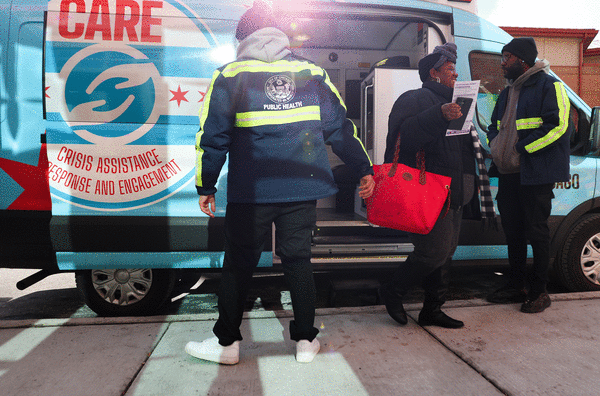
Throughout his 2023 mayoral campaign, Brandon Johnson championed a progressive vision of sending teams of mental health clinicians instead of police officers to help people suffering from psychiatric emergencies.
But since he took office and started phasing cops out of the city’s Crisis Assistance Response and Engagement program, those teams of mental health workers have struggled to respond to 911 calls. CARE’s dispatch volume plummeted almost 70% during his second year, according to data obtained via a public records request, and plunged again last year after the Chicago Police Department took back its devices that provide real-time updates on radio and dispatch communications.
Those in-vehicle machines, known as portable device terminals, were a critical tool for teams of mental health workers to learn about psychiatric emergencies they could help defuse. Proponents of CARE have long argued that police are not well-suited for managing those scenes, but without access to those live devices, scores of 911 calls involving Chicagoans who may need mental health assistance are once again only getting police and Fire Department responses.
The Johnson administration has still not managed to get those terminals back to the CARE teams, nor will it say whether it ever intends to. Instead, the mayor’s team touted a still-in-progress overhaul of the emergency dispatch system that would allow CARE to bypass police and fire channels.
The program’s struggles since Johnson turned it over to the Chicago Department of Public Health also prompted several months of unusually hostile back-and-forth between his top aides and his handpicked health commissioner, Dr. Olusimbo “Simbo” Ige, until he asked for her resignation in May.
The mayor’s team repeatedly pushed Ige to hire more CARE workers, while she argued that was futile because the teams already on the payroll had so little work to do. Ige’s exit came weeks after the Tribune reported on her controversial decision to return tens of millions in COVID-19 funds to the federal government.
One mental health advocate lamented the time lost amid bureaucratic snags that “feel like they are solvable.”
“There’s a tremendous disconnect between the promises being made and what the results are on the ground,” said Jim Poole, senior policy director at the National Alliance on Mental Illness Chicago. “The will is there, but I think it is certainly too long. I think there are many that are frustrated by the pace of deployment.”
A review of internal documents obtained by the Tribune indicates the paralysis has been driven in part by friction between CDPH and the city’s public safety agencies, as well as political infighting within the Johnson administration, culminating with Ige’s reluctance to fill dozens of vacancies on the CARE team.
In response to the Tribune’s inquiries, Johnson’s deputy mayor of health and human services, Arturo Carrillo, said, “It was not a surprise to anyone that the volume had dropped.”
“It’s not as simple as flipping a switch. We do know that we are going to have to be very methodical in to how we’re creating this operation,” Carrillo said in an interview. “To answer your question, why it did not happen fast enough? Well, I think that the mayor was really clear from the start of this of this term that it was going to require a multiphase approach, one that was very deliberate.”
Ige did not respond to requests for comment.
After the Tribune requested records on the program’s pace, the mayor’s office last month announced a citywide expansion of the nonpolice model, though it still operates only Monday through Friday, 10 a.m. to 4:30 p.m. Carrillo also acknowledged CDPH has yet to finish hiring for all its CARE positions but said it intends to fully staff the program, with a second shift in the evening, by October.
“I’m glad that we seem to be righting the ship, but this should have been something that was taken care of years ago,” progressive Ald. Matt Martin, 47th, said when asked if the last few years of persistent setbacks should have taken this long to rectify.
CARE first launched in 2021 under Mayor Lori Lightfoot, one of several 911 response pilots that cropped up in American cities following the Minneapolis police murder of George Floyd. Supporters of the model note that many fatal interactions with cops stem from mental health crises, which behavioral clinicians are better trained at deescalating than law enforcement.
However, Lightfoot split with progressives over her decision to deploy a co-responder model that included Chicago police and fire paramedics, versus exclusively sending mental health workers. The scope of 911 calls were limited to those that didn’t involve the risk of violence.
Johnson then ousted Lightfoot in the mayor’s race three years ago. His promise to reopen shuttered city-run mental health clinics and prioritize crisis response teams without cops was a central campaign theme, and he fired his predecessor’s health commissioner, Dr. Allison Arwady, his first summer in office.
Johnson’s first budget made the CARE pilot permanent and doubled staff positions in 2024, to roars of approval from his progressive base. But the same year, the city quietly took down its public dashboard that displayed response volume over time, replacing that data with a page that shows only one number for the cumulative responses since the program began under Lightfoot.
Asked why the Health Department began hiding the breakdown, Carrillo said that was “because of the requirements for ARPA,” the federal American Rescue Plan Act that funded most of the CARE program. He did not point to any specific provision in that 2021 bill that would require Chicago to stop publishing progress on a government service funded by those stimulus dollars, but vowed the Johnson administration is “absolutely committed to reestablishing a dashboard.”
A Freedom of Information Act request for CARE data shows the pilot began with 37 responses in its inaugural year before shooting up to 481 in 2022 and 773 in 2023. In 2024, CARE dispatches dwindled to 239 responses, before the pilot concluded at the end of that year.
From then on, police officers and paramedics were no longer dispatched through CARE, only CDPH teams of mental health responders and EMTs. But even before that break was official, another bottleneck arose from the Fire Department.
CARE staffing data obtained by the Tribune show that as far back as the spring of 2023, CFD stopped reliably staffing response teams with its paramedics. By March 2024, one CARE unit was only operational for 30% of the month because the Fire Department team member missed 14 shifts, according to records.
That meant “there were many days on which the pilot did not operate due to lack of staff availability,” according to an evaluation from the University of Chicago Urban Labs. Thus, in 2024 CARE’s response volume plummeted by nearly 70%.
Fire Department spokesperson Larry Merritt did not respond to requests for comment. Erik Steinmetz, president of Firefighters Union Local 2, said “we are dramatically understaffed with paramedics” as is, but he’s dubious of the alternate response teams going out without Fire Department training.
“They’re setting them up for failure,” Steinmetz said about CARE cleaving from the Fire Department entirely. “It’s really either this is just going to be an unsuccessful program, or they’re going to run an unsuccessful program that’s going to get people hurt as well.”
The reasons for the program’s pace slowing again after CDPH took over all operations — despite a promising spike at the start of 2025 — are more complex.
Health Department spokesperson Hernan Fratto first told the Tribune that CARE made only 156 dispatches from December 2024 through November 2025. He explained in an April statement that “since the transition to an alternative response model, the scope of CARE operations has reduced since there is no longer CFD and CPD involvement.”
After the Tribune filed multiple FOIA requests seeking more records on CARE’s progress, CDPH produced a different dataset last month that showed 846 responses from that period.
The bulk of them were from the first six months of 2025; after that, only 183 responses were recorded from July to December, and so far this year there have been only 70 CARE dispatches.
Dr. Miao Jenny Hua, CDPH’s deputy commissioner of behavioral health, said the discrepancy was because Fratto’s total excluded CARE responses that didn’t originate from a city Office of Emergency Management and Communications dispatcher.
Per a copy of the CARE protocol obtained by the Tribune, units almost always arrive at a mental health emergency because they learn about it one of three ways: from OEMC 911 call-takers, by CPD requesting assistance or via the teams monitoring police radio communications themselves.
Under the original pilot, the third option — known as self-dispatch — was the most frequent way CARE workers found their way to a scene, comprising 42% of responses, followed by CPD requests at 34% and OEMC referrals at 21%, according to records. There were also nonemergency options that were rarely recorded during that period: “follow-up engagement” after one to 30 business days, or “proactive outreach” to offer social services.
The Health Department did not fulfill requests for data breaking down the different types of dispatches CARE completed from December 2024 onward. Nonetheless, the 52% dip last July and flatlining results thereafter reflect another complication the Johnson administration has not yet rectified: The Police Department stopped sharing its portable device terminals, eliminating the most reliable method for units to self-dispatch.
It was unclear why Chicago police leadership took the devices away from the mental health team vans, and department spokesperson Maggie Huynh deferred comment to the mayor’s office.
As recently as a few months ago, the mayor’s office was still seeking clarity on how various emergency equipment worked, email records show.
Lizbeth Reyes, an assistant under Carrillo, wrote to public safety officials on Feb. 18 seeking a meeting at OEMC to “help us gain a better understanding of the system.” But after OEMC officials hedged on whether they had the right equipment, CPD Crisis Intervention Unit coordinator Lt. Rhonda Anderson chimed in with a warning.
“CPD requested this meeting to ascertain an understanding of exactly what tools and access that CARE is requesting,” Anderson wrote. “It seems that many of the parties are unclear on terminology. … As I brought up previously, in order to move forward with a (memorandum of understanding), all parties need to understand the terminology and the legal parameters that govern access.”
The Health Department’s senior director of crisis services, Tiffany Patton-Burnside, then confirmed, “There is no member of the CARE team with access” to the Police Department’s live terminals.
Carrillo, for his part, did not say whether the Johnson administration currently planned to restore those devices beyond saying: “PDT access is something that we have to continue to examine, and that’s something we’re currently examining.” He also reiterated that the city is in the midst of building out a third OEMC pathway outside of CPD or CFD dispatch, one that would directly route mental health calls to CARE.
Progressive Caucus co-chair Ald. Andre Vasquez, 40th, said he remains confident in the vision of a nonpolice crisis response model but is concerned that the Johnson administration’s bungling of its implementation will embolden “the right making critiques about the program in general.”
“You’re the executive, buck stops there,” Vasquez said. “If we came into office saying we’re trying to deliver this as the opposite of neoliberal solutions, you can’t leave that thing lying on the table.”
Meanwhile, disputes within the Johnson administration over how to steer the CARE program stretched from last year up until Ige’s departure.
The most severe feud was between Carrillo and Ige, who in February filed a harassment complaint against Carrillo for what she described as “bullying me to make decisions that are not in the best interest of the city and the mayor’s priorities.” The complaint was deemed unfounded, per a statement from Carrillo, though Ige did write in an email to Hua later that month, “it was a very tense meeting with (Johnson’s chief of staff Cristina Pacione-Zayas) and the Mayor today.”
Johnson’s health commissioner would stay on for months and attempt to fend off Carrillo’s demands to explain hiring delays by insisting that “CARE is not receiving 911 calls to keep the current staff working,” as she phrased it in one February email.
“The staffing request presented by CDPH is based on program needs and not on political considerations,” Ige wrote to Johnson budget officials on Feb. 4 when defending her refusal to fill 14 CARE positions.
The hiring snafus threatened to blow up in the public during the last budget cycle, when only 28% of CARE’s 47 budgeted positions were filled as of October, per internal correspondence. By then, the Progressive Caucus was threatening to “voice their concern with this issue publicly” unless job postings for the crisis clinician roles went online, according to a Sept. 30 email from Johnson’s intergovernmental affairs chief, Emily Melbye.
Asked why Johnson’s top staffers took so long to rein in a health commissioner who served at the pleasure of the mayor, Carrillo said, “Yeah, the mayor doesn’t speak on personnel issues, and I won’t either.”
Mayoral officials had previously aimed for the citywide expansion to be rolled out by the end of March, then on May 1. Johnson ultimately debuted the announcement on May 13, just ahead of his three-year mark in office. Even as of last week, Hua said the CARE program remains about 50% staffed, but “it’s a moving target.”
“This is a promise that we made, and it’s a promise that I kept,” Johnson said at last month’s news conference, sans his health commissioner. “My administration continues to rebuild after the legacy of disinvestment and the destruction, which has been left by previous administrations who failed to prioritize the well-being of those who are most in need.”
_____
©2026 Chicago Tribune. Visit chicagotribune.com. Distributed by Tribune Content Agency, LLC.








Comments