Is Charlotte at risk for bigger measles outbreak as cases climb in the Carolinas?
Published in Health & Fitness
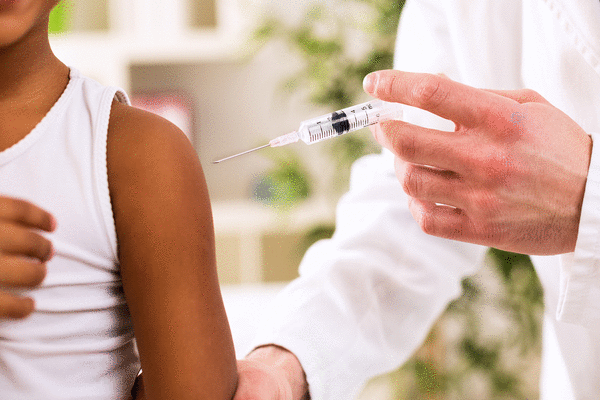
CHARLOTTE, N.C. — The spread of a highly contagious disease is creeping into the Charlotte region. But experts say there are steps the community can take to prevent the kind of widespread outbreaks springing up in other parts of the country.
Mecklenburg County in recent weeks reported three cases of measles. Nearby Union County sent out more than 170 quarantine orders in late January after an infected child went to school.
Those local instances come as cases surge nationally, including hundreds of infections just across the state line in South Carolina.
Medical experts and public health leaders say overcoming rising vaccine hesitancy is key to preventing further spread of measles in and around Charlotte, and the rise of other infectious diseases. That can be an increasingly difficult task as the anti-vaccination movement grows in the U.S. and schools struggle to reach vaccination rates that provide widespread protection.
“If people continue to follow guidance regarding vaccinations, we can continue to mitigate the spread of measles,” Mecklenburg Public Health interim director Dr. Kimberly Scott said.
Worsening measles situation in the Carolinas
Scott told The Charlotte Observer there remain three confirmed measles cases in Mecklenburg so far in 2026: two linked to the outbreak in Spartanburg, South Carolina, and one linked to other travel.
The county also recently issued an exposure notice for measles for people who attended events at Sardis Presbyterian School on Jan. 17.
“Our team is actively working on contact tracing and follow up in regards to those three incidents,” Scott said. “The overall risk to the public right now is still minimal for those folks who are fully vaccinated. Where the risk gets higher is for individuals who are currently unvaccinated.”
Union County Public Health Director Traci Colley said her county doesn’t have any confirmed cases of measles yet, but many of those potentially exposed to measles last month at a Monroe private school are still in quarantine. Measles symptoms typically appear 7 to 14 days after exposure.
“It is concerning because measles can cause serious health complications, especially in children younger than 5 years of age,” Colley said of the current situation in the Carolinas.
Statewide, North Carolina’s Department of Health and Human Services reports 15 measles cases since December, including one hospitalization. Things are more severe in neighboring South Carolina, where almost 900 measles cases have been reported since an outbreak began in the Upstate region in October.
That largest-in-the-nation outbreak is fueling a national rise in cases, with the Centers for Disease Control and Prevention reporting 588 measles cases in the U.S. so far in 2026. There were 2,267 cases nationwide in all of 2025, and three people died of measles last year.
The U.S is now in danger of losing its official status as a country that has eliminated measles pending a review by the Pan American Health Organization, NPR reports.
How vulnerable is Charlotte, NC to measles outbreak?
Dr. David Weber, an adult and pediatric infectious disease expert at UNC Health, told the Observer what makes measles risky is that it’s “highly infectious.”
Whereas someone with the flu or COVID-19 might infect two to four people if they go in a room while contagious, he explained, someone with measles “would give it to something like 14 to 18 people.” Measles also lingers in rooms longer than many other diseases, Weber added.
While the measles, mumps and rubella vaccine is “excellent” — 93% effective after one dose and 97% effective with two doses — falling vaccination rates mean more people are vulnerable to getting sick and spreading measles, Weber said.
Experts look to vaccination rates, particularly among elementary school-aged children, to measure a community’s ability to protect itself against measles, with a goal of 95% to provide widespread protection. An Observer investigation found about 106,000 North Carolina children in elementary school — or one in six — attend schools where fewer than 90% of kids are vaccinated.
Those kinds of numbers can lead to localized outbreaks, Weber said.
Scott told the Observer Mecklenburg’s MMR vaccination rate for kindergarteners is about 92%. In comparison, Spartanburg County has a school-age vaccination rate of 90%, South Carolina health officials told the Greenville News.
“92% is strong protection, but 95% is that ideal space for herd immunity,” Scott said. “So that creates potential gaps where if people are exposed to measles, there are spaces where measles can spread.”
What’s driving vaccine hesitancy?
Dr. Michael Smith, division chief of Pediatric Infectious Diseases at Duke, said given measles is “very much a vaccine-preventable disease ... almost all of the cases are in people who’ve been unvaccinated.”
Smith noted vaccine hesitancy started to rise in the U.S. “about 20 years ago” when a since-debunked study claimed there was a connection between vaccinations and autism.
That trend got a boost when President Donald Trump named longtime vaccine skeptic Robert Kennedy, Jr. to lead the federal Department of Health last year. Kennedy’s department has since dropped the number of vaccines it recommends for every child, and Trump said late last year combination childhood vaccines like the MMR shot should be separated in a break with decades of medical practice.
“That bleeds over into the general public having more vaccine hesitancy, over emphasizing the rare and uncommon side effects of a vaccine compared to the benefits of vaccines,” Weber said of the shift in federal messaging.
How to prevent spread of measles
Weber said it’s important for people to understand the serious nature of measles, particularly in young children. Historically, about 10 to 20% of measles patients get hospitalized, and one in 3,000 die, he said. Some also develop an “almost uniformly fatal” brain condition, subacute sclerosing panencephalitis, with no warning years after measles infection.
Scott said it’s “extremely important that people make sure that their children are vaccinated” to prevent a worsening situation in Mecklenburg County.
The American Academy of Pediatrics recommends babies get their first dose of the MMR vaccine between 12 and 15 months old and the second dose between 4 and 6 years old. Most adults who were vaccinated as children don’t need a booster, experts say, but adults who didn’t get the shots as kids can still get vaccinated.
The MMR vaccine is available through many health care providers, pharmacies and local health departments.
Scott encourages adults to use the state health department’s immunization record finder to verify their vaccination status.
Both Weber and Smith said if vaccine rates don’t pick up, rising measles cases could also be a “canary in the coal mine” for an uptick in other vaccine-preventable diseases that are just taking more time to spread again.
“I don’t really think we want to go back to those days of widespread disabilities and deaths from vaccine preventable illnesses,” Weber said.
©2026 The Charlotte Observer. Visit at charlotteobserver.com. Distributed by Tribune Content Agency, LLC.








Comments