Review: In the funny and sexy 'Wicker,' the perfect man is society's worst nightmare
Published in Entertainment News
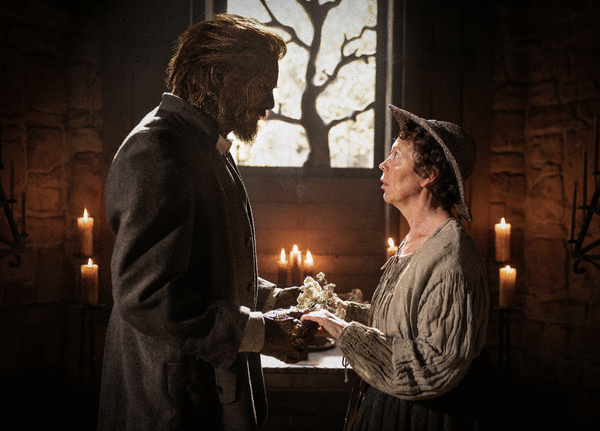
Reason No. 1 to watch "Wicker" is the natural intrigue of seeing Alexander Skarsgård molded out of twigs: face, arms, pecs and abs — and yes, there's also a shot of that.
Reason No. 2 is that the married filmmaking team of Alex Huston Fischer and Eleanor Wilson have made a mischievous, crowd-pleasing folktale with several sweet beats of romance. Their wicker man isn't an object of punishment, like the one that made Nicolas Cage flail around screaming about bees. His creator, an unnamed basket-weaver (Peter Dinklage), braided him as a mate for a lonely virgin, a fisherwoman (Olivia Colman) who stomps around her rustic village smelling like sushi and tossing her head back in an Eliza Doolittle guffaw.
In public, the fisherwoman acts tough. But alone in her candlelit cottage, she's visibly weary of her joyless routine. The liveliest noise in her spinster hovel is the sound she makes using the chamber pot. Once married, however, she wakes up the whole town screaming with delight; her wicker spouse is the handy type who breaks the bed at night and fixes it in the morning. His competence is a major turn-on.
Fischer and Wilson's bawdy fable is predominately about how this flammable hunk makes the rest of the villagers burn up with jealousy. He's not like the other men — he's better. The time period is vaguely medieval and the accents British, save for Skarsgård, who speaks in a flat, neutral exhale, the sound of breeze riffling through straw. Meanwhile, Dinklage's pizzicato mutterings always sound like he's about to burst into song.
Based on "The Wicker Husband," a 10-page short story by Ursula Wills-Jones, "Wicker" is pitching itself as kooky smut, which it is, for about 15 worthwhile minutes. Romantasy is a hot-selling genre. Forget Fabio: People are reading bodice-rippers about sexy dinosaurs, gargoyles, aliens, orcs and even trees. (Those curious to explore beyond mammalian biology should check out Chuck Tingle, the author of "I'm Gay for My Living Billionaire Jet Plane.")
That audience will want more scenes than they get of Skarsgård swooping Colman to bed as the sound design adds an array of naughty creaks. "Wicker's" louder point is societal. It's "Frankenstein" if the rabble wanted to be (or be with) the monster — and a parable with plenty to say about today.
Representing petty humanity are several couples each named for the husbands' jobs: the Tailors, the Bakers, the Innkeepers and the Bottlewashers. Elizabeth Debicki plays the queen bee, a bully born into high status as the doctor's daughter, whose icy lavender gowns contrast crisply against Colman's hand-knitted rags. Clever and ambitious, Debicki's snob is itching for an excuse to leave this hamlet for the city. Being stuck, she instead bends the residents to her will. As Hedda Gabler warned, bored women are time bombs whose agitation puts everyone at risk.
"Wicker" is brisk, visual storytelling boosted by Sofi Marshall's clever editing and Lol Crawley's assured camerawork. Smartly, Fischer and Wilson build out this community with its own strange customs, big and small, each executed without explanation, question or complaint. At weddings, brides proudly wear a heavy matrimonial collar, an accessory more often associated with the stockade, while grooms strap carrots to their crotches and waggle them at goats.
Nearly all of their rituals are rooted in female submission, expressed without words to keep the film from feeling like a lecture. The script prefers to show horrors without dwelling on them. When the perverted old butcher claims a beautiful young bride, the poor girl barely makes a peep. But we glimpse despair under her smile — and one of the next times we see her, she's chained up in a cellar.
Our hearts go out to the wives, even when their actions don't deserve it. "Wicker" also spends a fair amount of time with the husbands to show how much pressure they feel at home too, light as their burdens often seem. The innkeeper is annoyed that his wife wants more conversation. The newlywed bottlewasher is alarmed that his bride wants him to fix the roof. The wicker man's superiority makes all the villagers feel ashamed. "Wicker" is empathetic to their insecurities, yet it has no tolerance for how moral hypocrites ignore the opportunity for self-improvement in favor of scorching everything to the ground.
An orphan and an outcast, Colman's fisherwoman wasn't raised to fit in. Note how she dances, ignoring the regimented steps to nuzzle sweetly into her husband's rib cage. On her character's wedding day, Colman traipses into the church like it's a prank, then nervously straightens up as she realizes this ceremony is serious. The most touching beats in the film are simply scenes of a woman who's always fended for herself experiencing kindness. Love changes her, not all at once but gradually, like a rescue dog. And it makes her feel vulnerable too.
Colman nimbly balances right on the line between humor and pathos. Still, even she can't leap over the fact that the second half of the film skips several emotional beats. The fisherwoman's love story is "Wicker's" pulse, but the movie is really about the town and it sidelines her character to skewer the place. Frustratingly, by the end, we're barely inside her head or heart at all.
Skarsgård's wicker man is tall, blond and handsome on the outside, but hollow by design. He rarely shares what he's thinking, although there's one lovely image of him gazing at the sun through his woven hand, perhaps quietly contemplating his own existence. Lately, Skarsgård seems to be doing the same, gravitating toward roles that, at their core, interrogate the impact his looks have on other people. (See also the marvelous "Pillion," in which his silent biker dominates a cowed lover.)
The special effects team has done terrific work re-creating his body down to the creature's fringed lashes. More importantly, they've kept Skarsgård's sad blue eyes and the actor puts more soul into them than the script gives his character. "I was made for you," he says simply. The theater swoons.
———
‘WICKER’
MPA rating: R (for sexual content, language and brief full nudity)
Running time: 1:45
How to watch: In theaters Oct. 23
———
©2026 Los Angeles Times. Visit latimes.com. Distributed by Tribune Content Agency, LLC.









Comments