Q&A: Adrian Belew on King Crimson project Beat's upcoming fall tour
Published in Entertainment News
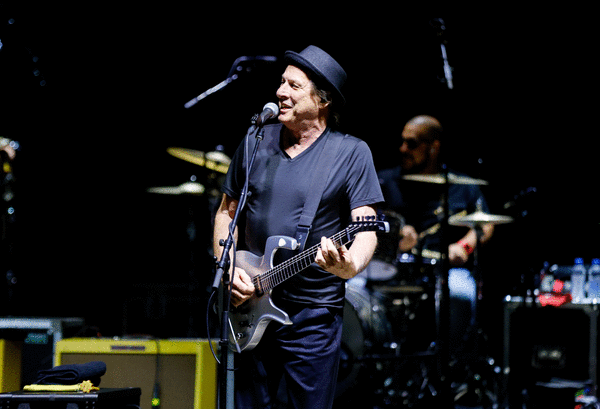
SAN JOSE, Calif. — We got the Beat.
Or, more accurately, we get the Beat — the King Crimson-related project featuring the formidable talents of guitarists Adrian Belew and Steve Vai, bassist Tony Levin and drummer Terry Bozzio — when the quartet kicks off its 2026 tour with dates at the Quarry Amphitheater in Santa Cruz on Oct. 9 and Blue Note Napa Summer Sessions at Meritage Resort on Oct. 10.
Showtime is 8 p.m. and tickets start at $95.18 in Santa Cruz (ticketweb.com) and $89 in Napa (ticketmaster.com).
The project made its debut in 2024 with the focus squarely on King Crimson’s three iconic ’80s art-rock albums — “Discipline,” “Beat” and “Three of a Perfect Pair” — which were the trio of Crimson offerings that featured both Belew and Levin (as well as drummer Bill Bruford and band leader/founder/guitarist Robert Fripp).
This time around, Belew and company are expanding the setlist to also include King Crimson material from the ’90s. One other difference is that it will be Bozzio setting the beat for the Beat, taking over on drums for Danny Carey while the Tool drummer honors others commitments.
All four men have ultra-impressive musical backgrounds. Belew is known for his work with David Bowie, Talking Heads and others, while Levin has been Peter Gabriel’s sideman since the late ’70s. Vai, a three-time Grammy winner, has 11 solo albums to his name and Bozzio was enshrined in the Modern Drummer Hall of Fame in 1997. And of massive significance is the fact that Belew, Bozzio and Vai all worked extensively with the one and only Frank Zappa.
I recently had the chance to catch up with Belew, who was Zooming in from his home in Mt. Juliet, Tennessee, and got to learn more about the Beat.
Q: Good to talk with you, Adrian. Let’s just jump right into the Beat and then we’ll kind of backtrack through some King Crimson history. So, tell me how this project came about.
A: Well, it started in 2019 when I made the realization that in two years, 2021, it would be the 40th anniversary of mine and Tony Levin’s joining up with Robert Fripp and Bill Bruford to create the King Crimson of the ’80s. I thought that’s something that really needs to be appreciated and celebrated. So, I took a long shot and I called Robert.
Q: Mr. King Crimson, himself.
A: I hadn’t talked to him in I don’t know how many years, but I thought, “Well, let’s just see if Robert’s into it.” In speaking with him, I realized that he was, but he had too many things in the works for the next three years. He was really unable to do anything, but he did say, “If you are passionate about this and you want to drive this, you have my blessing.”
I was working with a producer who produced the David Bowie shows that I did — Angelo Bundini is his name — and I said, “Well, maybe we can do this.” I asked him, “Could you produce it?”
Q: And then it was a matter of finding the right musicians for the project.
A: I said right off the bat that they have to be the highest quality musicians available — period. And they have to have a name because I want this to be as big as King Crimson and as impressive and as good.
Q: Setting the bar mighty high right there.
A: I don’t know what Robert thought. Maybe he thought I would just put together some people that I know and just go out and play some shows or whatever. That wasn’t good enough for me. By the way, I did call Bill Bruford, too, and he wasn’t even playing anymore at the time — so I knew that wasn’t going to work out before I even called.
So, Angelo and I started going at it and the first thing I said is, “Well, we need to call Steve Vai, because he’s the one guy I think who might be able to take up Robert’s seat. And if we don’t have that seat filled then we may as well not keep going.”
I called Steve from the parking lot of a grocery store and explained what it was that I thought we were gonna do and he was extremely excited.
Q: Yeah, I bet. He seems like the perfect candidate for the job.
A: The reason I called Steve was not only his ability — I figured he could do just about anything — but also that years ago I read in a magazine how much he loved the ’80s King Crimson and how impressed he was with the material and relentless kind of guitar style that (Fripp) had.
But then — boom! — COVID happened and it stopped us in our tracks.
Q: You and pretty much everyone else in the music business.
A: When bands went out and started playing again about two years later, I called Steve again. Wonderfully, he was more excited than ever.
And I knew that I wanted Tony to play. There’s no one who can play the ’80s music like Tony. He wrote his parts and he plays the very important stick parts, of course, without which you can’t play it.
The last thing in the puzzle for me was (the drums). I’ve known Danny Carey for many, many years and from the very moment I met him he hugged me so hard because he said, “You guys changed my life. The ’80s King Crimson has changed my whole way of looking at music.”
So, from there on, I kind of had him in mind as somebody who could do what Bill did — and would probably want to do it.
Q: Put all those pieces together and it sure seems like you’ve got what you need to handle the ’80s catalog.
A: We had the best band I could imagine playing this stuff. Everything came together.
Q: The band’s name is taken from album “Beat,” which was the second of the three King Crimson ’80s offerings. Talk to me about the meaning behind that title, which, I know, deeply ties into the literary tradition of the San Francisco Bay Area.
A: I’ll tell you the story from the beginning, which is when we were finishing the “Discipline” record and I was sitting in the studio lounge and Robert came out to me and said, “What are you reading?”
I said, “Well, I’m reading, you know, sort of the Beat Generation of writers. I’m especially enamored with Jack Kerouac and Neal Cassady and a few others that are working through this whole area that’s called spontaneous prose, and seeing if maybe I could try my hand at that.
A few minutes later, he came out and gave me a piece of paper and it said, “I’m wheels, I’m moving wheels.” And he said, “There you go. There’s your start, go.” And I said, “What?” And he said, “Start writing the next record right now.”
So, from the beginning, the album was about spontaneous prose and the Beat Generation of writers who did that.
Q: That’s cool to hear, especially since that literary movement and many of its key figures are so closely tied with this area. But why did you decide that title could also work as the moniker for this band?
A: OK, fast forward to when I had finally formed the band, I called Robert back and I said, “Well, here’s what has happened — five years have gone by — but I have actually done this.” He was very surprised, and asked, “Well, what are you gonna call the band?” And I said, “We haven’t really decided on it yet, but the producers are hoping for something that will suggest what it is.”
Robert said, “I have used ‘Discipline’ (the name of Crimson’s 1981 album) for a lot of things. You and Tony and Pat Mastelotto have had a summer camp every year for King Crimson music called ‘Three of a Perfect Pair’ (Crimson’s 1984 album). So, the only one left is ‘Beat” (the 1982 Crimson album). How about that?”
Q: Rounding all the bases. Sounds like a winner to me.
A: I loved it, actually. I thought it was a great title. I said, “If we call it Beat, will you support it?” He said, “Absolutely, I’ll be in the front row.”
So there you go, we had Robert’s blessing, and all it took from there was, you know, the next time we could all be in one place together and rehearse and go.
Q: I’m sure big Crimson fans are aware of this, but others might not know that the band that made “Beat” and those other two ’80s albums was almost called Discipline. There must be an interesting story behind that, so, please, do tell.
A: Robert called me on the first day I was in Europe with Talking Heads (in the early ’80s) on the morning I had arrived and woke me up kind of early and said, “I want to start a band — you and me and Bill Bruford.” It wasn’t called anything, but after a few more talks with him, he said, “It’ll be called Discipline.”
Then we got Tony, so you had two Americans, and Tony and I, right from the start, said, “Oh, Discipline, I don’t know — maybe that means something different in England, but it’s not a very friendly title for Americans.” And so we talked about it here and there a little bit, and one day Robert said, “Well, whatever we call this band, it has the spirit of King Crimson.” I said, “Well, why don’t we call it King Crimson?” And he said OK.
Q: You’re not going to do better than that band name — it’s a classic.
A: I felt proud to be in a band called King Crimson. I knew the band’s whole history very well. And to suddenly be in that band would be an honor to me.
Q: What’s the process been like of revisiting this material with Beat?
A: For me, personally, I’ve just tried to take it back to the place where we can start from. So, I wanted to make sure I could get some of the original types of sounds and things. That was maybe the hardest thing for me. I had been playing some of the songs with my trio over the years, but I probably had to learn two-thirds of the songs. And I made the choices as to which songs I thought we should play, which ones I wanted to sing, and rounded it out with the right amount of heavy duty King Crimson instrumental pieces.
Q: When did you get the sense that this project was really going to be something special?
A: I think the moment we convened and we played in Steve’s studio for three days. But we played really quietly. It was a very small room. We were just going to play through the arrangements to sort of get familiar with the beginnings, the endings, and the shape of the songs before we were going to go into a full-on 21-day rehearsal room production. And I think by the end of the second day, I was saying to myself, “This is gonna be way better than I thought.”
So the resurgence of it really came from the excitement amongst the four of us, and how great the music really is. It’s timeless, but also it’s still very difficult, you know. I mean, you don’t get to sleep during it, I’ll tell you that.
Q: What do you think it is about that era of King Crimson that continues to fascinate fans decade after decade?
A: Well, I think the ’80s band is the band. I think a lot of people feel that of all the variations of King Crimson — and I’ve been in five of them, so I’m allowed to say this — that one just hit the mark somehow. Nobody really understood what we were doing.
Robert had a vision of how the guitar playing should go. And everyone came into the rehearsals with basically instruments that were untried. Robert and I both had guitar synthesizers and nobody had that. Tony Levin had the Chapman Stick and nobody had ever even seen one of those. And Bill Bruford had a new thing called electronic drums.
So I kind of think it was the marriage of all the great ideas, but also the new gear that really helped set us apart. Nobody sounded like we did. And we really didn’t even think about it as we were doing it.
But when the record came out, I think it caught everybody off guard, like, “What the heck is this?”
©2026 MediaNews Group, Inc. Visit at mercurynews.com. Distributed by Tribune Content Agency, LLC.








Comments