Director David Ayer talks 'Heart of the Beast' and working with Brad Pitt
Published in Entertainment News


DALLAS — David Ayer’s latest film is sure to pull on a few heart strings.
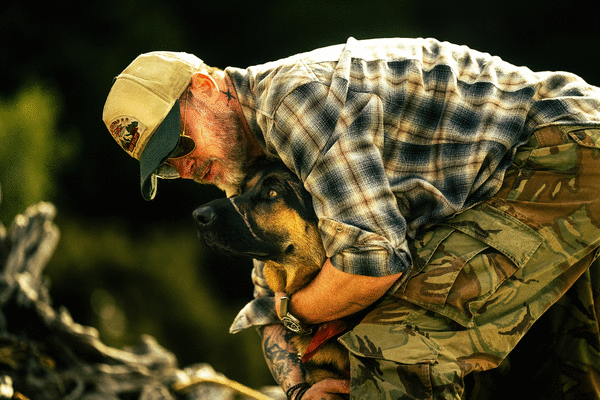
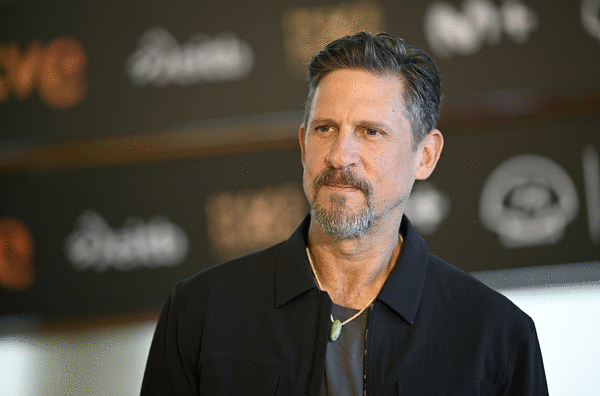
The 58-year-old filmmaker is behind the survival thriller “Heart of the Beast,” which opens in movie theaters this week. The Brad Pitt-starring film follows a retired Special Forces officer and his combat dog as they survive against the elements in the unforgiving Alaskan wilderness.
“I think the power of this movie is giving the audience this emotional symphony that will take all of us to this really strong powerful place,” Ayer said.
Ahead of the film’s release, Ayer recently stopped by Dallas as part of his promotional tour and spoke with the Star-Telegram about the project.
He talked about working with a dog actor, making a movie with little dialogue and his biggest battle on the New Zealand set. Ayer also shared a few comments about his time in Texas.
[This interview has been edited for clarity and length. There are no spoilers below.]
Q: My first thought after seeing the movie was that Uber (the main dog actor) is a great actor. I know actors do chemistry tests with each other — was there a dog chemistry test with Uber and Brad? How’d you know that he was the right one for this film?
A: We went and really had a lot of dog auditions in New Zealand, and we got lucky. Brad came out to New Zealand pretty early and just started working with them and learning how to be a dog trainer, learning Uber’s personality, and just really connecting with him more than anything. Early on, we did a sort of on-camera chemistry test, and we knew we had something once we saw that.
Q: Your films are about brotherhood and trust between either a partner or a team. When I think about James and Odin in “Heart of the Beast,” I think about them as partners. I don’t think about James as Odin’s owner or Odin as James’ dog. Could you speak about depicting that bond between them?
A: I mean, that relationship between James and Odin really is the story. It really is the movie. They’re kind of like an old married couple, you know? If you have pets, I mean, you know how much you can connect with the family dog and the dog is part of the family. But then, you add the military life and the military experience, and having gone to war together and saved each other from danger again and again, it creates a bond that is gonna transcend anything.
Q: I feel like the movie is about the battles we face in life, whether that be emotional, mental or physical. What was your biggest battle in making this movie?
A: My biggest battle in making this was embracing the simplicity of the story. Letting Brad’s performance speak for itself, letting the land speak for itself, finding, I guess, the whisper in the storm. It’s such a simple, beautiful story, and it just was about me getting out of the way of that story and then just witnessing.
Q: This is the smallest cast (three human performers and one dog) that you’ve ever had for a movie. So much of the movie is told through action and movement, and not a lot of dialogue. Obviously you’ve done action before, but this is different. Did you find that process to be challenging or more freeing?
A: It’s interesting because without all the dialogue kind of telling us what’s going on, or to entertain the audience that way, it really becomes about the visual and the image and what the frame is doing, what the camera’s doing, what the actor’s doing, and placing them in this world in such a believable way. There’s a lot of craftsmanship involved in this, and I was really exposed as a filmmaker, so I had to make sure you could turn the volume off and know exactly what’s going on.
Q: I want to ask you about a moment featuring J.K. Simmons’ character. When Brad first meets J.K., he’s a little standoffish and not sure about this guy. When they’re sitting around the campfire and talking, you can see Brad open up a little bit. There’s a quick shot of Brad putting a piece of wood in the fire, which is not a big thing, but to me, he’s putting wood in the fire to feed it so they can talk and get to know each other more. I don’t even know if I have a question about that. Could you talk about that scene? Because I found that small gesture to be quite profound and a step in building connection.
A: I mean, it is exactly that. It’s those little details, those little behaviors. It’s how to build a connection. It’s a story of someone connecting with another person, when it’s the absolute last thing they want to do, and yet there’s wisdom there. I think there’s a good message in that scene.
Q: In a survival story like this, a character is trying to get from point A to point B and along the way there are set pieces. The set pieces in this movie not only thrill, but inform the character of both James and Odin as they’re constantly saving each other. When it comes to crafting a set piece, are there any hallmarks your trying to hit? What makes a good set piece?
A: I mean, any good set piece is gonna have its own mini-story. It’s gonna have its own arc. A rival, a discovery, learning, then the challenge and then how you meet those challenges. Everything sort of serves to reveal more about James’ character, and more importantly, his relationship with Odin. It’s just a great maze for these characters to run through.
Q: Some of the marketing surrounding this movie has been explicit about Odin surviving the journey. I’m sure some people need that information before heading into the movie, but I’m curious what you think about all that?
A: It’s funny because you make movies and you can kill lots of people and no one’s really worried about that going in. But when it comes to a dog, they’re so important to us in the way we bond. And I think because they’re dependent upon us. The audience just wants to know the dog is taken care of and the dog’s safe. I think that’s important.
Q: I didn’t know much about combat dogs before this movie, so I feel like I learned something. For you, what do you think the power of this movie is?
A: I think the power of this movie is giving the audience this emotional symphony, that will take all of us to this really strong powerful place. There may be some crying, but it sets you down gently. I think it leaves us with a story of spiritual endurance and a story of heart and hope and sacrificial love in that, when you come at things from a place of love and trust, that’s the heart of a relationship and you can survive anything.
©2026 Fort Worth Star-Telegram. Visit star-telegram.com. Distributed by Tribune Content Agency, LLC.










Comments