Halsted Street to be the focus of a (third) documentary
Published in Entertainment News
CHICAGO — A number of Chicago thoroughfares have been immortalized in song over the years, from State Street to Lake Shore Drive. But it is Halsted Street that has been the subject of not one but two documentaries. Soon enough, a third will be set in motion.
The project is an effort to expand upon the two previous films. The first is a 16-minute silent film, titled “Halsted Street,” that captures “a cross section of Chicago as seen on Halsted Street from the city limits at the southern end to Lake Michigan on the north,” per the description at the film’s beginning, which can be watched at mediaburn.org.
It dates from 1932 and was made by filmmaker and labor organizer Conrad Friberg. It’s about a stretch that includes both farmland and more urbanized settings, full of streetcars and automobiles. There are also plenty of pedestrians, and the footage captures all kinds of wonderful details about local businesses of the era. One is called Swedish Records. Another has live ducks waddling about in its front window, which advertises the sale of eggs and pigeons. Another is a public bath house for curing “rheumatism. Neuritis. Colds. Poor blood circulation. High blood pressure. Great for reducing.”
The street is full of life and activity.
The other film is director David Simpson’s“Halsted Street, USA” from the 1990s, which directly references Friberg’s film and is an “hourlong kaleidoscopic look at the city as seen all along Halsted Street, beginning outside the city in the towns of Southern Illinois and running north to its merge with Broadway,” according to the Tribune’s review. The film captures a 400-mile stretch and incorporates footage from the earlier film to underscore the contrast.
Studs Terkel narrates, calling Halsted the backbone of Chicago and the melting pot at full boil. But if this is the melting pot, “Can it melt? Should it melt? And who are the people today who make up this stew? What thoughts and dreams, conflicts and tensions, simmer up from the cracks in the pavement?” The film begins at the southernmost tip of Halsted at the Ohio River, where it “creeps out of the water at a sleepy town called Cave-In-Rock, or as it’s officially known, Route 1.”
Now, decades later, a collection of artists, poets, journalists and neighborhood people are embarking on the latest study of Halsted.
They are members of the Mouse Arts and Letters Club, a social club that launched earlier this year and is based in the Bridgeport neighborhood.
“It’s kind of a combination of a salon and an attempt to reincarnate Chicago’s storied old bohemian clubs like the Dill Pickle Club,” said co-founder Morley Musick, “where poets and activists and musicians and anyone, really, can come and discuss ideas and art together, and make art together, and learn about hyperlocal goings-on as well as the broader world.” Musick’s day job is at the Indo-American Arts Council. He works as a freelance reporter, as well.
While conversations on social media often become contentious, the social club aims to subvert that while allowing for different kind of experience. “It’s at the heart of what we do,” said co-founder Blair Paddock, who is a reporter with WTTW. “We want to bring people together to participate in a discussion with an expert, or work on some sort of group project, so we can learn from one another. But we’re really anti-lecture.”
One series of discussions is called “Job Night.” Inspired by Terkel’s 1974 nonfiction book “Working,” each event features three people from a particular industry who take questions about their jobs. Musick and Paddock are planning an upcoming “Job Night” that will feature a wig manufacturer, a toupee installer and a hair stylist, for example.
The club also functions as an answer to the question: How do you meet people and make new friends as an adult?
The Halsted documentary is a natural outgrowth of the club’s interests and proclivities, with an intention to expand upon the first two Halsted films.
“There’s a Trib article from the 1920s that’s very grand in how it describes Halsted Street as this melting pot,” Paddock said. “The Polish are here! The Germans are here! It seems like Halsted was big in the imagination of Chicagoans in terms of how the city is able to bring all walks of life together.”
That is why “we are very strictly staying on Halsted” for the film’s focus, she said. “This isn’t a neighborhood portrait. It’s a street portrait. We don’t want to stray away from that.”
Any point in history is fair game, “but it’s not going to be as straightforward as the preceding two films because of how many different disciplines the many collaborators at Mouse are going to bring to bear,” said Musick.
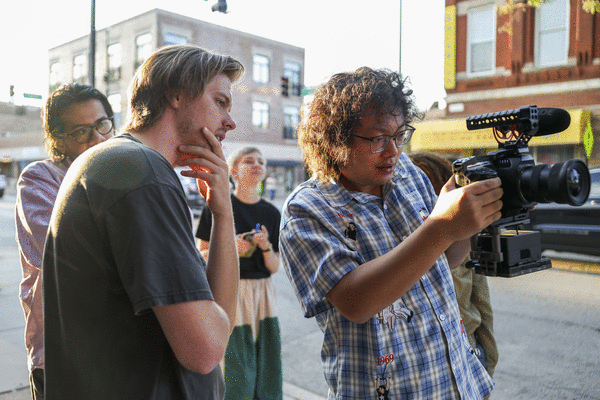
To cover the expansive length of the street, the group will split into teams, each with a checklist of things they need to capture or create. In essence, there will be several mini-documentary crews working on specific sections of the street.
“They will conduct interviews on a certain span of blocks or miles,” said Musick. “They will do some kind of historical re-enactment of something from Chicago’s newspaper archives that happened on that section of Halsted. They will produce visual art representing that section in some way. They’ll also find someone from that section of Halsted to write and record a poem about the street. They’ll take photographs of that section. And then all of that will be available to be collaged into the final film.”
There are animators, as well as historical re-enactors in the club who will bring their talents to bear, including Paul Durica, who is the director of exhibitions at the Chicago History Museum. “For years, he has done historical recreations of the Battle of the Viaduct, which was a workers’ uprising in 1877,” Musick said. “He’s planning the biggest re-enactment yet for next year. So we’ll be filming their planning meetings as well as the historical re-enactment itself, which happens on Halsted Street.”
When everyone is done, all the work will be assembled chronologically, or maybe geographically, or by some other framework to be determined later. It’s a shoestring operation. “Everyone is volunteering,” said Paddock. They already have access to a few cameras through friends who are filmmakers and are “fundraising to get one more nice video camera,” according to Musick.
It’s a project that’s designed to appeal to anyone with an interest in Chicago history and a curiosity about the city’s nooks and crannies and footnotes. “We’ll be doing a fair bit of historical research for the project,” Paddock said.
“As we film,” Musick added, “there’s a hope that we’ll assemble a merry band of people spanning the North and the South Sides who want to become collaborators and start to interview each other so the North and South Sides learn about each other more.”
©2026 Chicago Tribune. Visit at chicagotribune.com. Distributed by Tribune Content Agency, LLC.








Comments