Gustavo says goodbye with with four-night Hollywood Bowl extravaganza
Published in Entertainment News
LOS ANGELES — On Sunday, Oct. 3, 2009, at 2 p.m., an atmospheric electricity pervaded the Hollywood Bowl when Johnny Polanco came on stage. The salsa star led what has now come to be held as a legendary day-long concert, which included Cuban and mariachi musicians, a large gospel choir, Flea, Herbie Hancock and Taj Mahal. None were the main attraction.
The Bowl, like the moon that warm fall day, was full and free. All 18,000 tickets had been given to anyone willing to brave long lines. From east to west, north to south, L.A. was garlanded with banners that read "¡Bienvenido Gustavo!"
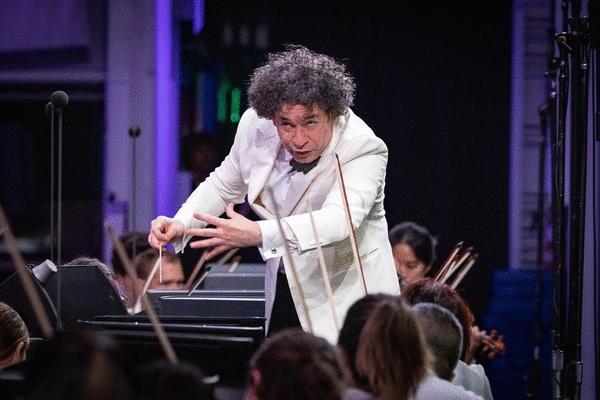
This was Gustavo Dudamel's first concert as music director of the Los Angeles Philharmonic. It was capped by a supremely confident and irrepressibly jubilant 28-year-old Dudamel leading a performance of Beethoven's Ninth Symphony that turned its "Ode to Joy" finale into a resolutely joyous heralding of a new epoch of promise for L.A.
For the last year, "Gracias Gustavo" garlands have adorned the city, thanking Dudamel for doing just that during his 17 seasons heading the L.A. Phil. Over the weekend, a supremely happy-seeming Dudamel, before heading to the New York Philharmonic in a couple weeks, milked the thanks in a back-to-the-Bowl, four-night blowout.
It began Thursday with a Beethoven Ninth of extraordinary assurance. Throughout the weekend, Dudamel embraced the worlds of Hollywood, Latin music in many guises and old-fashioned rock. The marathon ended Sunday with Dudamel literally enthroned by, and serenaded by, Chris Martin of the band Coldplay.
Throughout his 17 L.A. Phil seasons, Dudamel has tirelessly acted on his mantras that we are all one people, that there is only one music and that music education is a human right. With that mantra in mind, he created YOLA (Youth Orchestra Los Angeles), a free teaching program initially centered in South-Central L.A. for young children, immediately after having been announced as upcoming L.A. Phil music director in 2007.
He has included YOLA in L.A. Phil activities throughout his tenure, taking them on foreign orchestra tours and even including them on a Super Bowl halftime. He has expanded the L.A. Phil range to include a wide range of pop, folk, film and world music. He has put the L.A. Phil in the spotlight in a way no modern orchestra can match.
All of that was on display at the Bowl, as well as the limits of what an orchestra can do. Epoch-making, however, is a work in progress, with its ups and downs. And the Bowl, which Dudamel has embraced unlike any previous L.A. Phil music director, remains the Bowl, a fabulous gathering place but one of musical compromises along with exaltation.
In many ways, YOLA was the glory of the "¡Bienvenido Gustavo!" Bowl program 17 years ago, and it proved even more so for the goodbye Gustavo, or more accurately "hasta pronto," see you soon. He's back in less than four months, in a laureate role conducting the L.A. Phil at Walt Disney Concert Hall and insists he'll remain a summer fixture at his beloved Bowl.
At Dudamel's very first visit to YOLA in 2008 at the EXPO Center, he coached very young kids who had been given cardboard violins and told them if they worked hard, he would bring them to Disney Hall and the Hollywood Bowl. He kept that promise, and a YOLA orchestra with real instruments played an arrangement of Beethoven's "Ode to Joy" on the "¡Bienvenido Gustavo!" program. Thursday night, members of YOLA were professional enough to join the L.A. Phil in Beethoven's Ninth.
The program began with further emphasis on youth, offering the premiere of film composer Michael Giacchino's "Hymns of the Heart," written to feature Los Angeles Children's Chorus and children from Education Through Music-Los Angeles, a program in under-funded schools. Poet Amanda Gorman, who served as sometime narrator, added unnecessary glamour. The kids singing was what mattered.
The orchestra was just back three nights earlier from a U.K. tour, and those programs included Beethoven's Sixth and Seventh Symphonies. I heard the Proms concerts, where Beethoven bloomed with illuminating lyricism, color, rhythmic versatility. British critics, maybe expecting flamboyance and unused to the exquisite smells of jacaranda and night-blooming jasmine, found it laid-back.
Beethoven's Ninth begins by evoking the awe of emptiness and carries on building a universe in which we rejoice in the ecstasy of brotherly (and presumably sisterly) love. This Ninth — featuring the Los Angeles Master Chorale and four superb vocal soloists (Saioa Hernández, Tamara Mumford, David Portillo and Ryan Speedo Green) — became Beethoven, alive in the moment, an instrument of utter joy. Dudamel could have easily left it at that, coming a full circle from 17 years ago.
Instead, this was just the start. The next night, "Gustavo's Fiesta" involved an array of Latin musicians, with Dudamel and the orchestra appearing after intermission. The program opened marvelously with Los Panchos, a Mexican trio originally formed in New York in 1944. The current members are entrancing, boasting a gorgeous blend of voices and guitar. They made the circle fuller, Los Panchos having been a major influence on Johnny Polanco.
The crowd had come, though, to dance, and dance they did to the lively Colombian cumbia group, La Sonora Dinamita, who were followed by the sophisticated Catalan singer Sílvia Pérez Cruz and the Mariachi Reyna de Los Ángeles. Dudamel and the orchestra accompanied the eloquent Lila Downs and much of the evening was then given over to the popular, Grammy-gleaning Los Tigres del Norte. Rather than accompanying Los Tigres, which tend to lean in the direction of Las Vegas, Dudamel energized them.
Saturday night's 18,000 were for Foo Fighters. Many stood in what looked like an hour-long line for merch from the long-standing band, which was making its long-awaited Hollywood Bowl debut. Its 90-minute set was lustily accompanied by Dudamel and his band. Dave Grohl was effusive in his praise of Dudamel, saying this is what he wanted to do every night forever. It was very loud. The decibel meter on my cellphone showed an average level of 105, which is jackhammer level, capable of causing permanent hearing loss after 15 minutes. No music is worth that.
I'm not sure it registered with a Foo-happy crowd, but there was a meaningful moment of silence in the first half, which consisted of Venezuelan composer Aldemaro Romero's "Fuga con Pajarillo," for which five remarkable Venezuelan folk musicians joined the L.A. Phil and members of YOLA. A maracas solo by Ernesto Laya, however, seemed to be too soft to be picked up by the microphones, yet he held a cheering crowd rapt simply by his rhythmic movements. We heard with our eyes.
Dudamel made Sunday's grand finale a benefit concert for Venezuela to support earthquake relief. Besides Chris Martin (a surprise guest) and Beck, it included, among others, star Venezuelan vocalists Lasso and Nella, Mexican star Meme de Real from rock band Café Tacvba, Colombian crooner Carlos Vives and the famed Mexican singer-songwriter Natalia Lafourcade.
Dudamel opened with a Latinized version of Strauss' "Tritsch-Tratsch Polka," with which he once astonished the Viennese at their traditional New Year's concert, and repeated Romero's "Fuga." This time Laya's hushed solo was slightly audible and equally astonishing.
Dudamel addressed the audience, sounding very much like he had 17 years ago at the Bowl, extolling in our being a crowd of many types together for many musics. L.A., he said, made him an Angeleno. (The L.A. Phil has posted a high-quality video of the concert on YouTube, but careless advertisements make it unwatchable.)
In the meantime, New York now has placed high, L.A.-level hopes on Dudamel as the next champion in the creation of a riper Big Apple begun by the election of Mayor Zohran Mamdani and the Knicks' NBA victory.
Pity L.A. Phil didn't copyright "¡Bienvenido Gustavo!"
©2026 Los Angeles Times. Visit at latimes.com. Distributed by Tribune Content Agency, LLC.







Comments