Tupac in Baltimore: With murder trial underway, city remembers an artist in the making
Published in Entertainment News
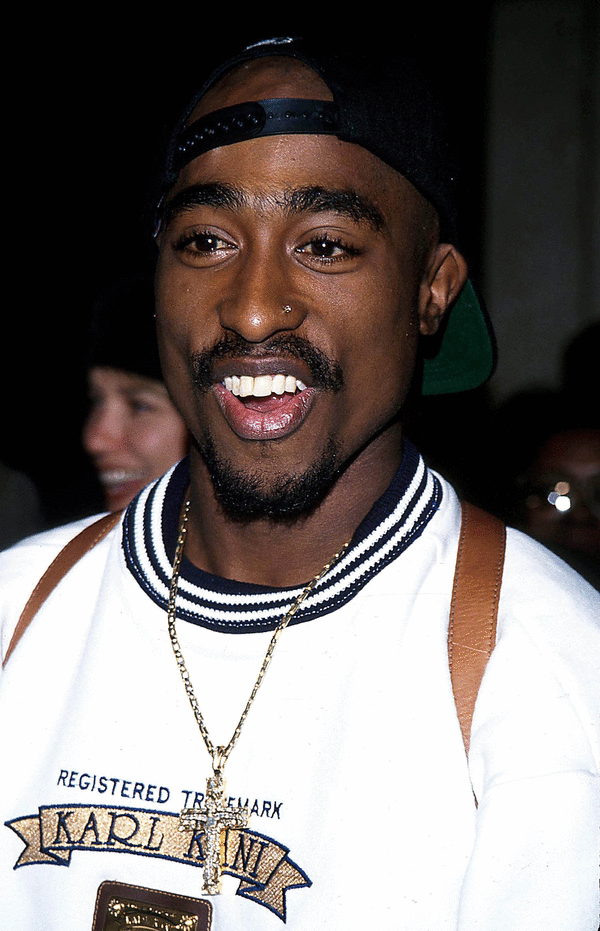
BALTIMORE — Likely few rap stars are so beloved by the city they lived in for a mere four years that they merit both a baseball bobblehead and a forever place in its public library vault.
But Tupac Shakur, whose 1996 killing has finally led to a trial that began in Las Vegas Monday, spoke so deeply to Baltimore that lines formed shortly after sunrise for his Orioles bobblehead night at Camden Yards this May. And the lyrics his 14-year-old self wrote to win a 1985 library contest — “Yo’ Enoch Pratt, Bust this” — are housed in the Pratt’s vault of valuables next to a lock of Edgar Allen Poe’s hair.
“You can’t take your eyes off him,” Deborah Taylor, a retired librarian, remembers a contest judge writing.
Taylor said she picked up Shakur and his East-Side Crew of rappers, at the home he lived in at 3955 Greenmount Ave. in Pen Lucy because they didn’t have a way to get to the contest. The crew bested about 10 to 12 other rap acts, performing at the Pimlico branch, which no longer exists, and then at the finals at the Pennsylvania Avenue branch, she said.
“It was packed,” said Taylor, who retired after 43 years at the Pratt. “I heard someone in line saying, ‘Oh my God, they’re rapping in the library.'”
Taylor tossed the lyrics into her desk drawer, along with other programs and such from her years as coordinator of school and student services. When Shakur was killed in a drive-by shooting in Las Vegas in 1996, then Pratt CEO Carla Hayden decided to preserve the lined notebook paper in the library’s vault, Taylor said.
“We always believed the library should be a place of expression,” Taylor said, “not just a place to read.”
She followed Shakur’s rise, going to see the 1993 movie "Poetic Justice" that he starred in with Janet Jackson, and delighted to be invited to R House for another only-in-Baltimore honor, a launch of a Taharka Brothers ice cream, named after one of his most popular hits, "Keep Ya Head Up."
The song, a tribute to Black women and resilience, is among a body of work that critics say made Shakur one of the greats, blending personal experience and vulnerability with trenchant social commentary.
“Everyone agreed he was exceptionally gifted as an actor, and that contributed to his effectiveness as a rapper,” said Donald Hicken, who was head of the Baltimore School for the Arts’ theater department during Tupac’s time there.
Tupac had a tough childhood, Hicken said, and that experience, along with his natural charisma and risk-taking, added to his art.
“It made him more emotionally available,” Hicken said.
His mother, Afeni Shakur, who was a member of the Black Panthers in New York, moved Tupac, then 13, and his younger sister Sekyiwa, to Baltimore in 1984. Tupac attended Roland Park Middle School for eighth grade and Dunbar High School as a freshman, before learning about the arts school.
His audition, a scene from “A Raisin in the Sun,” which he’d previously performed at a Harlem community theater group, won him a place in the class of 1989. There, he would become close friends with Jada Pinkett (before she added her married name, Smith) and was well known both for his acting chops and rapping.
“He came in sophomore year, and because it was a small school, within the first month everybody knew each other,” said Maryland Del. Sean Stinnett, who was in the same class as Tupac.
It was a talent-rich environment, Stinnett said, with Josh Charles also in their class, and the likes of future Alvin Ailey dancer Linda-Denise Fisher-Harrell at the school at the same time, as well.
Stinnett still thinks of Shakur as an actor. He was that good.
“You could believe whatever role he was portraying,” Stinnett said. “You could turn your back, and still feel the character he was playing from the sound of his voice.”
But in 1988, Afeni Shakur moved the family to California, much to Tupac’s dismay.
“He always credited the school with where he learned to be an artist,” Hicken said.
The acting teacher tried to keep Tupac, offering to get him a host family so he could finish his career. But a tearful Tupac told him he couldn’t stay behind.
“I have to go,” Hicken remembered him saying. “It’s my mom and my sister.”
Shakur’s “Dear Mama,” about his mother’s struggles with poverty and addiction, was added to the Library of Congress’ National Recording Registry in 2010. Afeni Shakur died in 2016.
Stinnett recalled several years after graduation being on the beach in Venice, California, and hearing people buzzing: “Tupac is down there.”
Having stayed in touch with him, Stinnett walked down to where the commotion was, saw his old friend, and the years melted away.
“It was like we had just seen each other,” he said.
While they lost touch — Shakur continually had to change his number as his fame grew — Stinnett said he is hoping the trial will bring long-awaited justice for family and friends.
Duane “Keffe D” Davis, 63, is on trial for allegedly orchestrating the fatal shooting that also injured Marion “Suge” Knight, founder of Death Row Records, which had represented Shakur. He has pleaded not guilty.
“Justice has to be served,” said Stinnett of the long-delayed accounting for the now 30-year-old crime. “You need closure.”
For those in Baltimore, Shakur remains someone beyond his “Thug Life” persona.
Hicken thinks of that as a role that his student assumed, perhaps too well.
“I cautioned him about that,” said Hicken, whom Shakur visited several times after he moved away. “That world is a very damaging and confused place. He was fully engaged in that world, and he was using it as an artist to express what he wanted to express.
“I’m afraid,” he said, “his role consumed him.”
©2026 Baltimore Sun. Visit baltimoresun.com. Distributed by Tribune Content Agency, LLC.









Comments