'Top Chef' host Kristen Kish will defend quickfires for money '100%'
Published in Entertainment News
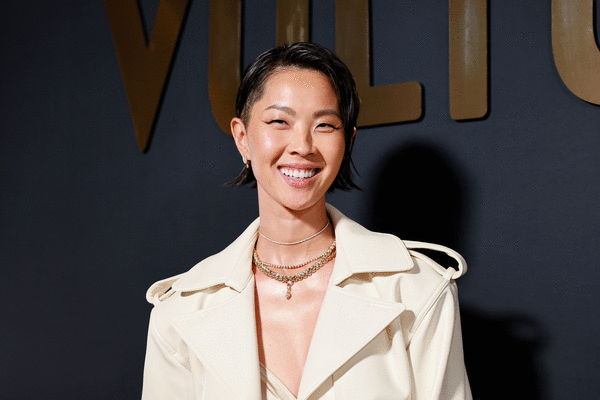
LOS ANGELES — This spring, at an FYC dinner for "Top Chef" at "Top Chef Middle East" winner Charbel Hayek's Ladyhawk in West Hollywood, I dug into the restaurant's Bill Addison-approved mezze platter alongside host Kristen Kish and used the opportunity to venture that the recent 23rd season, set primarily in Charlotte, North Carolina, had made her into the new Tim Gunn, whose empathetic mentorship of flailing fashion designers defined "Project Runway" for a generation of viewers.
Kish, a past "Top Chef" winner who admits she did not watch much reality competition before taking the helm of Bravo's cooking contest in 2024, diplomatically skirts any attempt at comparison with Gunn, predecessor Padma Lakshmi or "The Traitors" emcee Alan Cumming. But she acknowledges that her distinct approach — kinder, gentler, more tearful — is rooted in her particular skill set: "It's similar to how I responded to being led in kitchens," she says. "You don't lead with fear. You lead with compassion and empathy and encouragement and confidence. And two things can be true at the same time ... I can require more from them, and I can also cry because I'm filled with joy for their progress."
Emmy-nominated for reality competition series and reality host, "Top Chef: Carolinas" epitomizes Kish's swift remaking of the role in her own image. The season, which concluded in June, finds Kish comforting a distraught chef, Nana Araba Wilmot, who fails to plate her dish in the allotted time; navigating thorny questions of fairness and wellness with an injured contestant, Jennifer Lee Jackson, and her fellow-contestant partner, Justin Tootla; even facing acrimonious "feedback about [her] feedback" when chef Sieger Bayer is eliminated from the competition.
I recently caught up with Kish as she prepared for an Envelope photo shoot to ask her about the season's most talked-about moments, recent criticism of the format and the hard work of being a good host. Read excerpts from our conversation below.
Q: Are you a big crier in your everyday life?
A: Yes. It started when I met my wife. I was required to be more emotionally available. I was required to be able to talk about how I feel and why I'm feeling it. I think that's also just personal human growth — leaning into vulnerability without it feeling like you are weaker or less than. And since meeting my wife, in general in life, I feel things deeper. I think that there is a level of compassion and empathy that I had never tapped into before. And I can't turn that off when I go onto television, so you're gonna get it.
Q: I wanted to talk about specific instances that came up this season where you got to jump in in a more intensive way. What's your memory of that moment with Nana?
A: The cooking part was over, the timers went off. They're just walking out trying to get the food to the table. My memory is watching her walk out, and in the moment, I was like, "She's either going to drop the plates, she's going to pass out [or] she's gonna fall to her knees." Everything in me was like, "I can't let that happen." I have had panic attacks before, I know what that feels like. And if someone saw me struggling, I would hope that someone would also have stepped in to help me. And whether there is a camera there or not, you see someone about to fall or hyperventilate, you're going to naturally, as a human, go and help them. It was instant, without even thinking about it. I was like, "Not on my watch is this going to happen."
Q: I wrote a piece back during the COVID-19 Portland season about the camaraderie of the "Top Chef" universe. And your interaction with her felt, to me, very much of a piece with that. There is a sense of solidarity among everyone who's part of this world.
A: It's like a kitchen. That's the side of my brain that I think allows me to host in this unique way — the combination of it being my industry, something that I have spent two decades of my life finding my place in, and then also having been on that other side of being thrust onto television with cameras in your face, requiring you to cook perfectly. So those things coming together, I think I react differently, and I hopefully can see the process less in pieces and more as a whole thing for somebody.
Q: I'm curious how that worldview applies to a situation like with Jennifer and Justin, where you're navigating the rules of the game, but you also have to handle it with care because they're people in a difficult situation in the same way that Nana is.
A: This was pretty wild. Obviously, we had seen [Jennifer] struggling, and there was a conversation behind the scenes like, "If she sits out one more time, someone's got to say something." [Then] we saw her face drooping, which was a clear medical emergency. And at that point, off camera, everyone's like, "She has got to go for safety, for her own well-being."
That particular day, I was flying to go to the Creative Arts Emmys. So I was just like, "Well, I'm just gonna stay at [the] stage, de-glammed in my airplane outfit, and just wait for my flight." There happened to be storms. My flight's getting delayed. Our executive producers are running against the clock trying to get all the moving pieces. Because at the end of the day, I'm the one that has to go back on camera to talk to Justin [who was offered the chance to return to the competition after being eliminated to replace his wife but declined]. Call it the universe [aligning] or meant-to-be timing, I'm not sure — all of it happened and all the puzzle pieces were put back together in order for me to go do my bit with Justin, explain to him and offer him what we're offering him before I had to leave for the airport. I remember our executive producer was like, "Are you fine going as you are?" I'm in my airplane outfit, no makeup and a backwards hat. I was like, "This is a very real moment that's happening in real time. Imagine if I got re-glammed and go back in there. You get sucked right back out of the real moment that's happening."
Q: When a moment like that comes up that's completely out of left field — unlike anything that I can remember on the show, even from before you were host — do you get nervous?
A: No, not at all. ... It's not that I forget about the cameras, but I understand, being a contestant, this is their real life that's happening. I'm just a part of that. And so I don't get nervous for my part. I get nervous because for them, going through this, I wonder how they're feeling. And so I put myself in their shoes a lot without even thinking about it. And I'm like, "Well, how would you want to hear the news? How would you wanna be cared for? How would want to be handled?" The last thing you want is some TV moment where all of a sudden they throw glam and put me back in an outfit and throw me out there and walk up to Justin and deliver it like I deliver "pack your knives and go."
Q: In the case of Sieger, he's snapping back at you in a more negative way. What's your memory of how that played out?
A: I remember being taken aback. It was kind of a surprise. You can see it in everybody's faces. That was the last thing we were expecting. But as much as I was surprised in the moment, I'm not surprised that it happened. I wouldn't have done that. However, I can understand why he would have done that and why he did do that. These people come from their kitchens, and they take their craft very seriously, and they understand the benefit and the opportunity that comes with "Top Chef." When you want something so bad and you feel like it's not fair, that reaction comes out of all of us at different points in our life. His just so happened to [be] on national television. I don't fault him for it. He can have whatever reaction he wants. But I definitely was surprised.
Looking back on it, I know what he was trying to say. I kind of wished for him that he could have put the actual words in there with energy that was more of a conversation that we could have had. But emotions were high, and he didn't think before he spoke.
Q: The Hollywood Reporter TV critic Daniel Fienberg wrote a piece this season criticizing the quickfire challenges, casting and other elements of the production and calling the show "broken." Are there any changes that you would make to the format in your quest for realness and authenticity?
A: In terms of the quickfire, I will say, there's been a lot of discourse online. And I think I replied to someone on Threads. It was like, "The quickfire should go back to getting you immunity." I 100% disagree. As the chef going through that process, when you leave your job, and you have never seen money like they're throwing around just for cooking a great dish for 30 minutes, you are all in. You are cooking to get that money. I still remember when I left my job [to be on the show]. I left being paid for two months. You're giving up two months of pay. That's kind of a big deal for anybody. And I think at the time when I left, I was making $35,000 a year. To go on a show where for 30 minutes, I have a chance to win $10,000, f— yeah, I'm all in. I want the money. Because usually the way it works, the only person that gets the money really is the person at the end. But over the course of the season, every quickfire has a chance to win at least $10,000. I'm still taking it as seriously as immunity, 100%.
Q: We've talked about how much work you're putting into the job of hosting. You're not just showing up and reading a script and walking off set. If you were speaking to Emmy voters, what would you want them to appreciate about your job?
A: I make it look easy. And I make it look easy because there's been two decades of a lot of work in this industry to get to be the person that can authentically and genuinely speak about this show and to lead it in my role. I was [a] chef contestant before. I am the host of the show now. I've seen a full 360 view of what this show can do and how it runs. ... The art of subtlety and nuance and true compassion and care for real-life people and real relationships is not a performance. It is how you interact every single day, whether a camera is running or not running. It's the conversations for four hours that we have at [the] judge's table about food and about our industry. It's moments in between where we're eating and dining with people from the food world and beyond. Every single Emmy season, I'm like, "It's real people, real food, real careers, real skill, that you as real viewers and fans get to go experience in the real world. We're not f— around here." "Top Chef" has changed the way people dine and talk about food and how they see food television.
©2026 Los Angeles Times. Visit latimes.com. Distributed by Tribune Content Agency, LLC.










Comments