Commentary: AI-obsessed filmmakers are making a crucial miscalculation
Published in Entertainment News
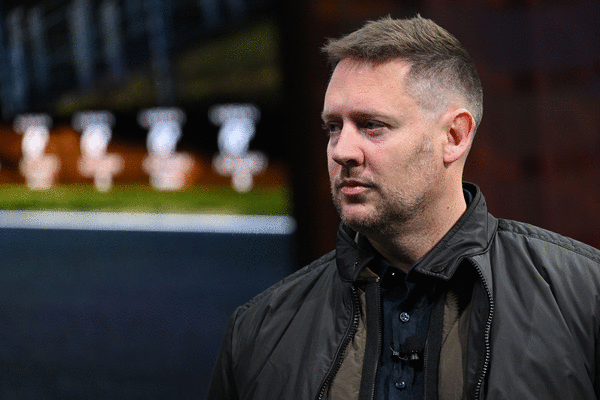
Established filmmakers haven’t minced words about their opposition to AI: Guillermo del Toro said he’d “rather die” than use generative AI, while James Cameron has called AI actors “horrifying.” Industry peers have embraced the technology despite these rebukes. Last month, director Neill Blomkamp released a 13-minute sci-fi short generated through prompts in Seedance 2.0 as part of announcing his new AI-focused film studio. Additionally, Darren Aronofsky’s AI studio, Primordial Soup, is raising $15 million in equity, according to an SEC filing.
The questionable artistic merits of AI filmmaking notwithstanding, these moves underline a consequential trend in Hollywood. For some filmmakers, AI isn’t a creative revolution as much as a way to package themselves as disruptors and access capital that has become harder to attain. But when this kind of investment focuses on the technology behind these projects, rather than the quality of the films themselves, it risks mistaking a new way to fund movies for a reason audiences will want to watch them.
Creatives haven’t been shy about AI becoming a useful financing tool. Roger Avary, the Oscar-winning co-writer of "Pulp Fiction," said in an interview with Joe Rogan in February that it had become “almost impossible” to get traditional funding for projects before launching an AI production company. “Just by attaching the word ‘AI’ and [the fact] that it’s a technology-based company, all of a sudden, investors came in, and we’re in production on three films now,” he said.
Similarly, Alex Proyas, who hasn’t directed a feature film since "Gods of Egypt" bombed at the box office in 2016, announced in April that his passion project, "Heaven," will be produced using Ex Machina Studios’ proprietary AI. In a statement to Deadline earlier this year, the company said the technology allows for “expansive worlds to be realized at a responsible budget,” echoing Proyas’ previous comments that AI can help filmmakers “do more for less.”
If Avary and Proyas make the personal case for investing in AI — the traditional Hollywood system is no longer opening doors for them — Aronofsky makes the institutional one. Primordial Soup launched in 2025 through a partnership with Google DeepMind and a mentorship model for emerging filmmakers. Now, the studio is raising funds when investment in AI video and media startups has surged over 43% year over year, according to PitchBook data. But its early output has also exposed the gap between investor enthusiasm and audience acceptance.
Primordial Soup’s AI-generated historical docuseries, "On This Day… 1776," received significant backlash earlier this year. It was an ironic outcome for a studio founded by an Oscar-nominated auteur and built around the mantra “make soup, not slop.” Blomkamp’s AI short drew a similarly negative reception upon release.
These responses reinforce the central challenge facing AI-assisted productions: The technology is often perceived as a creative shortcut more than an artistic breakthrough. For filmmakers whose careers have stalled, that distinction matters. Blomkamp is a case in point. Since his best picture-nominated debut, "District 9," his filmography has been defined by high-profile unrealized projects — enough to merit their own Wikipedia page — as much as the movies he’s actually made. Like Avary and Proyas, Blomkamp has found a new source of financing, but not necessarily a new reason for viewers to follow his work.
Of course, not everyone in Hollywood drawn to AI is using it as a lifeline. Michael Mann has suggested he might experiment with AI for aging and de-aging characters in "Heat 2." Martin Scorsese is using AI to help with storyboarding. George Lucas, one of the most technologically ambitious filmmakers of his generation, believes that AI is the future of filmmaking, likening skeptics to people who preferred horses and carts after the advent of automobiles. Notably, none of them are hurting for financing or industry relevance. Their interest in AI comes across more as curiosity than desperation.
Perhaps these tools will become more commonplace in Hollywood, particularly if they reliably lower production costs. But there’s a difference between filmmakers using AI to enhance a creative vision and using AI to sell investors on one. If the latter is pursued, the technology will fail to build trust with audiences.
Filmmakers have faced this predicament before while trying to secure a second act. The solution requires more than seed capital; it requires ingenuity.
After M. Night Shyamalan delivered back-to-back critical and commercial flops with "The Last Airbender" and "After Earth," he went back to basics. He took out a loan against his own estate to self-finance 2015’s "The Visit" for $5 million; the film went on to gross nearly $100 million. He followed that up with "Split," which had a $9 million production budget and ended up making $278 million worldwide. In both cases, Shyamalan returned to what audiences loved about his movies in the first place: high-concept premises and shocking third-act twists.
Moviegoers reward films they want to see. That lesson is clear, but the current wave of AI evangelists hasn’t learned it. The technology may change how Hollywood makes movies, but it can’t manufacture the audience support that makes a comeback story possible.
———
This column reflects the personal views of the author and does not necessarily reflect the opinion of the editorial board or Bloomberg LP and its owners.
Miles Surrey is a Brooklyn-based culture writer. His work has also appeared in The Ringer, Men’s Health, and Vox.
©2026 Bloomberg L.P. Visit bloomberg.com/opinion. Distributed by Tribune Content Agency, LLC.










Comments