Banksy didn't authorize the Banksy exhibition in Tampa, but he knows about it
Published in Entertainment News
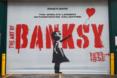
TAMPA, Fla. — For years, Michele Boersma, curator of a private collection of 160 works by the artist Banksy going on display in Tampa this week, has traded emails with the artist’s mysterious and notoriously strict authentication office known as Pest Control.
It’s the only conduit for those without a direct relationship with Banksy to reach out to the artist, whose identity has never been confirmed.
“I”m 99% sure there’s a section of that correspondence that was directly with (Banksy),” Boersma said. “At some point I’m like, ‘I’m in my 50s, you’re in your 50s, and we’re emailing each other at 2 o’clock at night. I know who I’m talking to. Why are we playing this game?’”
At first, the emails felt only contentious. Banksy, he said, had been actively trying to disrupt the traveling exhibition behind the scenes, pressuring collectors who’d purchased pieces to not allow them into the show. Boersma, to get cooperation, agreed to cover the edition numbers on some artworks so that Pest Control wouldn’t know whose they were.
There were other attempts at disruption, Boersma said, without getting into details. “It involved (Banksy) involving his Hollywood friends and two very influential artists to try to stop us.”
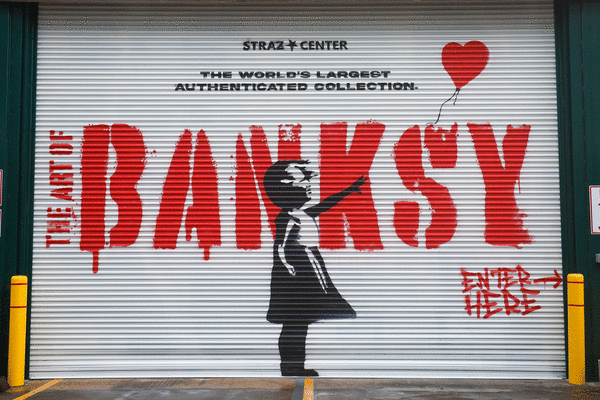
That complicated relationship follows “The Art of Banksy” to Tampa, where it opens Friday and runs through Sept. 27 on the stage of Morsani Hall at the Straz Center for the Performing Arts. Visitors will walk through a temporary museum displaying prints, paintings, sculptures, sketches, stencils and ephemera owned by about 40 private collectors. Tickets start at $29.99 before fees.
Banksy emerged from the graffiti scene in Bristol, England, in the ‘90s and gained attention in the 2000s as his darkly funny stencils appeared on walls across the world. His instantly recognizable attacks on war, authority, consumerism and inequality — and his hidden identity — created a phenomenon. Soaring auction prices, famous collectors and the Oscar-nominated documentary “Exit Through the Gift Shop” put him at the center of the art world.
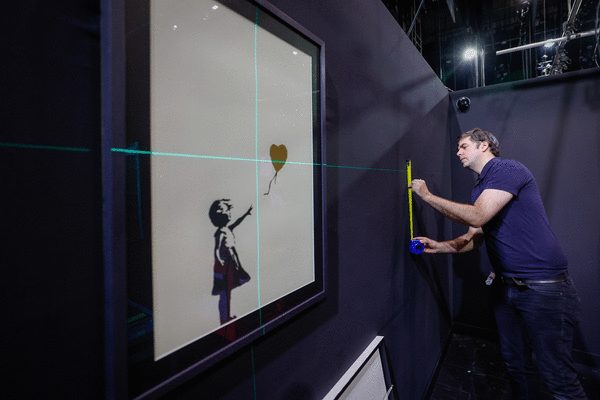
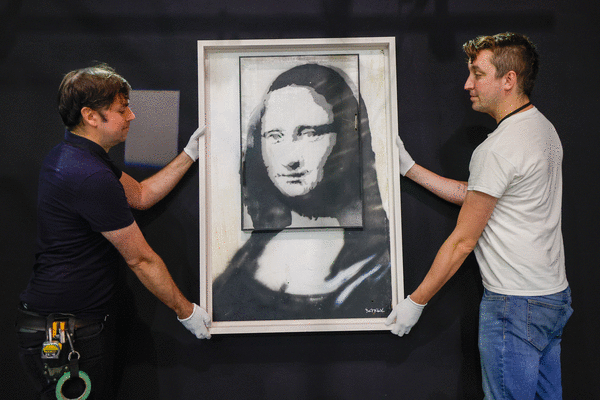
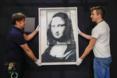
The exhibition in Tampa includes familiar images such as “Girl with Balloon” and “Rude Copper,” along with what its organizers call the original “Flower Thrower,” apparently made as a gift to one of Banksy’s former girlfriends years before the image became internationally recognizable. Another featured work is a version of the “Mona Lisa” that was purchased by actor Brad Pitt, returned to Banksy in 2022 and transformed into a new work that is now being publicly displayed in the United States for the first time.
The show has traveled internationally for about a decade, but Tampa marks the first time it has been installed directly on a theater stage. Temporary walls were erected across the stage and orchestra pit area, creating a sort of maze where the art will be individually lit and rock music will play. Videos feature people from Banksy’s past, including printmaker Ben Eine and former girlfriend Leonie Laws.
Banksy did not curate, approve or authorize any of it.
Pest Control declined to comment on specifics of “The Art of Banksy” or Boersma’s characterizations of their communication. In an email to the Tampa Bay Times signed “PCO,” the office only reiterated that the exhibition is “wholly unofficial and unauthorized.”
But over the years, Boersma said, Banksy has stopped trying to disrupt the exhibition. And he has never condemned “The Art of Banksy” publicly. That’s not an endorsement, by any stretch, but to Boersma, it means something.
“If you look at Pest Control’s website right now, on the homepage above or under their logo, there’s a message attacking another exhibition in London,” Boersma said. “They could have done that when we were in London, but they never did.”
He feels his exhibition, due to its effort to authenticate every artwork, has reached a sort of “gentleman’s agreement” with the artist.
Most of the works in the exhibition carry certificates of authenticity issued by Pest Control. Other pieces, such as personal sketches or gifts, fall into categories for which Banksy does not issue certificates. Those have been supported by provenance connecting them directly to Banksy or his associates, including correspondence, photographs and statements from their original owners.
Boersma said the exhibition has turned down objects that looked convincing when he and other experts could not trace their histories.
“The risk of us putting it on display and then it not being correct was just not worth it,” Boersma said.
The relationship with Pest Control shifted, Boersma said, when the office began pressing him to provide a list of works traveling under Banksy’s name. Boersma initially refused, but it became clear to him they only wanted to make sure anything identified as a Banksy was actually made by Banksy — and that any work made by somebody else properly credited the real artist.
That made Boersma realize they were, from different angles, trying to protect the same thing.
“I’m taking a leap of faith,” Boersma recalled writing. “I’ll send you the artwork list.” It was, he said, “the beginning of us doing a dance of trusting each other.” Pest Control, he said, will flag anything that isn’t right.
Pest Control did not confirm that arrangement to the Times.
The producers are making some of that email correspondence part of the Tampa attraction. Visitors purchasing the VIP experience can enter a lounge displaying selections from the emails. The exhibition’s website characterizes them as an ongoing dialogue about authenticity and intellectual property.
Corey Ross, owner of Starvox Entertainment and a producer of the exhibition, said the presence of actual artwork is the main difference between “The Art of Banksy” and competing attractions that rely heavily on enlarged scans, recreated images or immersive projections.
Boersma, Ross said, spent years developing relationships with collectors and convincing them to let valuable and sometimes intensely personal objects travel.
“This show, in a way, celebrates the collectors as much as it celebrates Banksy,” Ross said.
The works in this exhibition are not taken from streets or public walls, or works that were ever available to see for free, its producers say. They are objects Banksy sold or gave to people who now control where they are displayed. They also believe that as more artwork is stashed in storage containers to avoid taxes, awaiting the day it will be flipped for a big payoff, there’s value in keeping it on display somewhere.
Many of the lenders are not wealthy art investors, Boersma said. They are early admirers who bought prints when they cost 50 or 100 pounds or spent years of savings on a work before Banksy’s market exploded. Some knew the artist personally. Others bought the art before his name alone could add hundreds of thousands of dollars to its value.
The exhibition’s early “Flower Thrower” offers the most personal example.
Boersma said Banksy made the small work in 1997 as a Valentine’s Day gift for Laws. In a filmed interview included in the exhibition, Laws recounts receiving it and later sending it to Pest Control while seeking formal authentication.
The work was returned months later with its original personal message partly ground away and replaced. The exhibition will show visitors a scan of the reverse side, where remnants of the first inscription can still be seen.
For Ross, an independently assembled retrospective can do something Banksy’s own projects can’t do. When Banksy creates an exhibition, it is typically a new artwork, not a history. “The Art of Banksy” places pieces from different stages of his career together, alongside the stories of the people who acquired them.
Museums generally have policies against staging a retrospective for a living artist without that artist’s direct cooperation.
“When someone is as public and as political and as influential as Banksy has been,” Ross said, “there’s also a place and value for a third party to look at what his work is and to talk about it.” Banksy is arguably the most famous living artist in the world.
Tampa artist Leon Bedore, better known as Tes One, sees the absence of Banksy’s permission as a disqualifying problem.
Bedore, whose career has roots in graffiti, declined an invitation to walk through the exhibition before it opened.
“The reason is that ‘The Art of Banksy’ is not an authorized exhibition of his work,” Bedore wrote in an email. “It’s just one of many exhibitions that tour and exploit his work for spectacle and profit.
“If you’re a fan of Banksy, I highly encourage you to seek out and experience his work where he originally placed it,” he wrote. “Context is key, and an unauthorized exhibition has none of it.”
Bedore acknowledged that this exhibition may not be as egregious as some others. Still, he objected to a business using the name and imagery of a living artist who continues to make and curate his own work, particularly when visitors will exit through a merchandise shop.
Boersma believes visitors can understand the contradiction and still gain something from seeing the art.
He said Banksy’s direct images, political humor and visual jokes make him accessible to people who might feel intimidated in a conventional museum. Visitors may enter knowing only “Girl with Balloon” and leave with a broader sense of the artist’s methods, relationships and career.
“From a black-and-white image in their mind,” Boersma said, “we gave it color.”
And then they will exit through the gift shop.
Ross said the exhibition plans to place a Banksy quotation near its merch: “We can’t do anything to change the world until capitalism crumbles. In the meantime, we should all go shopping to console ourselves.”
Whether that makes the shop part of Banksy’s joke or completely misses the point is up to the visitor.
©2026 Tampa Bay Times. Visit tampabay.com. Distributed by Tribune Content Agency, LLC.






Comments