Column: At the Stratford Festival, an artistic director retires. Prematurely, of course.
Published in Entertainment News
STRATFORD, Ontario — I have come to realize that I do not approve of excellent artistic directors leaving theaters when they still have much to give.
At some point during the COVID crisis, it became an article of faith that longtime artistic leaders should “make way,” or some other such nonsense, usually propagated by those with a vested interest in acquiring their jobs. Many felt pressured to go, even if they did not want to in their heart of hearts. Valued experience, not just of theater but of life itself, suddenly became a deficit. But I find such exits are sad occasions, despite the balloons and speechifying.
Sad for audiences, I mean. In the theater, directors tend to get more honest, and thus more interesting, as they age. Boards of directors often find, too late, that such directors are not easily replaced.
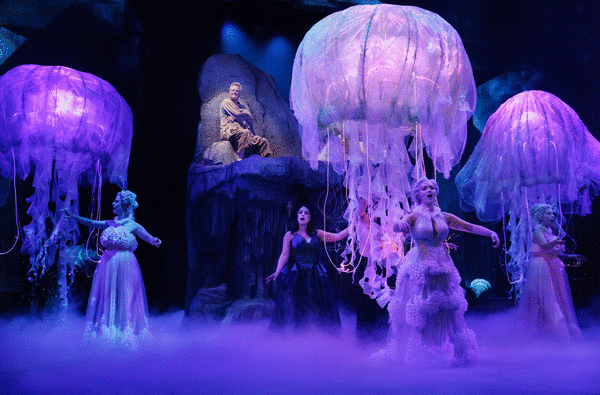
Still, some artistic directors feel so moved to step down, sometimes for perfectly valid reasons of their own. And so I found myself last weekend at the Stratford Festival in Canada, at a theater I’ve been attending for more than 30 years, watching “The Tempest,” the valedictorian show from Stratford’s departing artistic director Antoni Cimolino, whose career at this remarkable institution spans 40 years, first as an actor, then as executive director, and finally as artistic director.
In the second scene of “The Tempest,” hard upon the shipwreck that begins Shakespeare’s drama, the central character takes off his magical cloak.
“Lie there, my art,” Prospero famously says.
Here in the famous Festival Theatre, the sprite Ariel, played in splendidly sprightly fashion by Marissa Orjalo, opens up the top of a piano, a piece of island flotsam and Prospero, in the form of the veteran actor Geraint Wyn Davies, shoves his coat inside, throws up his hands and closes the lid.
There are two implications of this action. One is that Prospero (really the rightful Duke of Milan) now plans to tell his daughter, Miranda, some hard truths he can no longer conjure away, as if he has been using his creative powers all these years to hide or to obfuscate. The other is that Prospero, widely seen as an authorial proxy, is himself retiring.
That set up is but one reason why “The Tempest” is a favorite of those who want to put a period on their directing careers. (Anton Chekhov’s “The Cherry Orchard,” the 2023 choice of Robert Falls at the Goodman Theatre, is another popular selection). Prospero’s final speech, gorgeously delivered here by Wyn Davies, continues the theme. “Our revels now are ended. These our actors, as I foretold you, were all spirits, and are melted into air, into thin air: And, like the baseless fabric of this vision, The cloud-capp’d towers, the gorgeous palaces, the solemn temples, the great globe itself, Yea, all which it inherit, shall dissolve, And, like this insubstantial pageant faded, Leave not a rack behind.”
This is not what you hear at most retirement parties. Few retirees want to be remembered for not even leaving a puff of smoke in their wakes. Cimolino, whose gentle stewardship of this juggernaut of a theater, especially during that existential COVID crisis, was as sure as it was self-effacing, leaves a great deal more.
One could start with his legacy of leaving the best place to see Shakespeare in North America. Sans pareil. We could go on with the economic impact on this region of Ontario, where the massive festival is the biggest draw. One might mention his eschewing of ego and his care and maintenance of his company of the best Canadian and international actors. We certainly would need to remark on the humanity and honesty of so many of his productions.
Gripped as I was each and every minute, I didn’t find “The Tempest” to be a perfect show, notwithstanding the 69-year-old Wyn Davis’ raw and vulnerable performance, as well as the most guileless and warm-centered Miranda (Ashley Dingwell) and Ferdinand (Dakota Jamal Wellman) one could imagine. Most notably, it somehow underplays the emotional heft of the pivotal father-son reunion at its conclusion, here too rushed for my tastes, given that it forms Prospero’s most tangible legacy.
The production begins with an epic, Cameron Mackintosh-style shipwreck, a sight to see. But once we’re back on the island, the thrilling scale of the production dissipates, seemingly with intention. I took that, frankly, as a directorial reticence when it came to staging a full-on, see-ya-later blowout with look-at-what-I-have-been-able-to-do trickery at every turn. It is as if Cimolino wishes to instead telegraph a lifelong love of simplicity, a determination not to be too much on the nose, a belief that all you need are actors and a tropical rock or two. So it is as if we are watching two shows, the one ambivalent about the other. Both are deeply moving in their own ways. But “The Tempest” is one piece, nonetheless, and the production suggests to me nothing so much as the complexity of leaving, which is exactly as it should be.
On this first trip to Stratford this summer, I restricted myself to Shakespeare, given that Cimolino kept the Bard at the center of operations, even when, incredible as it may seem, there were some voices suggesting that should change.
An argument for its ongoing centrality certainly can be found in director Haysam Kadri’s incisive production of “Othello,” a stripped-back take that focuses not so much on why Othello is so taken in by jealousy, or even why Evan Buliung’s Iago is as diabolic as he proves to be, but on the human pain that flows from all of that. The most striking image in the show is of the bodies of a gentle Desdemona (Krystin Pellerin) and a messed-up Othello (André Sills), intertwined on the bed, the metaphorical seat of all of their problems. Sills, whose felicity with Shakespeare’s language is so formidable as to sometimes walk off with Othello’s requisite vulnerability, did not always travel far enough down Kadri’s road. But the show still makes its point that the world of this play has narcissistic aggressors and flailing victims, and those who fall into both of those categories. And it most interestingly posits the notion that Emilia, wife of Iago, is perhaps the one character with foresight and clarity, an idea that the superb Jessica B. Hill pushes with all her might.
Emilia as the moral conscience of “Othello” is counterintuitive, given how she is taken in by her husband, and it’s the opposite of how Emilia is usually played. But the idea works, not least because Buliung shows us an emotionally stunted Iago, a wasp who hasn’t much life left after leaving his sting on the man he hates the most. I was put in mind of Jeffrey Epstein and those in his orbit, frankly. Day after day, as those allegations drip and denials fall apart, we try to parse the guilty from the oppressed. “Othello,” I realized, is very instructive on those matters.
If all this sounds too heady, well, there is “A Midsummer Night’s Dream,” a very Canadian “Midsummer Nights Dream,” directed by Graham Abbey, founder of the Toronto’s Groundling Theatre, and filled with gentle friendliness, optimism and a gestalt that reminded me of the great early years of Franco Dragone at the Cirque du Soleil, even though it uses a lot of digital technology, nonexistent at the time.
Here again, Hill, a new star of the festival, is magnificent, this time as Helena, in love with Thomas Duplessie’s Demetrius. You believe in her youthful obsession with the guy, which takes Helena so far down the road as to call herself his “spaniel,” but she also shows us a woman with a future. Indeed, the women of this “Midsummer” — also Ijeoma Emesowum’s Hippolyta and Vivien Endicott-Douglas’s Hermia — run the show, notwithstanding some jolly rude mechanicals and Mike Nadajewski’s puckish Puck, here focused on getting the audience clapping along with this exuberant celebration of life.
“Midsummer,” of course, is a play about the promise of youth, penned when Shakespeare was barely into his 30s.
Unlike Prospero, and surely Cimelino, he had yet to fully realize that we are such stuff as dreams are made of.
Nor did he yet see that sometimes people leave you halfway through the woods.
“The Tempest” continues through Oct. 24 in the Festival Theatre; “Othello” through Sept. 27 in the Tom Patterson Theatre; and “A Midsummer Night’s Dream” through Sept. 26 in the Tom Patterson Theatre. Tickets and more information at www.stratfordfestival.ca
———
(Chris Jones is editorial page editor, as well as chief theater critic for the Chicago Tribune.)
———
©2026 Chicago Tribune. Visit chicagotribune.com. Distributed by Tribune Content Agency, LLC.










Comments