Tim Allen's voice took him from Detroit to infinity and beyond
Published in Entertainment News
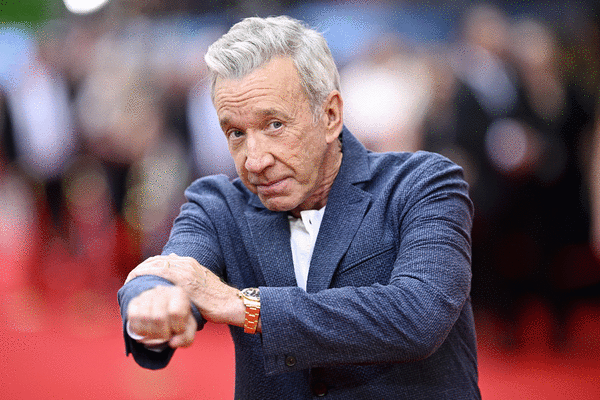


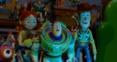

DETROIT — Tim Allen's voice precedes him.
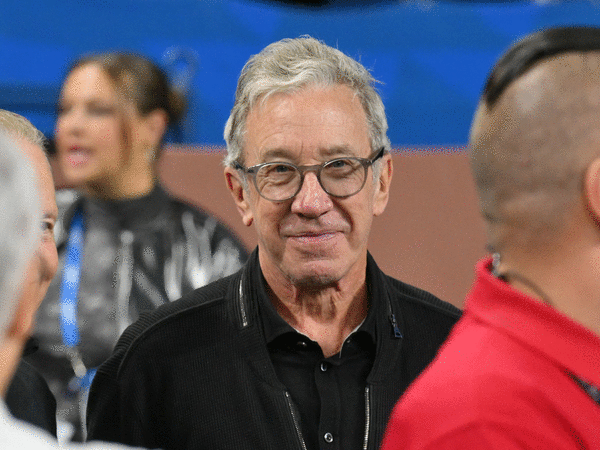
The Metro Detroit-raised actor and comedian says he's recognized for his voice so often that when he goes to football games — either at Ford Field to watch the Lions, or in his wife Jane's hometown to watch her beloved Pittsburgh Steelers — he has to be reminded to keep his voice down so he doesn't startle those around him.
"We get into the stands and my wife goes, 'You have to shut up,'" says Allen, on a Zoom call earlier this month from the Pixar studios in California. "Because if I start talking, everyone either goes, 'it's Santa!' or 'it's Buzz Lightyear!'"
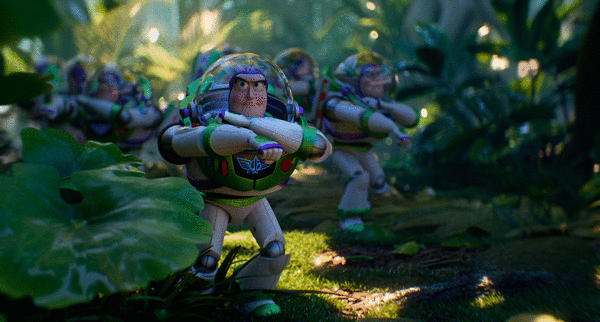
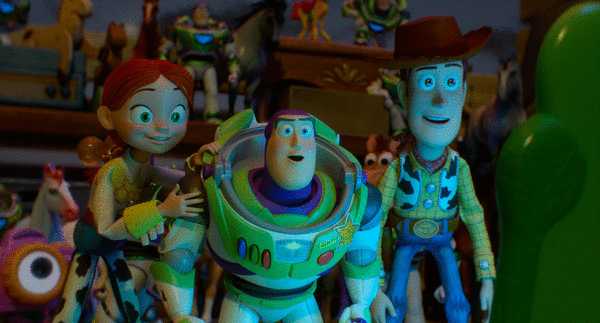
Allen played Santa Claus in Disney's "The Santa Clause" films, and he's been Buzz Lightyear, the heroic Space Ranger action figure in Pixar's "Toy Story" franchise, since 1995. The latest "Toy Story" adventure, "Toy Story 5," opens in theaters in Friday.
He's also been the voice of the Pure Michigan ad campaign, his "calm, melodic delivery" providing the campaign with "considerable emotional weight," says Pure Michigan vice president Kelly Wolgamott.
Allen says that voice role, for his home state's long-running tourism campaign (he voiced the Pure Michigan spots from 2006-2020, and again in 2022) had a profound effect on him.
"It changed my life," says the actor, who turned 73 last week.
Allen plans to take in a little Pure Michigan this summer when he travels Up North with his family, he says.
"I'm heading up to Traverse City in a couple weeks. I've had a spot up there for years, so I'm going to be up there for three, four weeks," he says. "My parents went up there, my mom has friends up there, I spent my childhood up there — I love it up there."
He'd stay longer, he says, but he's got work to tend to: "Shifting Gears," his current ABC sitcom, starts production on its third season in late July.
By that time, "Toy Story 5" will likely have put its stamp on the summer box office. And it will have proven once again that voicing an action figure in the first fully computer-animated feature film was one of the savviest and most lucrative career moves Allen could have ever made.
To infinity ...
Allen was in the dining room of his Beverly Hills home — that's the Metro Detroit Beverly Hills, not the 90210 one — when he was first pitched the original "Toy Story."
He was filming the second season of "Home Improvement" at the time, the smash ABC sitcom about an accident-prone TV repair show host that launched in 1991 and made Tim Allen a household name. He would film "Home Improvement" in Los Angeles and then fly back home to Metro Detroit as his schedule allowed.
At the time, "I was knee deep into becoming a thing," says Allen, who was born in Denver and lived the first 13 years of his life there before moving to Birmingham with his mother and his five siblings.
After graduating from Seaholm High School and studying at Western and Central Michigan Universities, his stand-up career began to take off in the 1980s.
By the '90s, offers were rolling in, and one of them was "Toy Story."
It was to be the first computer-animated feature film, and the animation style was revolutionary at the time, evolving from traditional hand-drawn, flat animation to computer-rendered 3D landscapes, a wholesale reinvention of the art form.
Allen had seen early works from Pixar's John Lasseter and he was excited by the possibilities of the new form of storytelling.
"It was the first digital animation, and I was all in," says Allen, who was 40 at the time. "Instead of being startled by it, I was intrigued. So when I saw the 'Toy Story' thing, I said, 'Yeah.'"
Allen had studied at Ron Rose Productions in Southfield, where he was schooled by "the famous" Mike Carroll, he says, in the art of voice-over work.
Buzz Lightyear, as pitched to him, had more of a radio announcer-style voice, talking in a typical advertisement pitchman cadence. Allen had notes.
"It was very A.M. radio," he says, "and I changed the character a little bit to be less disc jockey-ish. I just kind of slowed it down and made the words (more) me."
His Buzz would be paired opposite Tom Hanks' Woody, an old-timey cowboy doll. Allen had never worked with Hanks, but he had come close, kind of: before "Home Improvement" was picked up by ABC, the network wanted Allen to star in a sitcom based on "Turner & Hooch," the 1989 comedy starring Hanks stars as a cop opposite his canine partner.
Allen turned his nose up at the offer.
"They wanted me to be Hanks, and I said, 'no, I don't want to do that,'" he says. "I was doing quite well, I had done the (1990) Showtime special 'Men are Pigs,' and I was starting to do very well as a stand-up doing concerts. And I wasn't willing to give that up to play Tom Hanks."
That's when he pitched ABC execs the idea of "This Old House," but instead of the host fixing stuff, he broke everything. "And that's 'Home Improvement,'" Allen says. "The first five episodes were my act at that point, and that started all this."
... and beyond!
As "Toy Story" was originally conceived, Allen and Hanks' characters were much less warm, and spent their time bickering at each other and the other toys.
"Woody and Buzz, in the original (conception), were very bad cop, bad cop. Yelling the whole time, yelling at the toys," he says. "And it was funny, but it was a cartoon you wouldn't watch."
After an early version of the movie was screened for execs in late 1993, it bombed in the room so badly the screening became known as the "Black Friday Incident."
But filmmakers decided to take the pieces that worked, retool the story, and give it another go.
"They called us back and said, 'You know what, we're gonna ditch that, and we're gonna try it again.' I'm surprised they did it," Allen says.
The script was softened, and the push-pull relationship between Buzz and Woody became the center of the story.
"We made this tepid friendship that didn't work out at the beginning, because (my character) was delusional because (he) thought he was a Space Ranger, and (Woody) was, 'You are a toy!' And then that became a friendship," Allen says.
It worked, and became a generational touchstone.
"Toy Story" opened in November 1995 and became a massive hit with critics and audiences alike, earning over $400 million worldwide, anchored by the star power of Allen and Hanks.
At the time, Robin Williams had done "Aladdin," but it wasn't de rigueur for established stars to voice animated characters in movies. Allen and Hanks completely shifted that paradigm.
"I think they did this as a safety valve," Allen says. "They said, 'lets have the two stars, Tim Allen and Tom Hanks,' and they put our names above the title. I think the first two were 'Tim Allen and Tom Hanks in Toy Story.' Legally, they didn't realize — I'm sure they weren't happy about it after the fact — but because of the rules with the unions, if you put your name above the title, you're the star of the movie, not Woody and Buzz.
"And that became a contract thing that was very beneficial to both of us," he says. "I'm not sure they do that anymore."
"Toy Story 2" was released in 1999, followed by "Toy Story 3" in 2010 and "Toy Story 4" in 2019. (Allen did not voice the character in 2022's stand-alone "Lightyear," which approached the character from a different perspective.)
Now Allen and Buzz are inextricably linked, says "Toy Story 5" producer Lindsey Collins.
"I don't know how to imagine somebody other than Tim as Buzz," she says. "It's like asking, 'What would you have named your child if you hadn't given them the name you chose?' Buzz is so informed by Tim. I think the fact that he is enormously funny, he has this ability to combine overly confident humor with a soft vulnerability underneath. I think that's what makes Buzz so charming, and I think that's very much what makes Tim so charming."
"Toy Story 5's" co-director, Kenna Harris, says Allen's mixture of authority and humor are indelible to the character.
"Buzz Lightyear is a soldier, and I think Tim has a quality to his voice that in certain sequences, certainly, I take him very seriously, and I would follow him to the ends of the Earth. And then it's when you let him go on long enough that you start to realize that there's this goofy undercurrent to all of it," Harris says. "He can't hold the 'authority' for very long because the goofiness comes out."
Exercising his voice
Allen says voice work on a "Toy Story" film is laid down over a period of two to three years.
"It's five- to six-hour sessions, four to six of them, but they spread them out," he says. Voice parts are recorded individually, he says, and later assembled into the whole, and actors typically only see their characters' own scenes while recording.
Now that Allen has been voicing Buzz Lightyear for three decades, when it came time for "Toy Story 5," his pipes needed a little bit of cleaning.
When recording sessions for the new film started, "really kindly but accurately, someone said, 'boy, Buzz is sounding kind of old.' And I went, 'What are you saying?'" says Allen. "And I felt very weakened and vulnerable at that point as an actor. I was thinking, 'Am I able to do this anymore?'"
He was, but he needed to get his voice in shape.
Allen was sent to a vocal coach in New York City that works with opera and Broadway singers, "and she was wonderful," Allen says. She taught Allen to warm up his voice before his vocal sessions, the same way you stretch your muscles before working out at the gym.
"She said, 'You've just gotta work out. This is how real actors do it in the opera and Broadway that do this. You've gotta stretch your vocal chords.' And so she gave me these vocal exercises, and everything worked out alright."
Now that he knows how to get his voice into Buzz Lightyear mode anytime he needs to, Allen sees plenty of possibilities ahead for the character, whether that means new places to take "Toy Story" or fresh adventures for Buzz.
"I'm already asking questions like, what is Bonnie's future now as she grows up? And where is Andy? Andy's gotta be somewhere, married. I mean, there's so many things that could open up as a storyteller," he says.
"There's a whole bunch of other Buzzes, are there Buzzes in other families? I don't think there's as many Woodys, because I believe he was an antique toy, so I'm not sure there are many of him around. Oh my gosh, you could open this up to a huge world.
"Not that we need to," he says. "Tom (Hanks) says it best: 'If you took the '5' off this title, this is just 'Toy Story, Later.' This is the 'Toy Story,' the story of toys. There doesn't have to be an end to it."
In other words, he'll voice the character to infinity and beyond, as long as the story's right.
"Without great stories, there's no reason to do this," he says. "Because this isn't about money. It's about that old-school thing of, we-want-to-entertain-all-of-you. And if we can do that, we're going to make a story out of it."
©2026 The Detroit News. Visit detroitnews.com. Distributed by Tribune Content Agency, LLC.







Comments