Movie review: Hero of folklore worse off in 'The Death of Robin Hood'
Published in Entertainment News
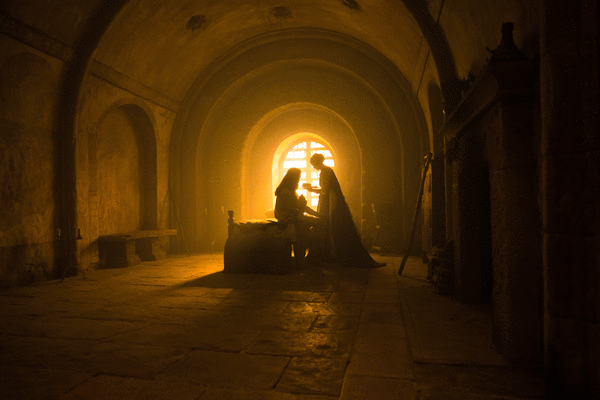
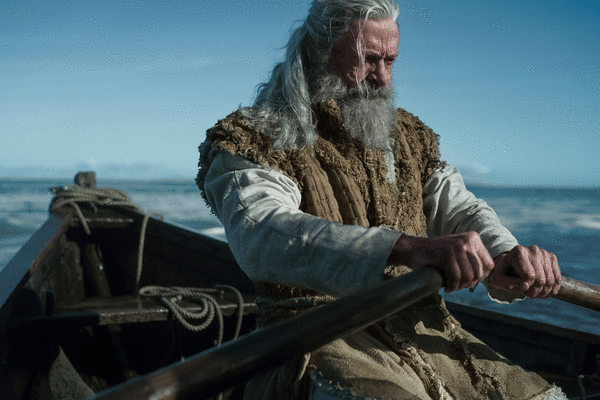


“Who lives, who dies, who tells your story?” This is one of the culminating lines from Lin-Manuel Miranda’s smash hit 2015 musical “Hamilton,” but it’s also the animating force behind Michael Sarnoski’s “The Death of Robin Hood,” starring Hugh Jackman in the title role. This legendary figure of English folklore has a specific meaning attached to his name, which is synonymous with the altruistic impulse to redistribute wealth. But in his take on the tale, focusing on the end of his life, Sarnoski suggests that perhaps Robin Hood wasn’t such a good guy, even if he was robbing from the rich to give to the poor. It all depends on who’s telling the story, right?
Sarnoski burst onto the scene in 2021 with his debut feature “Pig,” in which he outfitted Nicolas Cage with a long gray wig and sent him on a dangerous quest (to find his beloved, valuable pet). He does something similar in “The Death of Robin Hood,” outfitting Jackman in a long gray wig and sending him on a quest (to achieve some kind of salvation).
But first, Sarnoski has to establish that this Robin Hood isn’t the one we remember from the movies — he’s not the dashing cartoon Disney fox, or Errol Flynn, or Kevin Costner, or Cary Elwes, or Russell Crowe, or even Taron Egerton. No, this Robin Hood is much worse, sleeping in matted filth on the moors, reduced to a feral life of constant vigilance against murderous revenge-seekers for the years of evil deeds he’s carried out with his compatriot, Little John (Bill Skarsgård).
Now called Edward, Little John has achieved some measure of domesticity, but still, he and Robin go a-murdering once again, resulting in a yet another vengeful attack from a relative of their victims. A wounded Robin ends up in an idyllic priory on a coastal island, tended to by a healer, Brigid (Jodie Comer), learning the ropes from the local leper (Murray Bartlett). In this oasis, Robin’s identity is unknown, and he finds the space to embrace a gentler side of himself, particularly with Little John/Edward’s daughter, Little Margaret (Faith Delaney).
Set on the misty outlying islands of the North Atlantic, with its blend of bloody, brutal violence, primitive spirituality and meditative tone, “The Death of Robin Hood” is situated in the realm of films like David Lowery’s “The Green Knight” and Robert Eggers’ “The Northman.” Cinematographer Pat Scola pulls some arresting images out of the fire and fog, and the score of largely traditional Celtic music by Jim Ghedi is easily one of the best of the year. The film is a fine showcase for a different kind of performance from Jackman, and Comer is always a compelling screen presence.
But “The Death of Robin Hood” isn’t as hallucinatory or weird as it could — or should — be. Sarnoski gestures at bleakness but feints from full existential crisis; he tries and fails to be witchy. Despite all the mud and blood, nothing about this film is particularly earthy or embodied. It ends up as this profoundly dull and utterly pointless commentary on the concept of narrative and mythology. “What if Robin Hood was a bad guy?” OK, what of it? The best concept that Sarnoski presents here is the hell of living in an endless cycle of vengeance, but he allows his anti-hero to escape that all too cleanly and conveniently. This Robin Hood is just an old, tired man who ultimately finds some peace at the end of his life, even if it’s unearned.
As an audience, we’re left wondering what all of this is for, and who it’s for. Why trouble the Robin Hood myth at all, and why now? One can’t help but cynically wonder if the inspiration for this project was merely the convenience of recognizable intellectual property and available financing from Screen Ireland. This theory might be creatively pessimistic, but it is a nagging question, especially when the ones posed by the film are already so stale and tired. Expect no revelations from “The Death of Robin Hood” except the one that’s announced in the title.
———
'THE DEATH OF ROBIN HOOD'
2 stars (out of 4)
MPA rating: R (for strong bloody violence)
Running time: 2:03
How to watch: In theaters June 19
———
©2026 Tribune Content Agency, LLC








Comments