Movie review: 'Power Ballad' lacks staying power of Carney's prior films
Published in Entertainment News
John Carney has a shtick. It’s a good shtick, but it is a shtick, a formula he’s developed over the past two decades, since his breakout film, “Once.” He makes music-motivated movies about songwriters and musicians and the way they express themselves through song — a natural fit for the former member of the Irish rock band the Frames. The films are usually feel-good stories, not always particularly challenging, but warm, catchy easy listening, like a great pop song.
Often set in his native Ireland, he’s explored family and coming-of-age music fables, most recently with “Sing Street” and “Flora and Son.” But with his latest, “Power Ballad,” the bloom is off the rose. The formula is apparent, and it feels a bit like plug-and-play Carney, as he assembles a couple of immensely charming performers and his songwriting partner Gary Clark for what’s essentially a thought experiment about the sticky situation that can be creative collaboration.
“Power Ballad,” co-written with Peter McDonald, who also co-stars, is a film about what it means to find satisfaction in your life and work — what it means to have big dreams, and how those dreams might evolve, and the human desire to be recognized and acknowledged for our contributions. It’s also about how painful plagiarism is. But that it’s about all that first and foremost, and about the characters and their world second, is a flaw. The characters don’t feel grounded in a palpable reality, and so it’s more about the ideas than the people, leaving “Power Ballad” painfully thin and somewhat underbaked as a movie.
As a concept, it’s a lot like the recent “Mother Mary,” about two people wrestling over creative authorship, set in the pop music world. Here, we have our protagonist, Rick Power (Paul Rudd), an American in Dublin, who put down roots and got married when he knocked up a fan as a touring musician (possibly) on the verge of a breakthrough. He has a cozy life with his wife (Marcella Plunkett) and teenage daughter (Beth Fallon), living out a sliver of his rock star dreams as the frontman for a wedding band, the Bride & Groove.
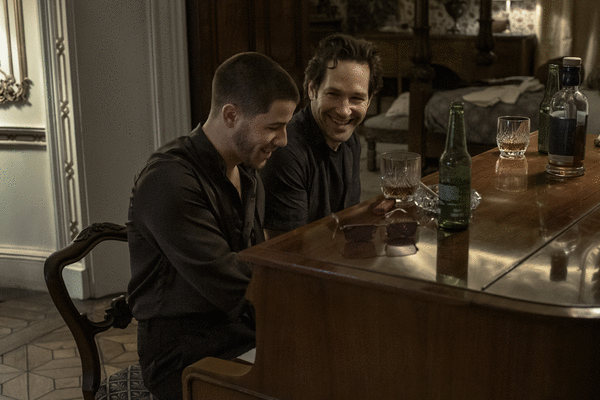
At a lavish wedding on a sprawling estate, he reluctantly allows a famous singer, Danny Wilson (Nick Jonas), a former boy band superstar, to hop onstage for a crowd-pleasing duet. The two find a groove together, and later spend the night smoking, drinking and jamming in Danny’s suite. But when Rick hears the chorus he was noodling on blaring over mall speakers months later, he tries desperately to claim ownership, though he has no proof it’s his. Feeling gaslit by a world in which Danny’s song, “How to Write a Song (Without You),” is a massive, inescapable global hit, he starts to spiral.
The premise makes for a good setup, but “Power Ballad” is weirdly conflict-avoidant. Yes, Rick’s crashout leads him to a kind of rock bottom, but Carney glosses over the really tough, sticky situations, and instead focuses on weird fantasy wish fulfillment. Rick and his burnout buddy Sandy (McDonald) take off for Los Angeles to confront Danny, and through a series of mind-boggling good luck and coincidences, actually manage to do so. There are dream sequences and then sequences that you wonder if they’re dreams or not, so unlikely they are to actually happen.
But even more odd is the lack of villainy in a movie that has the opportunity for some real villains. Carney regular Jack Reynor plays Danny’s smarmy manager Mac Darling, but Carney never lets him get really nasty. Danny himself could be a villain in his avoidance, but the film really wants Rick and Danny to see eye-to-eye as artists. Every potentially hard moment is either too goofy, or elided entirely, and while the ruthlessly efficient storytelling is somewhat elegant, it’s also quite abrupt.
Watching the delightful Rudd perform as a wedding singer is obviously fun, and the central song in question is, of course, quite good — Clark and Carney are quite the pop songwriting duo (just look at the bangers from “Sing Street”). Jonas plays a meta character that’s a riff on himself, but sadly he’s not given much to do beyond that, though he does have the range.
Unlike Carney’s other films, that feel more grounded and emotionally textured, this one feels untethered, disconnected from any sort of reality. Conceptually, and in execution, “Power Ballad” is so light, it feels like it might blow away with a puff of wind. The beat goes on, but this one just doesn’t have the staying power of Carney’s other hits.
———
'POWER BALLAD'
2.5 stars (out of 4)
MPA rating: R (for language throughout and some drug use)
Running time: 1:38
How to watch: In select theaters May 29, in wide release June 5
———
©2026 Tribune Content Agency, LLC











Comments