Rex Reed, contrarian film critic who perfected the skewering celebrity interview, dies at 87
Published in Entertainment News
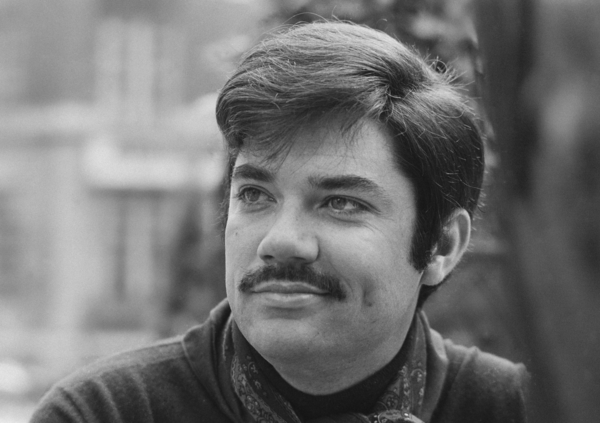
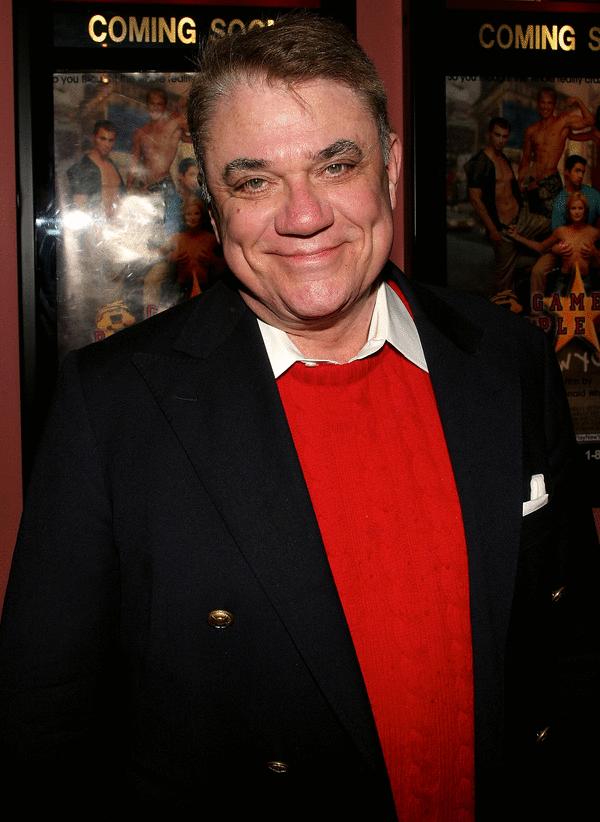
LOS ANGELES — Rex Reed, the longtime movie critic and celebrity interviewer known for his contrarian attitude and eloquent, vicious jabs of his pen, died Tuesday. He was 87.
The journalist died at his Manhattan home after a short illness, publicist Sean Katz told the Associated Press on behalf of Reed’s friend William Kapfer. Reed died in his sleep, according to his New York Observer editor, Merin Curotto.
Reed was nothing if not consistent in his swipes at acclaimed actors and directors alike — the newer the acclaim, the more likely the criticism.
“For me, it ended in the ‘40s,” Reed told former Times columnist Patrick Goldstein in 2003. “I have more fun watching Vincente Minnelli musicals and Michael Curtiz crime thrillers than anything I see today. If J. Lo is the new Rita Hayworth, then let me off uptown.”
Goldstein noted that the “pioneer of the skewering star profile has a b—y integrity that has remained constant through decades of shifting critical fashion.”
“I like just as many films as I dislike,” Reed told the New York Times in 2018. “But I think we’re drowning in mediocrity. I just try as hard as I can to raise the level of consciousness. It’s so hard to get people to see good films.”
Born in Fort Worth, Texas, on Oct. 2, 1938, Reed was an only child who grew up watching movies. Initially, he would present reviews to his mother’s bridge club. He studied journalism at Louisiana State University and was a columnist for the school paper, the Daily Reveille, and for Baton Rouge’s Morning Observer.
“I interviewed anybody who came to the South to make a movie — and there were many of them because movies were being shot on location in plantation houses in Mississippi and Louisiana,” he told the New York Observer in 2024. “I remember when Angela Lansbury and Paul Newman and Lee Remick and Joanne Woodward and Orson Welles came to Baton Rouge and made a film called ‘The Long, Hot Summer.’ I got to meet every single one of those people. Angela Lansbury and I became great friends.”
Reed headed for New York City immediately after college and worked a series of odd jobs. Though he couldn’t get a job as a New York Times copy boy, he landed one of his first professional pieces in the city’s paper of record after crashing the Venice Film Festival in fall 1965 and faking his way through interviews with Buster Keaton and “Breathless” actor Jean-Paul Belmondo.
He wrote up the Keaton interview and sent it blindly to the New York Times. (Reed’s interview wound up being Keaton’s last.) The Belmondo piece went to the now-defunct New York Herald Tribune.
“When I got back to New York, I had two stories in the same Sunday, and I was the talk of the town,” Reed told the Los Angeles Times in 2003.
Those were the kinds of interviews that wound up in his 1968 collection “Do You Sleep in the Nude?,” allegedly named for a question he said he once asked Ava Gardner.
Reed wrote for many publications in the ensuing years, including Vogue, Esquire, GQ and Women’s Wear Daily, before landing at the New York Observer when it was founded as a print weekly in 1987.
“I took the lowest form of journalism — the celebrity interview — and did something with it,” Reed told his Observer editor Curotto in 2024. “I think I elevated the genre in the Times, Esquire, New York Magazine ... . And for a little boy who had no money and didn’t know a living soul who was famous to come to New York and make a name in journalism, that was no small achievement.”
He wasn’t one to cut stars slack for their bad behavior. Early in his career, when Barbra Streisand showed up three-and-a-half hours late for an interview, Reed described the scene thusly: “She plotzes into a chair with her legs spread out, bites into a green banana and says, ‘OK, ya got 20 minutes, whaddya want to know?’” He chased Warren Beatty around for an interview before “Bonnie and Clyde” came out in 1967, eventually writing for Esquire, “Interviewing Warren is like asking a hemophiliac for a pint of blood.”
Years later, in a 2013 review of “Identity Thief” for the New York Observer — which he joined when it launched in 1987 — he called star Melissa McCarthy “cacophonous,” “tractor-sized,” a “humongous creep” and a “hippo.”
“McCarthy is a gimmick comedian who has devoted her short career to being obese and obnoxious with equal success,” Reed wrote. “Poor Jason Bateman. How did an actor so charming, talented, attractive and versatile get stuck in so much dreck?”
Reed often went against the popular grain, calling out critical hits for what he saw as their fatal flaws. And he wasn’t unaware that he was bucking the tide, writing in late 2017 about “The Shape of Water,” “Here I am again, out on a limb with a saw in my hand. I’ve been here before, but never have I disagreed with quite so many colleagues (including a few I actually respect) about the same movie. But as the year draws to a close, I remain aghast at the way critics have not only embraced but slobbered over ‘The Shape of Water.’”
The film would, a few months later, win four Oscars, including those for directing and best picture.
Reed’s take on it? “[T]he more I try to find some kind of justifiable meaning and relevance, the more I find ‘The Shape of Water’ a loopy, lunkheaded load of drivel,” he wrote. “Not as stupid and pointless as that other critically overrated piece of junk ‘Get Out,’ but determined to go down trying.”
After Marlee Matlin won the 1987 Oscar for actress in a lead role for her work in “Children of a Lesser God,” Reed declared that she had won only because of a “pity vote.” He said nominating her was a waste because there weren’t many roles for a “deaf mute” to perform.
Matlin said years later that she couldn’t forget Reed’s words. “That stupid, f—ing ...,” Matlin told The Times’ columnist Glenn Whipp many years later, in 2021. “Clearly authenticity wasn’t in his vocabulary.”
Reed was an occasional actor himself, making a cameo in the 1978 version of “Superman” and performing small parts in a few films in the 1970s and ‘80s. He also hosted “At the Movies” for a while, taking a seat across from fellow critic Bill Harris, and served as a panelist on “The Gong Show.”
He was openly gay but declared himself free of relationships, “except friends.”
“Love is not something that I’ve been really good at,” he told the New York Times in 2018. “I think people are intimidated by people with opinions.”
Reed lived from 1969 until his death at the Dakota in Manhattan in a two-bedroom, two-bath apartment he bought for $30,000.
Reed’s final story for the Observer was an appreciation last December for Arthur L. Carter, who founded the outlet.
“Carter cared more about writers than their editorial opinions,” the critic wrote. “He was devoted to quality. He never rejected a single idea of mine and never failed to share enthusiasm for an article or review that particularly appealed to him. An expression of approval, no matter how small, is meaningful to a writer and is often overlooked. Carter was careful to make his approval every bit as valuable as his occasional criticism. As the only journalist known to have appeared in The New York Observer from its inception, I am proud to say that I have no memory of any negative reaction to any single review or feature I ever wrote. That, for any journalist with the remotest controversial reputation, is something uniquely unheard of.”
It was a self-centered burst of kindness that ran counter to much of what Reed was known for.
“I’d like to be remembered as someone who really tried to make things better,” the writer told his Observer editor earlier this year, according to the AP. “Or at least respected what was good when it happened. Not as a curmudgeon. That’s not what I am in real life.”
©2026 Los Angeles Times. Visit at latimes.com. Distributed by Tribune Content Agency, LLC.







Comments