This Orange County musician created No. 1 hits for both BTS and Bad Bunny
Published in Entertainment News
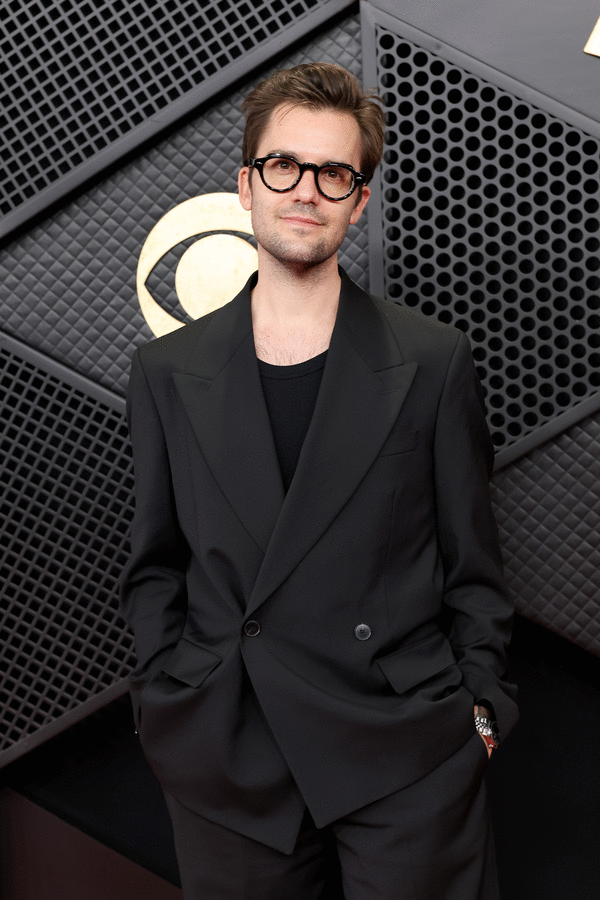
ANAHEIM, Calif. — Two weeks after Bad Bunny performed his 2025 single “DtMF” during the Super Bowl LX halftime show in February, the song shot to the top of the charts, becoming the Puerto Rican star’s first No. 1 hit on the Billboard 100 as a solo artist.
One month later, K-pop superstars BTS released “Swim,” the lead single off the comeback album “Arirang.” It also hit No. 1 on the same Billboard chart.
A Spanish-language reggaeton song? A K-pop tune sung in English? There’s not much in common there beyond the fact that Bad Bunny and BTS are two of the biggest acts in the world today.
But deep in the credits, an unexpected coincidence comes into focus. Someone named Tyler Spry is listed as a songwriter and producer on both of these No. 1 hits.
Which begs the question: Who the heck is Tyler Spry?
“I mean, I definitely fell into pop music,” says Spry, 33, who grew up in Orange County playing in countless punk and alternative rock bands. “I never listened to Top 40 radio growing up.
“But I think that is why I’ve been able to find a pocket where I can really thrive, because like I said, I’m bringing something different to the table that I think has served me well with collaborating with some of the artists that I work with.”
As a producer, songwriter, instrumentalist and recording engineer, Spry has worked on songs by artists as varied as Tate McCrae, OneRepublic, Katseye and Karol G.
As for his roots in alternative and indie rock, that’s in there, too, if you listen close enough.
“I think you can take a little bit of that indie and alternative and put it in anything,” Spry says on a recent Zoom from his home studio in Silver Lake, where he lives with his wife Alisa Xayalith, singer-keyboardist of the New Zealand band The Naked and Famous.
“It might be a synth that in my mind sounds like something off of ‘In Rainbows’ by Radiohead that I’m putting on a Tate McCrae record,” he says. “Or it might be trying to get the drums to be as crunchy as something I would have heard on an Arcade Fire album, but then putting it under a BTS song.
“I’m constantly bringing my musical heritage into the studio,” he adds.
A heritage that began on a guitar with only three strings.
Do it yourself
“I got my start in bands in the DIY scene in Orange County,” Spry says. “When I was in high school and when I was in college, playing in different bands, putting together shows and concerts, it was all a very DIY sort of mindset.
“We’d put together our own lighting rigs. I learned how to record because we would record our rehearsals and produce our demos. Didn’t have the resources to bring in outside help.”
His first guitar was borrowed from a neighbor, and there, too, a bit of improvisation was required.
“It only had three strings,” Spry says. “I remember learning as many chords as I could with those three strings, and then begging my mom to drop me off at Guitar Center on the weekends so I could practice on six.
“I carried that into the rest of my career, if I had to do something and I didn’t know how to do it. Like when I started as an engineer, I would just say yes and figure it out along the way. I brought that DIY mindset with me.”
As a Mission Viejo teenager at Tesoro and Capistrano high schools in South Orange County and as a college student at Vanguard University in Costa Mesa, Spry played in “so many bands that you’ve never heard of,” he says.
“I would tell my parents that I was going to go hang out with my friends, but really I’d be cramming as much gear as I could into a Ford Econoline van and driving down to San Diego to play the Ché Cafe or going to a festival across state lines. Kind of a punk mindset.”
Then, around 2015, Spry landed a semi-regular gig backing a pre-superstardom Sabrina Carpenter for a series of music video covers that Carpenter released in the mid-2010s.
“That was how I got introduced to pop,” he says of the YouTube videos on which he accompanies Carpenter on acoustic guitar — with all six strings.
“I realized, ‘Oh, I don’t have to tour to make music for a living. I can be in a studio in my house every day and live the kind of lifestyle I want to live while making music that reaches the world.”
In the room
About 10 years ago, Spry got hired as a recording engineer for OneRepublic, whose Ryan Tedder and Brent Kutzle became his mentors and teachers in the recording studio.
“Working with OneRepublic was a sharpening experience,” Spry says. “Doing everything from tuning and pocketing vocals performances to editing drums, programming, playing guitar on records, doing sound design.
“It was all stuff I was figuring out along the way, and it really helped carve a path for stepping into production later on,” he says.
Tedder and Kutzle were impressed and kept Spry on board as they produced records for other artists. Very big artists, as it happened.
“The second project we ever worked on was an album with U2,” Spry says. “I was thinking, ‘I’m in way over my head, and I love it.’ I was fortunate to work with them out of Electric Lady in New York a little bit. The Hit Factory in Florida.”
The 2017 album was U2’s “Songs of Experience.” The experience shaped the future of Spry’s career.
“It’s definitely one of those pinch-me moments where you think, ‘I don’t know what I’m doing, but I must be doing something right,’” he says. “I was new, but like I said, the mindset was just say yes and figure out how to do it later.
“I think that got me in the room,” Spry says of the impact of the U2 work on the work that followed.
It also helped him back at home at his family home in Mission Viejo.
“When the album dropped, that was the first time that my mom finally said, ‘Hey, it’s OK that you dropped out of college,’” he says, and smiles.
Modern songcraft
Looking at the credits of BTS’s “Swim,” it’s not at all unreasonable to wonder how a song that runs 2 minutes and 39 seconds could have nine songwriters listed.
Spry volunteered to break down how and why a modern pop song is touched by so many songwriters and producers before it is finished.
“The day we wrote ‘Swim,’ we had been working out of the studio for a few days at that point,” he says. “I was in the room with some of my co-writers, James Essien and Sean Foreman, and my co-producer on the song, Leclair.
“It’s just a couple of people starting the song,” Spry continues. “When you’re trying to find an outlier song, something really unexpected, like what we had been charged to do with ‘Swim,’ you have to create a space where you’re free to experiment and try anything.
“We had written one other song earlier in the day. It was decent, nothing incredible. So we decided to try for a second one and ‘Swim’ sort of fell out of the air within 30 minutes.”
The response that day at the studio was overwhelmingly positive, Spry says. Friends of the band, A&R guys, others somehow associated with the sessions, all “were coming out of the room saying, ‘Damn, that’s really cool.’
“Usually, the best songs appear pretty effortlessly like that,” he adds. “Like they already existed. But the finishing takes time, and that’s where some of the other collaborators end up coming in.
“I remember we played it for Ryan [Tedder] and he lit up by the time it got to the second verse, which was open at that point. He just freestyled the whole second verse flow.
“And with a group like BTS, because they have such a specific vision of what they want for the record, they’re tapping different people to make changes to the lyrics and the flows in places.”
Creating space
The producer credits on BTS’s new album “Arirang” range from one — Spry has the only solo production credit on the record for the song “Please” — up to four or five.
“As a producer, my main job is to create a space where the artist can express themselves and make the best song possible,” he says. “That looks different every time. Most of the time, we’re working out of my studio.
“Setting up the lights, making sure there’s a comfortable couch, having the equipment set up, so that when inspiration strikes, everything’s at arm’s length. I’m like a bandmate doing whatever needs to be done to get the record.
“Playing guitar, drums, or suggesting we take a break to go walk around the neighborhood,” Spry says. “Sometimes mixing cocktails or making lattes. It’s always different.”
Each artist has their own style of working with producers, he adds. “Some of them come in really loud, telling you exactly what they want to do. Some need space to think and feel.
“What I noticed with these guys [BTS] is how much they thrived when the room felt open,” Spry said. “Once we set that tone that any idea was welcome, that you could try something weird, they really opened up.
“A song like ‘Swim’ was created much in the same way. We weren’t trying to do anything specific. We were just painting. And you find a drum groove that feels fresh, you find some chords that maybe inspire a melody, and it just goes from there.”
No barriers
In addition to the two songs on BTS’s new album, Spry also co-wrote a pair of songs for Bad Bunny’s “Debí Tirar Más Fotos,” which earlier this year became the first-ever Spanish-language album to win the Grammy for album of the year.
Because of how the Grammys allocate credits, Spry didn’t take home a trophy for that. He did win a Latin Grammy for best urban song for “DtMF, and was nominated for three Grammys, including record and song of the year for “DtMF” as well as best dance pop recording for Tate McRae’s “Just Keep Watching” from the movie “F1.”
But Bad Bunny is just one of a handful of Spanish-language artists for whom he has written and produced, with big names such as recent Coachella headliner Karol G., Rauw Alejandro, Omar Apollo and Latin Mafia also among his collaborators.
In 2026, pop music is no longer limited by language or borders or even musical styles, Spry says.
“I think there’s no language barrier in music now,” he says. “Some of the biggest fans of the BTS project or the Bad Bunny project that I’ve met don’t even speak the language. I think people resonate with artists that are holistically themselves and artists that are making music that’s real and raw and authentic.
“And if it’s not in your primary language, it doesn’t matter.”
As for why BTS or Omar Apollo or any other international star might want to work with a punk rock kid from Orange County, there’s a reason, he adds.
“Every artist you work with, at the end of the day, really just wants you to be yourself,” Spry says. “They’re bringing their influences, their discography, their genre to the table, and they pull different writers and producers in to bring different sets of influences into the room.
“It’s what makes you different, that’s your creative superpower,” he says. “So I grew up listening to everything from David Bowie and the Smiths to Daft Punk and Massive Attack. Alternative, new wave, dance, punk.
“I bring my musical heritage into the studio regardless of genre, the same way that an artist will bring in theirs, and it leads to a song that sounds unlike what anybody else would make.”
©2026 MediaNews Group, Inc. Visit ocregister.com. Distributed by Tribune Content Agency, LLC.









Comments