John F. Kennedy Jr. was reportedly planning a daytime talk show: 'The next Oprah'
Published in Entertainment News
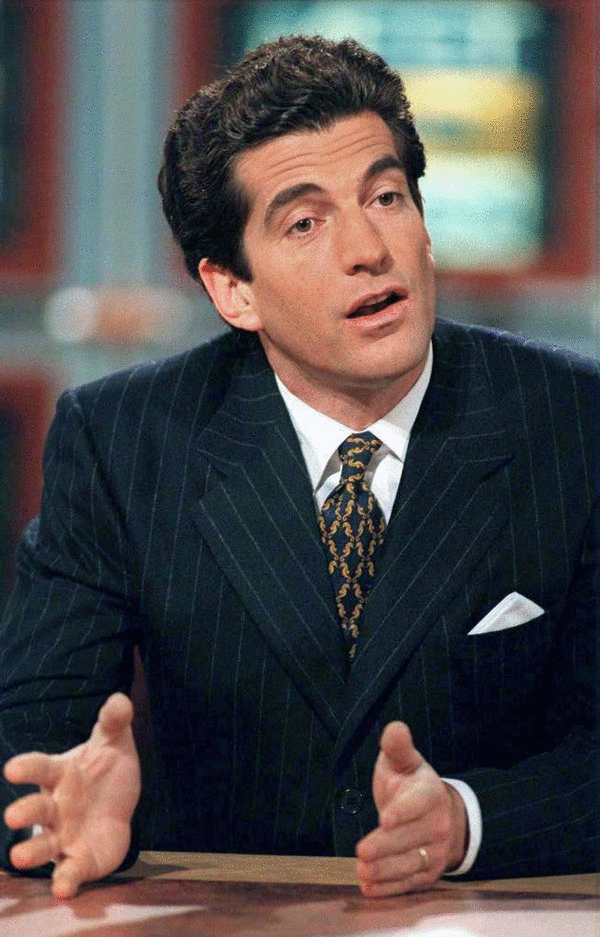
While it’s long been assumed that John F. Kennedy Jr. harbored ambitions to follow in his father’s footsteps and run for political office, a new report, quoting a former TV executive, reveals that he actually wanted to be “the next Phil Donahue, the next Oprah.”
Indeed, according to a report from gossip columnist Rob Shuter, Kennedy was in serious talks to headline a new daytime talk show and discussed these plans with Steve Rosenberg, the former president of Universal Domestic Television, on July 16, 1999 — the day that he, his wife Carolyn Bessette Kennedy and her sister, Lauren Bessette, died in a plane crash off the coast of Martha’s Vineyard.
Shuter said that Rosenberg went on the record to confirm Kennedy’s TV plans, writing on his Naughty But Nice Substack that the talk-show project wasn’t “speculation — it was already in motion.”
“In truth, we lost more than a TV show when John passed,” Rosenberg told Shuter. “A real tragedy — he was taken far too soon.”
Shuter wrote that the show would be designed “to capture Kennedy’s rare mix of charm, intelligence, and cultural magnetism.” In addition to being backed by Universal Television, its producers were the people behind hit daytime shows starring Maury Povich and Sally Jesse Raphael.
“There was a strong belief he could own daytime,” an insider told Shuter about Kennedy’s plans. “He had presence, charm and an ease you simply can’t teach.”
Following up on his report during an appearance on Maureen Callahan’s “The Nerve” YouTube show, Shuter said there “was a real plan” in place to at least shoot a pilot.
“I know the money was there and the affiliates were into it,” Shuter added. More important, Kennedy “was really into it. He liked the idea of being the next Phil Donahue, the next Oprah.”
Following Kennedy’s death, it was learned that he was in desperate need for a new career. After his stint as a prosecutor with the Manhattan District Attorney’s Office did not work out, he tried to be the editor-in-chief of the much-ballyhooed political magazine, “George,” which was launched in 1995. But that magazine was “circling the drain” at the time of his death, Callahan noted. In her book about the Kennedy family, “Ask Not: The Kennedys and the Women They Destroyed,” Callahan wrote that George, in just two years, went “from being one of the most successful launches in industry history to a spectacular failure, teetering on the brink of insolvency.”
But in talking to Shuter, Callahan also questioned whether Kennedy could have succeeded as a day-time talk show host, despite all his charm and charisma.
“I think there are qualities (he would need) in order to really connect with an audience, especially if he was talking to them one on one,” Callahan said. She was referring to the way that successful ’80s and ’90s talk-show personalities — Donahue, Winfrey, Povich and Raphael — were known for getting off the stage during tapings to interact with people in the audience and to encourage them to ask questions of guests, especially those presenting topical subjects.
“I don’t know if JFK Jr could have done it,” Callahan said. “I think he was way too guarded as a person. And I think he didn’t even really know who he himself was, or what he really wanted. I don’t think you can have a show revolve around a personality that feels so unformed.”
To that, Shuter acknowledged Kennedy’s challenges, explaining that talk-show hosts need to come across as authentic, even if they are later revealed to be not nice people like Ellen DeGeneres.
“If there is anything phony about you or if you have any secrets, it’s not going to work,” he said. “(Kennedy) had a lot of secrets and there was a phoniness about him. I can see why TV was obsessed with him. He was hot. TV likes good looking people. He was definitely that.”
One of Kennedy’s big secrets at the time of his death had to do with the dire state of his marriage. He and Carolyn had recently separated, according to Callahan’s book. Among many things, she was struggling with being in the constant spotlight as the glamorous wife of not just any Kennedy, but the son of late President John F. Kennedy and Jacqueline Kennedy Onassis.
Callahan reported that Carolyn Kennedy wanted a divorce because she suspected her husband had been unfaithful. Kennedy, meanwhile, didn’t want a divorce but was still telling friends that his wife was a drug addict and “crazy.”
Given Kennedy’s troubled marriage and his wife “melting down” from all the media attention, Callahan questioned why he would even consider launching a career in TV, which would inevitably bring even more media attention upon him and his wife. Shuter said this choice did show the extent to which the marriage was in trouble — because Kennedy didn’t appear to be concerned about the impact on his wife. “These two were a bad fit,” he said.
©#YR@ MediaNews Group, Inc. Visit at mercurynews.com. Distributed by Tribune Content Agency, LLC.






Comments