Architecture and Design Film Festival in Chicago opens with climate change as the subtext
Published in Entertainment News


CHICAGO — Though none of the films at the Architecture and Design Film Festival, taking place at the Chicago Cultural Center and the Siskel Film Center Feb. 19-22 are explicitly about climate change, that is the subtext running through many of them.
“When we were programming the films, climate change was not a specific theme that we were trying to explore,” says fest curator Kyler Berman. “However, I think that the issues surrounding environmental responsibility and climate change are so closely tied to design and architecture that it makes sense these themes appear in many of the films we screen.”
Hosted by the Chicago Architecture Center (the nonprofit that runs boat and walking tours of the city), the traveling fest comes to Chicago after earlier stops in New York, Los Angeles, Vancouver, Toronto and Mumbai.
The climate and architecture have always been enmeshed because we’re talking about shelter from the elements and questions like: What is livable? What will survive the conditions? What materials work best with that in mind, or are even available?
“These themes are always there,” says Adam Rubin, director of public engagement for the Chicago Architecture Center. “Now more than ever, we’re thinking about climate change because there’s no way to look away from it. It’s a subject that’s on everyone’s mind.”
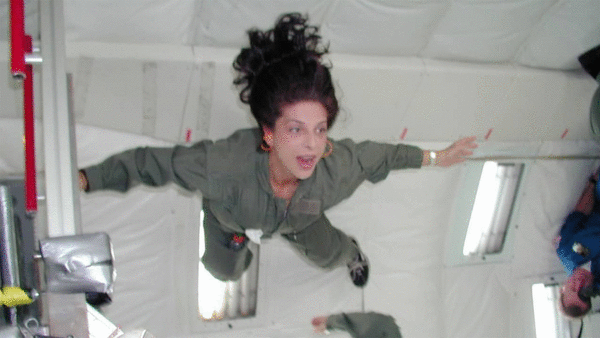
He mentions “The Space Architect” (Feb. 22), in which filmmaker Rebecca Carpenter interviews Constance Adams, the NASA architect of the title, in the last days of her life. Adams had an adventurous personality that ultimately led her to working at NASA, where she designed “vehicles and habitats for people to explore the stars.” At the age of 53, she was in the final stages of the cancer that would take her life, and the documentary is an opportunity for her to talk about her work one last time. (She would die four days after Carpenter filmed her.)
In the film, Adams reads from one of her old journals: “Working with psychologists, psychiatrists, flight surgeons, astronauts and engineers of all different stripes, I find myself thinking more fundamentally than I ever have about what it really means to be a human being, and what humans need from their environment.” The International Space Station was a testing ground for some of the ideas she worked on.
“This is largely a film where she talks about designing things for NASA astronauts,” says Rubin, “but her realization in her last days is that she’s designing for planet Earth and this is all ultimately much more about what’s happening here at home.”
Or as she says in the film, her work was really about how to adapt to “severe climate change,” in her words, and why that should be our priority: “This is the only planet that works for us. Never assume that we could get Mars up to speed in time for people to move there. It’s not even close.”
Filmmaker Carpenter will be at the screening. “Many of these films will have the filmmaker there to interview afterwards and talk about what we just saw,” Rubin says. “So even though it’s not a Chicago-centric film lineup, it ends up becoming a Chicago conversation. We’re one of the largest architectural centers in the world and it makes sense for the fest to come here, and this is an opportunity for us to talk about design on both a global scale and also tell human stories that make architecture accessible and relatable to everybody.
“Film is a really great way to do that, he says. “When we started to crunch the numbers of who is coming to the festival, about three out of four attendees are not members of the Chicago Architecture Center, and that was interesting to me. The film festival is really effective in reaching new audiences who are not necessarily architecture aficionados.”
Other documentaries on the lineup include “Changing Lanes” (Feb. 21), which focuses on bike safety challenges on streets that have been designed to favor cars, as well as grassroots efforts to redesign a specific area of Brooklyn after numerous people are injured and killed.
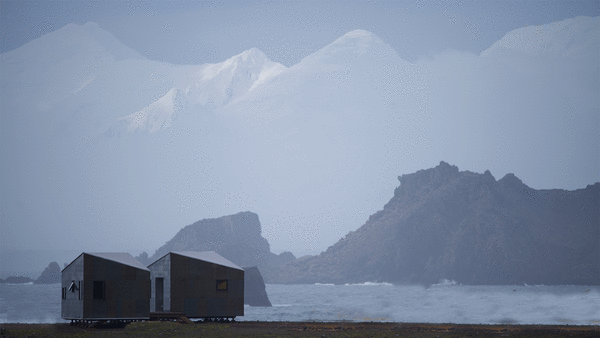
“Building on the Edge” (Feb. 21) is from director Bruce Borowsky and is about the design and construction of living and work quarters for scientists at the National Oceanic and Atmospheric Administration’s research station in Antarctica. It’s somewhat dry as a movie, but the information is compelling. Conditions are intense. The logistics are tricky. The previous accommodations were falling apart and filled with mold and they needed something new: An off-grid series of structures that collect their own water and generate their own power. So the scientists worked with architecture students at the University of Colorado at Denver.
Once again, climate change is front of mind.
This is “an area of the Antarctic where climate change is really rapid,” says one researcher. “It’s warming at one of the fastest rates on Earth, and what we’re trying to do is understand the health of the Antarctic ecosystem within that rapidly changing environment.” As the structures go up, penguins and seals wander by to observe the team’s progress.
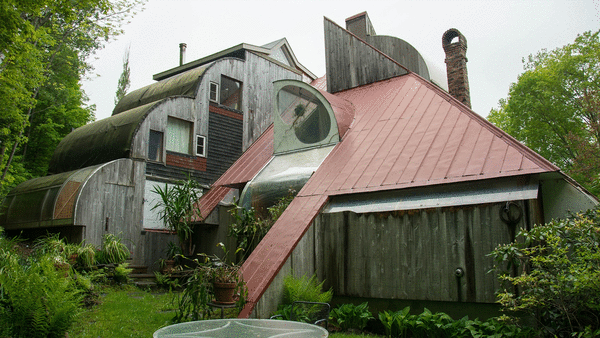
“Prickly Mountain and My Design-Build Life” (Feb. 19) comes from filmmaker Allie Rood, who grew up in Warren, Vermont, in a community of architects, mostly from Yale, who developed a style of working in the 1960s called design-build. It’s exactly how it sounds: The architects are not only the designers of the domicile, but the construction crew as well. Blueprints were rarely part of the process, which tended to be more improvisational. One of the philosophies: “Every screw-up is a possibility.”
The resulting houses built on Prickly Mountain are unusual and not especially concerned with symmetry, but the lines are clean nevertheless. The interiors are eclectic and sometimes less-than-practical — or even comfortable. Weird would not be an inaccurate description. But they are also warm and unique.
The film allows the viewer to be nosy and get a sense of what other people consider desirable living conditions.
“We’re all obsessed with that, whether we think so or not,” Rubin says. “We all want to see how other people are living.”
———
Architecture and Design Film Festival runs Feb. 19-22 at the Chicago Cultural Center (78 E. Washington St.) and the Siskel Film Center (164 N. State St.); tickets and more information at architecture.org.
———
©2026 Chicago Tribune. Visit chicagotribune.com. Distributed by Tribune Content Agency, LLC.









Comments