Q&A: 'What is yours won't miss you': Eve receives Grammy for 'You Got Me' 26 years later
Published in Entertainment News
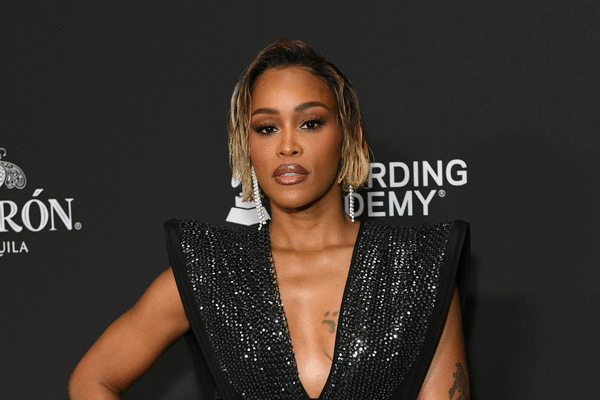
LOS ANGELES — During the summer of 1998, a 19-year-old rapper named Eve (formerly known as Eve of Destruction) received a phone call from her producer friend Scott Storch about an opportunity to hop on a record with the Roots.
The hip-hop band from Philadelphia, formed by Black Thought and Questlove, was bubbling at the time and Eve, a known battle rapper in the city, was excited to work together on a song called "You Got Me."
After tweaking the verse that Black Thought, the band's lead MC and co-founder, wrote for her, Eve laid down her vocals, rhyming the lyrics "Another lonely night? / It seems like I'm on the side, you only lovin' your mic."
"It was really exciting," Eve said, while lounging on a couch in a Hollywood residence. The rapper, actor and fashion designer has been based in London for the last decade. "I think that was my most professional setting because they obviously were already signed."
When the song, which is featured on the Roots' career-defining "Things Fall Apart" album, was released in 1999, it was the first time the world heard Eve's voice — but no one knew it was her. To her surprise, she wasn't listed as a contributing artist on the track.
She was also surprised to find out that Jill Scott, a poet and rising neo-soul singer from Philadelphia who wrote and sang the initial hook, was replaced by Grammy-winning singer Erykah Badu. After receiving the wrong address for the shoot, Eve wasn't featured in the music video either.
In 2000, the Roots and Badu won a Grammy for "You Got Me," but because Eve wasn't listed on the track, she didn't receive an award. By this time, Eve was signed to Ruff Ryders and promoting her debut album "Let There Be Eve...Ruff Ryders' First Lady" including her breakout single "Want Ya Want," so although it hurt her feelings at the time, she moved past it, she said.
"There was no time to kind of go back and think about it," said Eve, who opened up about the situation in her 2024 memoir "Who's That Girl." After years of seeing each other and even performing the song together, she and Questlove spoke about the matter for the first time when she made an appearance on his podcast and apologized to Eve for the oversight. "We were extremely inconsiderate, insular and uncommunicative with each other that things like that always spilled on the sidelines," the drummer said on the podcast. (Questlove wasn't available for comment further at the time of publication.)
Last fall, Eve received another unexpected phone call — this time from the Recording Academy. After hearing Eve talk about the "You Got Me" situation on Ebro Darden's podcast, the Recording Academy wanted to give her an award for her contributions to the track.
"They were like, 'Listen, we didn't even know about this situation at all until we heard the podcast,'" Eve recalled.
After 26 years, Eve was given a golden gramophone Thursday night during the Recording Academy Honors presented by the Black Music Collective in front of a star-studded audience. For her, the award feels like "validation in a way to that little girl, to little Eve," she said. "She deserves that."
She added, "Whatever is yours can't miss you."
Ahead of the ceremony, Eve spoke to The Times about coming up in the Philadelphia music scene as a teenager, what the "You Got Me" situation has taught her and what receiving this award means to her now. She also talked about the impact of her second studio album, "Scorpion," which turns 25 this year, and what it was like to bring her toddler son on tour with her for the first time.
[This interview has been lightly edited for length and clarity.]
Q: You grew up in West Philly at a time when so many future greats were coming up at once — t he Roots, Jill Scott, Bilal and Scott Storch. When you were just a teenager, you were hanging out at studios with some of them and attending jam sessions at Questlove's house. What did the energy in Philly feel like back then?
A: It was amazing because music was everywhere. I knew that I wanted it to be my life, so every weekend I was doing something. I should've been going to school, but I was going to the studio because I knew that I wanted music to be my life. And in Philly, there was always something going on whether it was a block party or a jam session or an open mic night. I was at everything.
Q: Scott Storch was the person who called you about getting on the Roots' "You Got Me" record. What was your reaction when you got that call?
A: When you are young, there's that no fear thing. I remember being excited, of course, but also like, "Yes! I'm supposed to be here," not from a cocky place but more affirmative. It was really exciting, but it was also very professional. I think that was my most professional setting because they obviously were already signed. I'd never been around that before, so I remember [being] like "This feels like the business."
Q: You were around 19 or 20 at that time, right?
A: I must have been around 19 because I would've gotten signed and dropped [from Aftermath] when I was 18. [laughs]
Q: At that time you were in between record deals, so it must have felt like a big opportunity.
A: Absolutely. You know what's funny, I probably just took it for granted in the sense of like "Oh yeah, this is the start." They are signed. It's funny because I think back on the situation and I guess I thought it was gonna pop off from there. That's why all the events that happened afterward were like "Ugh."
Q: Take me back to the day that you laid down your verse. Who was in the studio with you?
A: I'm pretty sure Black Thought and Jill [Scott] were there. Even if not the whole session, I don't know if I'd come in if she'd finished or whatever, but I'm pretty sure she was there.
Q: How did your verse come together?
A: I had this whole thing in my head, but Black Thought had a whole verse already. But then I was like, "I'm not gonna just say your verse." Now, I have a writer sometimes, but back then, especially because I was a battle rapper, it was like I can't say somebody else's bars. That's not real. So he had this whole thing and then I kind of tweaked it to make it feel and sound like me.
I had a lot of audacity back then. I really did. [laughs] Because most people would be like "Yeah, cool." Also, I was like if I'm going to put my voice on this, I really want to feel like me. I have thought about this [situation] so much now, and I'm sure that also attributed to them being like, "We don't need to reach out. We don't need to make sure it's OK" because the majority of it was written by him. Not that that's an excuse because there is no excuse.
Q: When was the first time that you realized you didn't receive credit for the song? If I'm not mistaken, I think Jill Scott found out that her vocals were replaced by Erykah Badu after she heard it on the radio.
A: I think it was kind of the same thing. It all happened so fast like, "Oh, the song is out." I probably heard it around the same time and thought "Oh, that's not Jill. Oh, that's Erykah Badu." It was such a weird timeline because I did the song a year or a few months before, and then by the time I heard the song, I was living in Harlem and I was signed to Ruff Ryders.
Q: The song went on to win a Grammy for rap performance by a duo or group in 2000, but because you weren't credited, you didn't receive an award. In your book, you talk about how this situation lined up with you being dropped from Aftermath Entertainment and moving back home from L.A. How did you deal with all of this emotionally?
A: I feel like I had a month that I was just [felt] — I don't know if I'd call it depressed — deflated. I really felt like damn, this was it and now I'm back home. I was just in L.A. in a condo with a nice bank account. Now I'm back at my mom's house in my pajamas and I gotta catch the bus. What the hell is happening to my life? [laughs] That was horrible so I was wrestling with my feelings and my sadness, but my mom was great. My mom has always been my rock. She was supportive and she [didn't] tell me to get over it. She kind of just let me wallow in it, but [she was] positive as well like, "Maybe that wasn't the time." It was crazy, but I will say, I needed it. I'm happy that happened because I wouldn't have the career I have now. Like going back to the Aftermath thing, if I had come out then, I wouldn't have the career that I have now. I feel like I did need to be humbled because it was definitely the Philly attitude that got me fired, that got me dropped. [laughs] My name at the time was Eve of Destruction, my battle rap name, so it was the time that I sat with my feelings and I was like if I get this chance again who is it that I want to be as an artist? Who do I want to show the world? I didn't want to take on a title. I was like I'm just going to show them myself. I'm going to show them Eve.
Q: Some fans knew that you didn't receive credit on this track, but others found out for the first time when you talked about it last year during an appearance on Ebro Darden's podcast.
A: It's crazy how many people are mad about it for me. I had friends who were like, "Girl, so what's going to happen?" [laughs] But it is a funny thing. Why wasn't I mad enough? Or was it — this is the over-analyzer [in me] — one of those moments where I just wanted to forget about it. Because, yeah, my feelings were definitely hurt if it was a fake address. Or did we get the address wrong? So maybe I was like, "I'll just put it on the back burner," but Ebro definitely did not. And you know what, I'm happy he didn't because sometimes it takes for a person to be your champion or your cheerleader in certain things and I do appreciate it.
Q: "You Got Me" is one of the Roots' biggest songs to this day. Was it weird hearing it played everywhere when it first came out?
A: During that time I did not see them. It was very weird. That song had come out, I was doing my thing, but we ran in different circles hip-hop-wise. I guess we just never crossed paths. I never really saw them. I think they were on tour by then and I was with Ruff Ryders. We didn't see each other until years later because we have performed that song now three times probably at separate points in my career, which is also weird. [laughs]
Q: That is weird.
A: It's weird. I don't know what's wrong.
Q: Now, 26 years after "You Got Me" won a Grammy, you are finally receiving your award and honored at the Black Music Collective Recording Academy Honors. What was your reaction when you found out?
A: It was weird at first because the [academy] called a lot of different people. They called like four different people because they wouldn't tell anybody why they wanted to talk to me. Finally, I think Swizz [Beatz] was probably the last person they called. Then we got on the phone and I remember I was having martinis in London. It was a FaceTime [call] and I was standing under a lamp. It was not professional on my side and I was trying real hard not to be tipsy. I was like, "This is so cool. Thank you, guys." [laughs] My friend, who I was with, was like "What did you have to take a call for?" and I was like "Girllll." So it was a fun night. I came home and told my husband, fell asleep and when I woke up, I completely forgot about it. Then my friend texted me and was like "Do you remember?" and I was like "Oh s—! Yeah!" It's just such a cool thing and since then it's been like "Wow." They said, "We could send you the Grammy, but we'd like to give it to you." It's really nice. It's a really interesting feeling because obviously it's been so long, something that I thought I was done with, in a way, so it feels good.
Q: What did they tell you exactly?
A: They were like "Listen, we didn't even know about this situation at all until we heard the podcast." It was the podcast that I did with Ebro when they were like "Oh nah." Even Swizz was like "Sis, we gotta make this happen. That's not cool." And I was like "OK, cool."
Q: Does receiving this award now feel like reconciliation at all? Or maybe validation?
A: In a way, validation to that little girl, to little me. It sounds a bit cheesy, but she deserves that. It's a great moment. I'm still wrapping my head around it in a way especially since I've been away from music for so long and for this to be happening like this is very cool.
Q: What have you learned or taken away from this situation?
A: I think I'm honestly still processing because I was joking, but kind of not, like I want to talk to my therapist about why I let this go. What was it? Why did I think, "Oh nah, it's cool. We squashed it." But it's like no, this is bigger than that. But good s— comes to good people and I know for sure I definitely deserve it. [laughs]
Q: In other exciting news, this March marks the 25th anniversary of your second album, "Scorpion." What memories rush back to you when you think about that time of your life, living and working in Miami?
A: Oh my God. There's so many. It was so fun. I remember the house we rented. I had one Yorkie, then I bought her a friend in Florida. It was silly s— that I remember and then just being in the studio day and night. Then the Marleys were on the other side. It was just a good time. I was fully in it. It was a lot of pressure because it was like "We gotta get this album done now." It's when I really think I felt the business of music in the sense of like, "We gotta meet these deadlines. We gotta get this album out," which was stressful but I was still naive enough, I think, to still be having fun. I was going out. I met Trina. Trina is my girl. Overall, it was a really good time.
Q: Between experimenting with new sounds, crossing genres with artists like Gwen Stefani, and making the theme red, "Scorpion" felt very intentional. Reflecting back, what did that era represent for you personally beyond the music?
A: I feel very lucky that Ruff Ryders always allowed me to artistically do what I wanted to do. They never said things like "Oh this might not work." And even sonically, they weren't the ones who were fighting back, it was more like executives and Interscope, but for me "Scorpion" means red. Red is a scorpion color. We gotta come out stinging, but I also want to show that I've grown, that I've matured and really show what my ear is. I felt really lucky that they didn't fight me on it. They let me do exactly what I needed to do. It felt collaborative because that's how Ruff Ryders worked anyway. There were people in and out of the studio all the time, but it made it good because sometimes a conversation led to a hook or a verse.
Q: Last year you went on tour with Nelly, Ja Rule and Chingy, and you brought along your son. What was it like having him there with you, seeing you on stage?
A: It was grueling. I ain't gone lie. It was amazing, but being on tour with a toddler is different. That being said, the reason I said yes to doing the tour is because he's young enough that I can kind of tote him around, but he's old enough that he can remember. Seeing him on the side of the stage was like "Oh, my little baby." It was also fun. Like everybody on that tour had bangers, so even me performing or being backstage and hearing Ja or hearing Nelly or hearing Chingy, it was a good tour. The crowd showed up. It was a really cool tour too because in some places, it was like generations of people together like the kids and the moms, and then there were a lot of young people, and I was like "Oh, I love this."
Q: What else do you have coming up?
A: Listening to new music and discovering new artists. I am excited about this 25th anniversary because we are going to do some really fun stuff with it and we're talking about some re-imaginings with it. Just touch some of the songs that people love and give it a bit of life. What else? I don't know. I'm just "momming." That's my favorite thing right now. He's getting so big. I cannot believe he's about to be 4. Watching him grow is nice.
©2026 Los Angeles Times. Visit latimes.com. Distributed by Tribune Content Agency, LLC.





Comments