As ICE raids American cities, artists fight back before the Grammys with 'More teeth ... more rage'
Published in Entertainment News


LOS ANGELES — Last week, Matthew Allen, a Minneapolis rapper and activist who performs as Nur-D, put his body on the line to fight ICE.
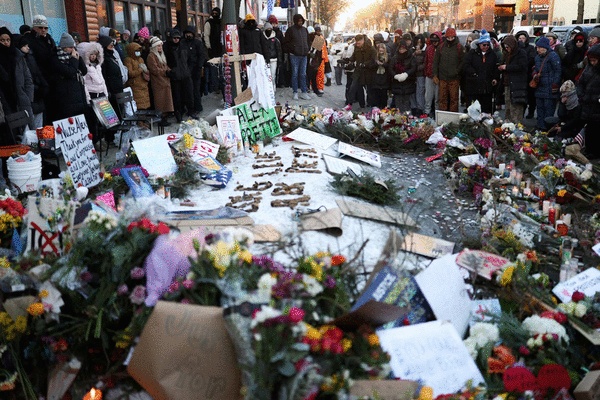
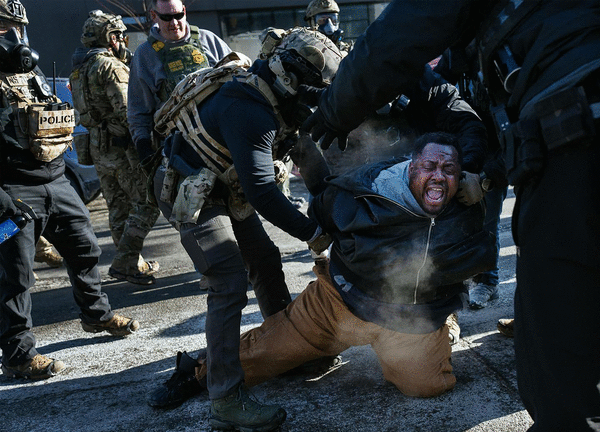
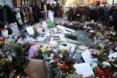
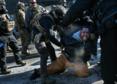
Just an hour after ICE agents killed Minneapolis nurse Alex Pretti on Jan. 24, and days after Renee Good's similar slaying nearby, Allen joined a protest on Nicollet Avenue. As Allen retreated from a line of ICE agents, he said they shot him in the back with a projectile. A widely circulated video shows the agents tackling and pinning him to ground.
"My name is Matthew James Obadiah Allen, I am a United States citizen," he screams in the video. "They're restraining me, spraying me and beating me. I have done nothing."
"If you kill me in this street," he shouts, before an agent blasts him in the face with a chemical agent.
Allen said he was later released without charges. But his words in the video felt akin to what he does in his music.
"My hope was to have a record of what was happening," Allen said in an interview, days after the incident. "If I was gonna die, I just wanted to make it incredibly clear who I was, what the reality of the situation was, so it's as hard as possible for them to spin it."
"The beating was horrible, the spray burned like acid. It was a frozen hell," he continued. "But the important thing was getting the last word out."
As the United States convulses with violent raids from emboldened ICE agents, citizens across the country have fought back with block-by-block mutual aid. Artist and music communities, long a source of activism and encouragement for street protests, have responded in kind.
This weekend's Grammys and next weekend's Super Bowl — with a halftime performance from Puerto Rican megastar Bad Bunny — arrive at a crucible moment. Artists with public platforms are figuring out how to use it as friends and neighbors are being taken, beaten or killed.
"Growing up, I didn't now about what was happening in Compton, but I heard it in the music I listened to," Allen said. "So many people I've shared stages with are out there on the streets right now. I can tell you that the fact I'm still alive to write more music means I'm going to let them know how it really was."
After Donald Trump returned to the presidency last year, many artists who were devastated by Kamala Harris' defeat anticipated a dangerous term to come, but were also exhausted and bewildered by the election.
The months of brutal ICE raids and detentions that followed — which have already claimed nine lives in 2026 alone — have galvanized them again.
A huge swath of acts from Lady Gaga, Tyler, the Creator, Neil Young, Dave Grohl and Lamb of God's singer Randy Blythe have lambasted the violence of the raids on stages and social media. Bruce Springsteen released a single, "Streets of Minneapolis," that called back to the rapid-response social songwriting tradition of his beloved Pete Seeger — "Through the winter's ice and cold / Down Nicollet Avenue / A city aflame fought fire and ice / 'Neath an occupier's boots."
María Zardoya, of the new artist-nominated group the Marías, donated all proceeds from a recent solo show to the National Day Laborer Organizing Network. Rapper Ice-T reworked his band Body Count's classic "Cop Killer" to lash back at ICE. Ariana Grande was unambiguous in a recent post quoting New York City Mayor Zohran Mamdani — "ICE terrorizes our cities. ICE puts us all in danger. Abolish ICE."
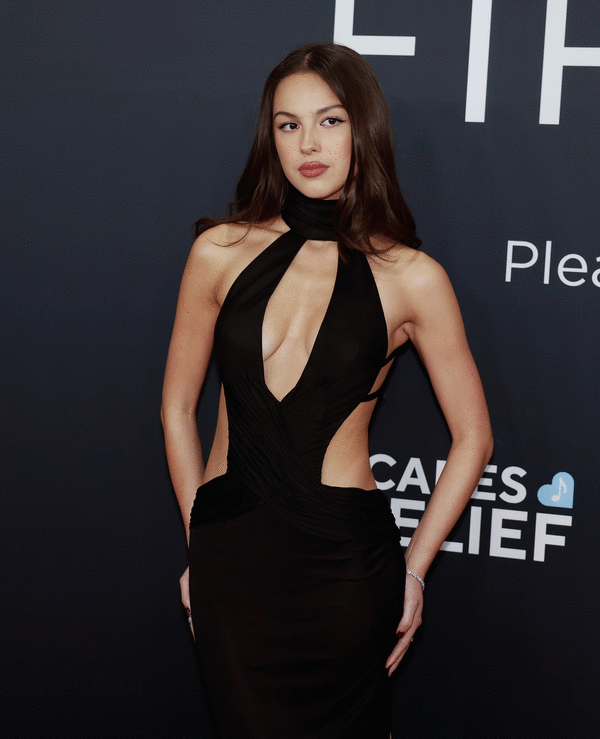
At the Grammys on Sunday, the activist campaign ICE Out will continue amid a wave of national strikes and protests this weekend. Organizers will give anti-ICE pins to artists taking the Grammy red carpet, with A-list acts like Olivia Rodrigo ready to talk about ending the brutality.
"ICE's cruelty in terrorizing our communities has gone too far," said Nelini Stamp, the director of strategy for Working Families Power , which is helping coordinate this "ICE Out" Grammys campaign. "It is sad that it has taken public deaths to get to this point, but I think that we are seeing a huge movement here. They have been attacking immigrants since Trump ran the first time in 2016, but they're realizing that they have gone overboard."
Rhiannon Giddens, the Pulitzer- and Grammy-winning artist up for folk album this year, will participate in the campaign.
"Since at least the 1800s, people have seen these things happening and have used music to protest against them. It's as American as anything," Giddens said, citing the popular abolitionist Hutchinson Family Singers group in the 1840s.
"When [Native] kids were put into residential homes, when there were slave patrols and all of these violent state-sanctioned actions, people were using their voices and protesting," Giddens continued. "People who have platforms can use them to build up and inform, if they let go of some of the music industry's trappings of capitalism and celebrity and really start focusing on communities."
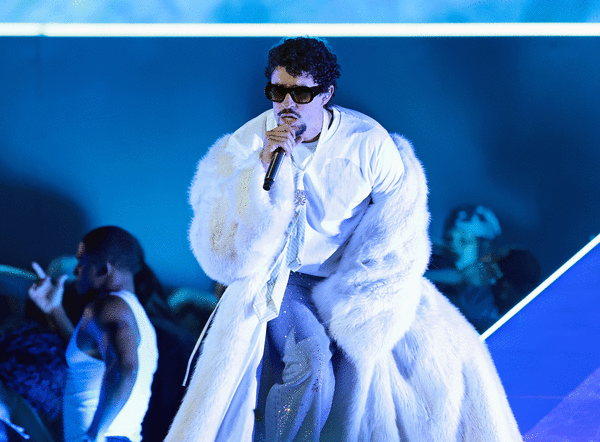
Bad Bunny, who is nominated for six Grammy awards including album, song and record, will also perform at the Super Bowl halftime show Feb. 8. The Puerto Rican superstar has used his status to advocate for his island after Trump's meager response following Hurricane Maria. Bad Bunny demurred on touring the mainland U.S. to support his smash 2025 LP "Debi Tirar Mas Fotos," citing the threat his large Latino fan base would face from ICE raids at concerts. Instead, he played a 31-show residency in Puerto Rico.
"It's incredibly significant for him to perform at the Super Bowl now, at a time when Latinos, Spanish speakers, migrants or people who appear to be these things are being terrorized and murdered in front of our faces," said Vanessa Diaz, a professor at Loyola Marymount University and co-author of a new book "P FKN R: How Bad Bunny Became the Global Voice of Puerto Rican Resistance."
"He's been active in protest and critiquing Trump since his first TV appearance on Fallon in 2018," Diaz said. "But it's not just that he's against Trump, he's against the whole project of getting Trump into that place of power."
Diaz doesn't expect openly antagonistic messaging at the halftime show — perhaps the lighter-blue Puerto Rican independence flag as a covert anti-occupation gesture. "It's fascinating because the NFL is conservative," Diaz said. "But there is a power tug of war happening. Cultural power now happens to go against conservative politics. The NFL just knows he's one of the biggest artists in world."
A Super Bowl-opening set from Green Day, who last year posted video from anti-ICE protests in Los Angeles synced to their single "F— Off," will just be "salt in the wound," Diaz said.
Music clearly matters to the Trump administration's messaging. Trump has recently appeared onstage with MAGA convert Nicki Minaj, and remade the Kennedy Center in his own name, atypically hosting its annual gala feting Kiss, George Strait, Gloria Gaynor and Michael Crawford. ICE's parent agency, the Department of Homeland Security, has used popular songs from acts like Olivia Rodrigo and Sabrina Carpenter in clips posted to social media, which the artists promptly lambasted. ("Don't ever use my songs to promote your racist, hateful propaganda," Rodrigo said, after the agency used her single "All-American Bitch" in a video).
The Southern Poverty Law Center cited a post from DHS that used a song "We'll Have Our Home Again," attributed to an obscure folk group called the Pine Tree Riots, which the SPLC called "a secretive white nationalist group."
After Springsteen released "Streets of Minneapolis," White House spokeswoman Abigail Jackson told Variety that "The Trump Administration is focused on encouraging state and local Democrats to work with federal law enforcement officers on removing dangerous criminal illegal aliens from their communities — not random songs with irrelevant opinions and inaccurate information."
Yet President Trump declined to attend the Super Bowl this year, in part, due to Bad Bunny and Green Day's performances — "I'm anti-them," Trump said. "I think it's a terrible choice. All it does is sow hatred. Terrible."
Stamp believes that the anti-ICE activism from musicians gets under Trump's skin.
"It matters to him because Trump is a product of popular culture," Stamp said. "He hosted the Kennedy Center Honors. He wanted the fake FIFA peace prize because he didn't get the Nobel peace prize. This administration is about spectacle, and his supporters like [Larry Ellison and Jeff Bezos] are buying pop cultural spaces because they want [Trump] to be popular. The performance art and political propaganda that they put on is all inspired by pop culture."
As L.A. prepares to host massive events like the Grammys, Oscars, the World Cup and the Olympics, it looks likely to face continued waves of raids. On New Year's Eve, ICE officer Brian Palacios shot and killed Keith Porter Jr. in a Northridge apartment complex.
For Dayna Frank, chief executive of the Minneapolis venue First Avenue and an activist with ICE Out, local music communities should be on the front lines for organizing and offering relief. Frank cited local groups like the Minnesota Immigrant Rights Action Committee and Monarca doing crucial work, who could benefit from music industry action. Groups like the Coalition for Humane Immigrant Rights Los Angeles do similar advocacy here.
The scene on the ground in Minneapolis is "completely catastrophic," Frank said. "There's such a level of fear for what you're going to see walking around the block, hearing all the whistles. But seeing musicians in solidarity can be incredibly important for the everyday residents doing everything they can to donate goods, drive people to work, patrol school zones."
Going out in Minneapolis is tense, but "the feeling at shows has still been incredibly special," Frank said. "It's a moment where you don't take things for granted, that we're lucky to be in a space where people feel what we're feeling."
For Allen, after years of street protests decrying the killings of Philando Castile and George Floyd, he's already writing for his Nur-D project, documenting this perilous, invigorating moment of resisting ICE in his city.
"In 2020, I remember I spent all day doing mutual aid, then coming into the booth to write with the chemical gas smell still coming off my clothes while I recorded," he said. "It's very similar now. You can turn the other cheek once. But Minnesota has gone through state-sanctioned violence and the quelling of speech before. The music coming out of here the second time, it might have more teeth. It might have more rage."
©2026 Los Angeles Times. Visit latimes.com. Distributed by Tribune Content Agency, LLC.







Comments