Second City changes its storied e.t.c. Stage to … improv?
Published in Entertainment News
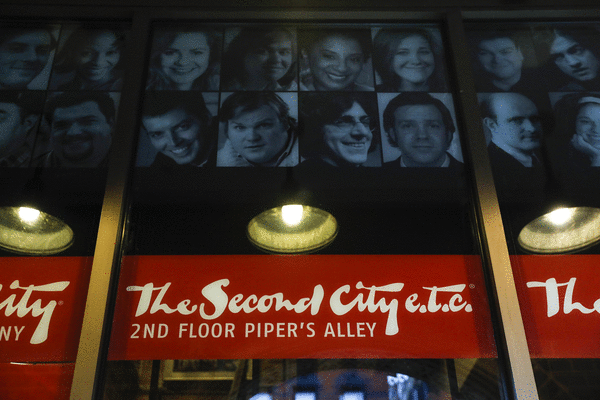
CHICAGO — Del Close must be looking down in triumph from the afterlife, with or without the skull he famously wished to be donated after his death in 1999 to the Goodman Theatre’s props department for use in “Hamlet.”
Beginning Thursday, and for the first time in its 43-year history, Chicago’s Second City e.t.c. Stage is changing over its storied revue, which launched the careers of the likes of Keegan-Michael Key and Jack McBrayer, to an all-improv show titled “Improv Supernova.”
Instead of the traditional compilation of scripted sketches, written by the cast and similar in format to the flagship Chicago Mainstage, the new e.t.c. show in Second City’s second stage in the Piper’s Alley complex in Old Town will be composed entirely of improvised scenes and structured scenarios. “Everything will be unscripted,” said Anne Libera, the new endeavor’s director. “We want to do a killer improv show.”
“The world is moving at incredible speed,” said Second City CEO Ed Wells, by way of explaining the change. “We want to reflect the world we live in. But what was true yesterday might not be true tomorrow. How do you comment on that in real time? Doing a show that is live and fully improvised every night might just fit that.”
As logical as that sounds, and Second City VP of creative Jen Ellison describes the change as a “moment of exploration and innovation” rather than necessarily a permanent change, longtime followers of Chicago’s improv and comedy scene have reason to be gobsmacked.
Second City’s co-founder and longtime head honcho, the late Bernie Sahlins, was vehemently opposed to improv as a performance medium, insisting for decades that its value was as a tool to create satirical material that could then be shaped, honed and, well, scripted. This was the formula that also created (and still sustains) the seminal NBC sketch show “Saturday Night Live!,” essentially a Second City creative process on an accelerated timeline and with cameras and guest hosts alongside an audience.
The devise-and-script approach (performers like Tina Fey and Jim Belushi did not own the rights to the material they penned) also meant that Second City has created a rich archive of excellent, company-owned material that it can use for its various touring shows, cruise ship productions and themed compilations.
In total contrast, Close insisted for decades that improv was a legitimate art-form in and of itself and he fought with Sahlins over the matter every chance he got. Close’s ideas were writ large in the 1990s at Improv Olympic (now the iO Theatre), and they remain very much alive with such storied, veteran long-form improvisers as TJ Jagodowski and Dave Pasquesi, making up shows out of whole cloth and attracting packed audiences in both Chicago and New York.
Sahlins and Close were friends and the improv-sketch divide was never absolute in Chicago comedy circles. Over the years, Second City revues have included some improvised elements (albeit well protected against failure by clever scripts) as well as free improv post-shows, used to develop future materials. And great sketch performers like Fey would perform at Second City and then rush over to do late-night improv games at Improv Olympic in Wrigleyville.
Still, the feud was famously intense enough that it generated a famous story, widely told in each man’s remembrance, that Sahlins had found his way to Close’s hospital room when the latter was dying. Close had opened his eyes long enough to spy Sahlins and insist, for the last time, that improv was a legitimate art form.
Sahlins then said, “It is tonight,” receiving a raised eyebrow and wry smile in return for his magnanimous gesture.
So, while the Thursday change at the e.t.c. might not be seismic, one might legitimately call the stakes a matter of life and death.
There have been 49 e.t.c revues, including the most recent one, “Chaos Theory of Everything,” which closed quietly, sending the theater atypically dark while the new project has been created.
Libera said she had sought out improvisers of the highest quality, adept in both long-form and short-form, descriptors that refer to the difference between improvised scenes that can last only a matter of seconds and those that can run on and on for hours.
Ellison added that “historically, improv has been the way to innovate” in the world of Second City, which is true, but in the development of rehearsed and scripted material.
“Over the years,” she said, “we have found that the best things come out of what happens when we throw away a lot of assumptions of what we do.”
Of course, there is also a famous Chicago entertainment brand to not throw out, which in this case has been aligned since the 1950s with scripted sketch comedy, even if Sahlins and producer Joyce Sloane founded the e.t.c. space in 1982 to create a space for experimentation, a sketch show offering edgier material than the tourist trap next door.
Times have changed and, for almost all of the intervening years, e.t.c. has functioned mostly as a slightly scrappier sibling to the Mainstage, often the choice of visitors when the Mainstage has sold out. That said, it quite often has been better in quality, and visiting scouts from network TV and the like invariably have watched both casts. So one might see the loss of a second scripted Chicago revue as a loss of opportunity for those who want to make a career in that form.
Of course, this is the slow winter season and, like many Chicago performing arts organizations, Second City, which was sold by former local owner Andrew Alexander to Zelnick Media Capital in 2021, has found itself in a more challenging economic landscape with tickets to the lesser-known e.t.c. harder to sell. If this doesn’t work, it can always change back. Everyone at the theater says they want to see what happens first. The show will now be about 90 minutes, including intermission, shorter than the traditional revues. But, one assumes, more up-to-date.
“We want to create a new kind of relationship with the audience and we don’t plan to be games and jokes driven,” Libera, a comedy historian, says. “We really see this as going back to our first principles of the founding of the company,” noting the roots of Second City in the improv games created by Viola Spolin and further developed by her son Paul Sills and others.
Ellison struck a middle ground between the famed Sahlins-Close polarity. “I think improv is both a tool and a performance medium,” she said, shrewdly, given these circumstances. “One can shake the hand of the other. I don’t look at a box of crayons and say, ‘Look at the art I made.’ I use them. We can be inside our tradition and also push back against our tradition.”
Sahlins, it is fair to say, would have been all for pushback, just as long as it did not involve improvising all night for an audience. And Alexander, who followed him at the helm, generally adhered to his principles. But, well, neither man is in charge anymore.
As for a critic who has never missed an e.t.c. revue for decades, there is now a new (or more accurately, given iO, a new, old) conundrum: how do you review a show that will be completely different every night? (It can be done.)
Second City, once famed for its starry openings, said its next official opening night at e.t.c. might be months away, and that it wished to be allowed some space to experiment and try something new.
“But we hope you will come,” Wells said, “and then come back several more times.”
©2026 Chicago Tribune. Visit chicagotribune.com. Distributed by Tribune Content Agency, LLC.






Comments