Americans are reading less. These 'introvert happy hours' are booming
Published in Books News
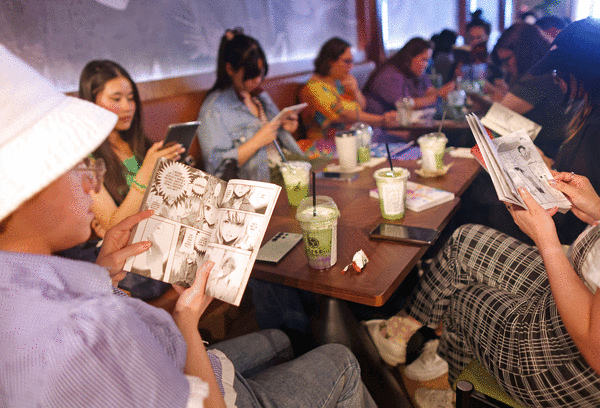
SAN JOSE, Calif. — One evening a month, roughly a dozen men and women convene at the Panera Bread in Campbell, filling the dining room’s largest table and spilling into nearby booths. They’re there for Silent Book Club, where their mission for the session is to read in silence, surrounded by other people, for an hour.
Once reading time kicked off during a recent meetup, the only sounds from the group were the quiet rustle of pages turning and the conscientious nibbling of snacks and sipping of tea as the cafe continued its bustle.
After the allotted hour of silent reading time, book club members took turns sharing about the diverse array of books they’d brought: “Thinking, Fast and Slow” by Daniel Kahneman, “The Housemaid” by Frieda McFadden, “Dungeon Crawler Carl” by Matt Dinniman, and “Burnout: The Secret to Unlocking the Stress Cycle” by Amelia and Emily Nagoski were among the titles people eagerly discussed. The group included a number of first-timers as well as regulars. Returning readers said they’ve found the practice helpful for building community, finding new reading suggestions and carving out more focused reading time from their distracted, busy lives.
“As an adult, it’s hard to find people who have a similar interest in a quiet, non-sport activity,” said Joy Oh, who brought “Burnout” to read at the Campbell event.
At a time of declining leisure reading, constant digital distraction and widespread loneliness, this Bay Area-born movement is turning a solitary activity into a low-pressure form of community.
Depending on who you ask, reading culture today is thriving, or in free fall. People who are already part of the reading community — or what Northwestern University professor emerita Wendy Griswold calls the “reading class” — say the opportunities to connect with other people around books, whether through social media or in-person events such as silent book clubs, are booming. Meanwhile, national reports point to a bigger-picture slump in book-reading: The National Endowment for the Arts reported that fewer than half of all adults reported having read a book in 2022, and the American Time Use Survey found the proportion of Americans who read for pleasure on a given day fell to 16% in 2023 from 28% in 2004.
Griswold, who studied the sociology of reading for decades, sees events like Silent Book Club as serving an existing group of people known as the “reading class” — representing the roughly 20-25% of U.S. adults who read about a book a month for pleasure. Those numbers are borne out in recent data from the Pew Research Center, which reported in October 2025 that about 24% of U.S. adults read at least 11 books a year. That cohort, often in the U.S., skews more educated, white and female than the population at large, according to Griswold’s research.
Members of the reading class have been worried about the decline of other people reading in their leisure time since at least the advent of television. But for most of recorded human history, she says, there’s only been a narrow segment of people who could read, and it wasn’t until the middle of the 19th century and late industrialization that the forces of increased amounts of leisure time — and not much to do in the evenings — led to larger segments of the population reading works by authors like Dickens and Tolstoy for fun, she says.
“We look back to this golden age, but the golden age was actually very short,” she says.
Today, whether social media – and its impact on young attention spans – will have a lasting impact on who constitutes this narrow reading class long-term is as yet unclear. “There is pretty good evidence that in many places reading is more difficult for young people,” she says.
The social nature of the silent book club, some attendees say, helps to provide structure and promote focus.
“I’d be looking at my phone and constantly being distracted,” Oh said.
Jacob Orozco, who’s been attending events hosted by San Jose’s Silent Book Club for a few months, said that the scheduled sessions help him to find small pockets of quiet time throughout the day so he can make progress on his book between meetups.
“There’s a really distinct energy with this group, with these gatherings,” said Mike Bogan, who started coming to the events in July. He added that the sessions have reignited his love for reading. Having a community to read with has also helped him find new titles through book swaps and recommendations, and a recent summer reading bingo challenge helped him get back to a reading cadence he hadn’t experienced since his 20s — about a book a week.
This was just one of several recurring monthly meetups organized by the San Jose chapter of Silent Book Club, an organization that first got its grassroots start here in the Bay Area. There are also regular walk-and-listen audiobook meetups, library reading sessions and gatherings at the Rose Garden, plus themed events, like a “Manga and Matcha” meetup held recently in Campbell. The Silent Book Club organization has grown dramatically since it began in 2012, and especially in the years since the pandemic — when COVID-19 hit, there were just 260 chapters in 30 countries. Today it supports around 2,200 such chapters across 70 countries spanning the world: Meetups have been held in locations as remote as Antarctica’s McMurdo Station.
How it started
Silent Book Club cofounder Guinevere de la Mare remembers wishing out loud that there were a book club without homework to her friend Laura Gluhanich back in 2012 when the two women — who’d become friends over their mutual love of books — were catching up at a San Francisco wine bar.
She’d been feeling stressed about not having finished a recent book club selection and began imagining what it would be like to just sit and read with friends, rather than meet up to talk about what they’d read.
“Let’s do it,” Gluhanich said.
But in the first couple of years, it was just Gluhanich and de la Mare. They started meeting up regularly to read, with just one rule: They had to each read one chapter of their respective books before they could start chatting. Soon, other friends heard about the practice and wanted to start their own reading gatherings. In 2015, Silent Book Club launched a website and social media accounts and began to formalize how people could start their own chapters.
“From there, it really has just been an upward trajectory,” de la Mare says. “We definitely saw the most significant growth after the pandemic. People were really, after lockdown, looking for ways to get back into the world in a safe, low-stakes way. Silent Book Club catered to that.”
Yet de la Mare remains bullish on the future of reading.
“Are people sitting by the fire reading leather-bound hardcover classics in the evenings? Nope, that’s definitely not happening as much anymore. Are young adults reading? Absolutely. Romantasy is booming,” de la Mare says. “If you spend a minute on BookTok or talk to independent bookstore authors who are bringing communities together to rise up and fight against Amazon, there is a huge movement of people who are very passionate about reading.”
Younger people in the millennial and Gen Z cohorts are also combining reading with socializing to combat loneliness, she says. “Connecting through books and book clubs is one of the ways they’re doing it,” de la Mare says.
Reading in the Bay
Silent Book Clubs have established a strong presence in the Bay Area. The trademarked organization gives each chapter a free license to use the brand, and organizers agree to follow the format: Hold a free meetup in a public place, and set aside an hour for quiet reading, with an option for people to stay and chat afterward. Beyond that, chapters are given flexibility to pick the time, frequency, location and method for publicizing their events, de la Mare says.
As a result, bookstores, libraries and individuals have taken the template and run with it, building their own reader communities around the world. “We try to keep our arms as open as possible to make room for more readers,” she says.
The meetups are particularly helpful for people who are new in town as a tool for making new friends, de la Mare adds. “You can identify as a book lover and find ‘kindred spirits,’ as Anne of Green Gables would say.”
That’s how Cleo Brock got involved with the San Jose Silent Book Club chapter. “I’d just moved to the Bay, and I didn’t know anyone,” she says. “I ended up finding some really good friends through this. To dive into talking about how good a book was — or how bad — you realize how many other things you have in common with people who read, separate from literature.”
Brock, along with friends and co-moderators, Michelle Berg, Hannah Nielsen and Amy Ly, now run Silent Book Club events in San Jose and Campbell nearly every week, moving between libraries, cafes, parks and pubs, coordinating sessions for readers of different book formats — the group hosts monthly audiobook walks, and recently hosted a “Matcha & Manga” meetup at the Campbell cafe Maruwu Seicha.
At Banter Bookshop, which opened in Fremont in 2022, around 10 to 20 people come to the store after hours on the second Wednesday of each month for Silent Book Club, according to owner Amy Davis.
“It’s been very positive for the store,” she says. “It seems to bring a lot of joy to a lot of people.”
There’s a wide range of ages represented in the readers who attend the Fremont events, and some of the Banter Bookshop regulars are starting to build friendships. They seem to appreciate the hour of quiet time, as well as the opportunity to take a break from screens, Davis says.
“I think we do have to pay attention to refocusing and building our stamina for focus,” she says. “It’s great to see people are still making it a priority.”
____
If you go
There are chapters in Oakland, Concord, Richmond, Benicia, Pittsburg, South San Francisco, Millbrae, Burlingame, San Mateo, Redwood City, Sunnyvale, San Jose, Fremont, San Francisco and Santa Cruz. A Livermore chapter just launched this summer at the new bookstore Word on the Street Books.
This week, from Oct. 4-10, the organization has partnered with libro.fm to hold special read-ins at libraries and bookstores in recognition of Banned Book Week.
Local events include:
•3 p.m. Oct. 4, Towne Center Books, 555 Main St., Pleasanton.
•7 p.m., Oct. 4, Peninsula Books, 441 Westlake Center, Daly City
•3 p.m. Oct. 7, Books on B, 1014 B. St., Hayward.
•6:30 p.m. Oct. 7, Banter Bookshop, 3768 Capitol Ave., Ste. F, Fremont.
•10:30 a.m. Oct. 10, San Mateo Public Library, 55 W. Hillsdale Blvd., San Mateo
©#YR@ MediaNews Group, Inc. Visit at mercurynews.com. Distributed by Tribune Content Agency, LLC.






Comments