Here's why there's great Indian food at truck stops across California
Published in Books News
This story really begins with butter chicken at a truck stop.
Because my husband’s family lives in Northern California, for the past 20 years, to make it to family gatherings, we have regularly traveled up and down the 5, the 99, the 101 — all the arteries running through California’s Central Valley and beyond.
If you know these routes, you know that if you look beyond the usual fast-food pit stops off many of the highway exits, there’s a host of delicious Indian food offerings at gas stations, truck stops and small family-run restaurants. We’re the kind of people who will always go for homemade cooking over processed fare, but I’ve always wondered, how did this Indian flavor end up in these unlikely spots?
San Diego author Madhushree Ghosh has the answer, and it’s a fascinating weave of Indian and American politics, migration, adaptation, labor history, and our cultural melting pot.
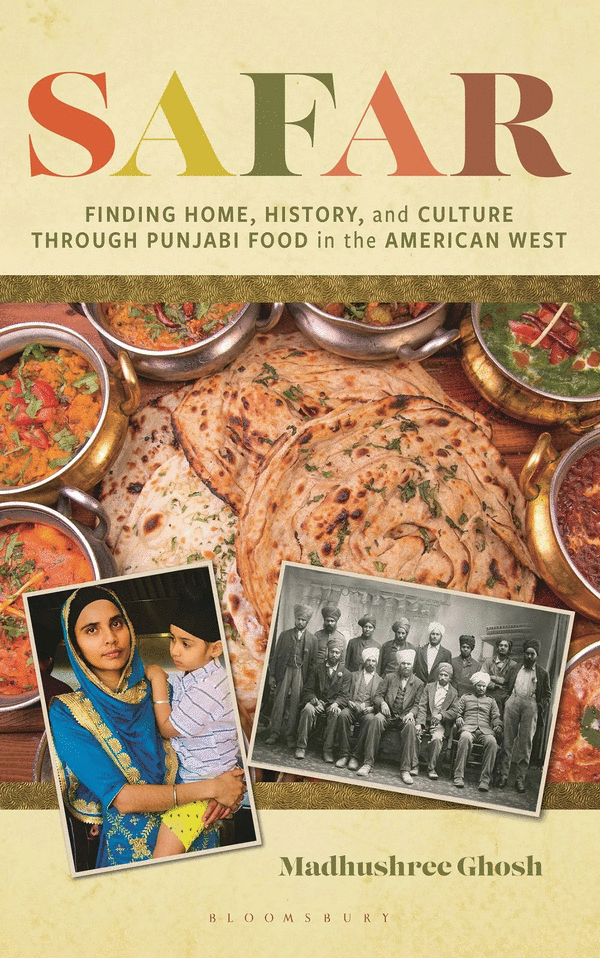
In her first book, the memoir “Khabaar: An Immigrant Journey of Food, Memory and Family,” Ghosh explored her own life story. But with her latest title, “Safar: Finding Home, History, and Culture Through Punjabi Food in the American West,” she turns her lens outward to tell not only how my favorite road stop butter chicken came to be, but a tale that goes back two centuries. Ghosh explained it in the following exchange, edited for space and clarity:
SD: How did you begin this project? It’s, in some ways, a journey into your own understanding of Indians in America. Did you begin thinking you were going to be writing about food only to discover a larger story about communities?
MH: I was thinking it was going to be a very simple book. [Laughs]
I’m sitting in the middle of Old Town San Diego, with this rich history of how Mexicans used to rule this world. I wanted to talk about the Mexican Americans and Mexican Indians, and how they have created a blended community. I have become friends with these people; I’ve known them for six, seven years. These people are getting older, so I really wanted to get their story out there. They’ve created this fusion food, Punjabi-Mexican. I wanted to use examples of two women from this culture, and talk about me and me belonging to all of this. That’s it. You know, three women. End of story.
And then you start reading, and then you start meeting the Mexicans who are part of the Punjabi Mexican community, and then you go down the rabbit hole. And here we are!
SD: So tell me, how did great Indian food become a staple at truck stops along the Central Valley?
MG: For that, we have to talk about the immigration wave of Punjabis who moved to the American West.
Before India was divided, there were Punjabi soldiers and farm workers [Punjab is an agricultural powerhouse region in India] who came to America for a better opportunity. First they came to Washington State and Oregon, but then left — or got kicked out of there — because of racial tensions. Then they came to the Central Valley. Those people were more of the, “I’m going to assimilate rather than hold on to my identity.” They are the ones who married the Mexicans who were here.
Then came the next wave in 1965 after the Civil Rights Movement, when people were not discriminated against on the basis of race and you could come in with your family. They came and settled in the Central Valley, and Imperial County and started growing food. They really took over farming in that region. It’s not that there weren’t other groups of people, but they were really good at working the land and bringing people in from their villages so they could then work more land. And slowly and steadily, they grew Central Valley, Yuba City, Sacramento, Fresno into the agricultural hub that it is.
Now, all these farmers were selling food and produce, but they needed transportation to take the food all over the country. And, of course, they themselves had a few trucks, but then a new generation of Sikhs, who were targets of political violence in India, arrived.
Now there was a better way of putting trucks together, getting friends of friends or family members to run those trucks. Women could actually run the operations behind the scenes and these guys could take over the trucking industry, and that’s what happened. So much so that one of the Sikh priests at Stockton’s Gurdwara said to me, “You know, if you see a Sikh running a 7-Eleven today, tomorrow he’s going to own a truck!”
Of course, people have branched out into being doctors and engineers and whatnot, but your question was, how did this happen? So now the other part of Sikhs getting into the trucking industry is because they are so visible with their turbans and their long beards, which are symbols of religious devotion for them. It was just so much easier to work in a profession where one’s faith would not be questioned.
And so, while it’s a lonely journey, they can be on the road and continue to look like a Sikh, pray like a Sikh, and just, you know, live the life of a Sikh. Yes, it is hard work, however, they’ve never shied away from hard work.
So that was the advantage. The disadvantage was, when you’re on the road, where is the food? Where do you get the food that you need? You can only do Subway sandwiches for so long! That’s what the diner owner of Fresno’s Golden State Boulevard, Punjabi Indian cuisine, told me. He said, “I got tired of looking for Indian food.” And so he started his dhaba just because he was like, okay, truckers are hungry.
SD: You weave so many threads together in this book. It is truly an education! I guess my final question is, during our next drive to Northern California, what do you want us to do differently?
MG: Look, I mean, you can always go to any dhaba along the road, get a roti, get chicken curry. It’s great. Do it. Spend some money with people who are actually making, you know, good work. But I really recommend actually seeking out a gurdwara. For the Sikhs, a gurdwara is like your church or your temple. The only thing you have to do is cover your head. And if you don’t have a head cover, they will actually give you a head cover right there. Just wear a T-shirt, and pants and you’ll be fine.
I’m not religious one bit, but it is so cool to go into a temple where they have Gurbani chanting scriptures. I don’t understand half the words they’re saying. But it’s just lovely, very similar to when you go into the church and you have choir music. It’s a good, peaceful place to be.
After you’ve gone there, go to the langar or the kitchen, which are free for all. It doesn’t matter who you are. So long as you wear your head cover, so long as you’re respectful. They offer you dal, chawal, roti, with a dessert, and maybe a vegetable, along with chai. I’ve done it so many times now. And it’s just fascinating. I love it. Nobody tries to convert you. They are just happy you’re there, that you’re part of the community, sharing a meal.
Listen, we don’t have to agree on everything, but so much of the time, we are caught in our own echo chambers. I believe that to constantly be striving for community will make us better people. It will make us more joyful people.
©2026 MediaNews Group, Inc. Visit ocregister.com. Distributed by Tribune Content Agency, LLC.











Comments