Secret codes, KGB interrogations and sheet music: This professor's new book is a true Cold War thriller
Published in Books News
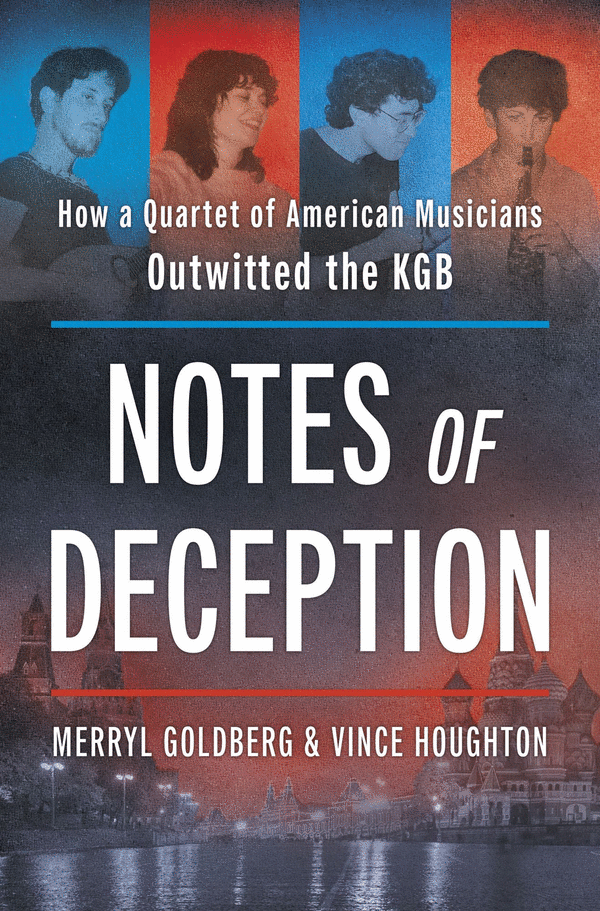
SAN DIEGO -- Back in 1985 in the Soviet Union, Merryl Goldberg was interrogated by the KGB three times, briefly kidnapped by the state security agency twice and put under house arrest once.
She’ll tell you it was worth it.
Today, Goldberg lives in Carlsbad and works at California State University San Marcos, where she’s a professor of music. But 41 years ago, she was a 26-year-old saxophone player tasked with a secret mission behind the Iron Curtain.
She and three bandmates from the Klezmer Conservatory Band in Boston, which performs traditional Yiddish and Jewish music, were set to meet and perform with refuseniks — Soviet citizens, mainly Jews, so named because they had been denied the right to emigrate.
It was no small job to visit refuseniks. The Soviet regime saw them as enemies of the state and, believing they would reveal state secrets, prohibited them from the leaving the country. Their restricted status turned many into dissenters and activists, often tailed by the KGB and getting their phone lines cut in an effort to keep their stories quiet.
If the KGB knew what Goldberg’s bandmates were doing, they could be deported — or worse.
So in classic spy fashion, the group devised secret codes to communicate with one another, hidden in plain sight, so the KGB would be none the wiser — using series of notes embedded in their sheet music.
“We made a nice little ensemble,” Goldberg said of the band. “The caveat is we had to do all of this in secret. We couldn’t tell anybody.”
It’s a wild tale, one that Goldberg recounts in a new book, “Notes of Deception,” she co-wrote with Vince Houghton, the director of the National Security Agency’s National Cryptologic Museum in Maryland.
Over 10 days in May of 1985, Goldberg and her bandmates — Rosalie Gerut, Hankus Netsky and Jeffrey Warschauer — traveled across the Soviet Union, meeting and sharing music with the refuseniks. Along the way, they were followed and questioned by KGB agents, were often separated from each other and slept in bugged hotel rooms.
In an effort to be as inconspicuous as possible, the musicians didn’t write anything down. Instead, the names of people they planned to meet, addresses and other important details were all hidden in the code of the music, its notes, chords and other symbols corresponding to letters of the alphabet.
When the KGB questioned the group and searched their belongings time and again, the officers had no idea what they were looking at, Goldberg recalls.
“Even a musician wouldn’t know that it was coded because it looked like 20th century music,” she said.
As the group learned the stories of the people they met, they encoded that into their music, too — ultimately smuggling it out of the country. And when they returned to the U.S., they shared their stories with the public — meeting with journalists who wrote about the refuseniks, and collaborating with advocates who encouraged people to urge their elected officials to act.
They held a concert and press conference on Capitol Hill with a congressional caucus, and they met with then-Sen. Ted Kennedy, who advocated for refuseniks and ultimately helped a family the band met in the Soviet Union emigrate.
The trip and their advocacy were part of a growing movement of advocacy for refuseniks, building on nearly two decades of organized campaigns by groups such as the Student Struggle for Soviet Jewry and the Union of Councils for Soviet Jews.
The year Goldberg and her bandmates made their trip, hopes for progress were already rising. As Mikhail Gorbachev became Soviet premier and promised new openness with a policy of glasnost, a slow thaw would begin toward free speech, human rights, the release of political dissidents and relaxed restrictions on emigration.
But that process would take years, and during the musicians’ time in the Soviet Union in 1985, Goldberg says they were bolstered by the refuseniks and their resistance against the regime.
“We were egged on by the people we met, who were so brave,” Goldberg said. “The courage and the confidence that they gave us, and the amazing spirit that they had.”
To some degree, Goldberg’s knack for the work ran in the family — her father was an intelligence agent for the U.S. Army while stationed in Korea during the Korean War.
But her enthusiasm for the entire trip went deeper.
The plan to visit the refuseniks was hatched in Boston, where Goldberg grew up, while she was performing with the Klezmer Conservatory Band. Like the other musicians, she was aware of the antisemitism and worse that Jews faced in the Soviet Union.
But the group had learned of the Phantom Orchestra, a group in Tbilisi, the capital of what is now Georgia, composed of musicians, poets and activists who had been barred from leaving the Soviet Union.
With the support from the group Action for Soviet Jewry, which helped Jewish people emigrate, it was decided that four members of the Klezmer Conservatory Band would go into the country to connect with the Phantom Orchestra and other refuseniks and bring back their stories to share with the wider world.
“I was all in,” Goldberg said.
The four musicians each brought something different to the table: Goldberg played the saxophone, Netsky the keyboard. Gerut sang, and Warschauer played guitar.
As they traveled through the Soviet Union, meeting with the Phantom Orchestra in Tbilisi and other refuseniks in Armenia, the group connected with the people through music.
They played traditional klezmer music, along with Beatles songs and an especially emotional “Somewhere Over the Rainbow” by Judy Garland, given the song’s sentiment of freedom.
Despite the harrowing elements of the trip, it’s those moments — of freedom and connection through music — that stand out to Goldberg as she looks back.
“It’s a way to feel human and dignified,” Goldberg said of the music. “And under the circumstances of so many of these folks being beaten, harassed, interrogated, imprisoned — just because they’re fighting for human rights — the music made a humongous difference.”
©2026 The San Diego Union-Tribune. Visit sandiegouniontribune.com. Distributed by Tribune Content Agency, LLC.










Comments