AI companies are destroying more books than you think, says bookseller
Published in Books News
ANAHEIM, Calif. — It’s evening in Frankfurt, Germany, when Scott Brown picks up the phone.
The Downtown Brown Books bookseller interrupted his vacation to discuss the use of books to train AI models — a process that destroys the books — and the practice’s effects on booksellers.
Brown, who’s based in Portland, Oregon, has written and reported in great depth on his Substack, Dispatches from the Rare Book Trade, in posts such as “Chop. Copy. Shred: Thoughts on Bookselling in the Age of AI” and “All the Companies Scanning Books for AI: The book scanning ecosystem is large and growing.”
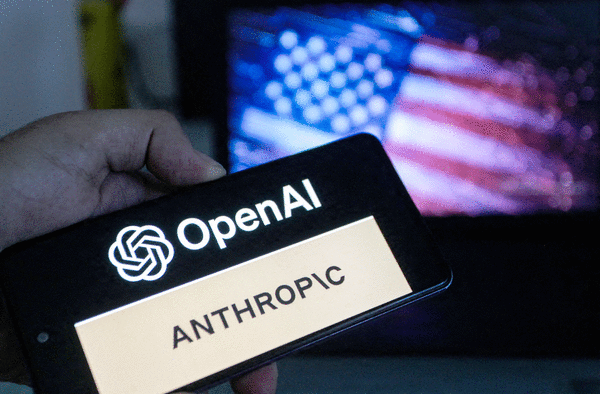
The scanning and shredding revelations began making headlines when court filings from the class-action lawsuit Bartz v. Anthropic became public, revealing the AI company’s so-called “Project Panama,” which aimed to “destructively scan all the books in the world,” and a contract that called for as many as 2 million books to be scanned — and destroyed.
The destruction is not an accident: It’s intentional. Per the judge’s ruling in the class-action suit (which was finalized last month with Athropic paying a settlement of $1.5 billion), AI companies can make a copy of a book — that is, feed it into their AI model — as long as they destroy the scanned copy and recycle it. One book in, one book out, per the ruling. The book’s contents, however, are no longer accessible.
“Everyone lost their [minds] over Project Panama, and that is so small in comparison to what’s really happening today,” says Brown.
The bookseller estimates that the number of books being destroyed is far higher than what’s being reported — somewhere in the tens of millions. The “destructive scan” numbers related to Anthropic, he says, have overshadowed the fact that more companies are engaging in the practice and in greater numbers now.
“Most of the discussion has been about Anthropic, the maker of Claude, because their documents were published as part of a court record, so people have drawn from that written record over and over and again,” he says.
“First of all, that was in the past. That was before all the local, independent bookstores started getting orders,” he says. ”Now it’s come out into the public.”
“It’s way more than Anthropic.”
Reporting by 404 Media, which added a tracking device to a large book order, traced a large shipment of books to an Amazon warehouse in Las Vegas. Per the report, employees told 404 that they take in large shipments of books, cut off the bindings and scan the pages – destroying the books in the process.
It’s worth noting it’s possible to scan books, as the Internet Archive does, in ways that don’t result in the total annihilation of the book.
So, why should the average reader be concerned about this?“People generally have an aversion to book burning, and there’s not a lot of difference between putting a book in a guillotine and then scanning it and sending it off to be recycled and burning it,” he says. “You are destroying books.”
These are books that booksellers had deemed worthy of selling to readers or collectors or, you know, actual people, he says. And while there are millions of copies of, say, Stephen King or David Baldacci available, that’s not the case for every book.
“There are also millions of titles that were not bestsellers, where there might only be five or 10 copies available for sale in the entire world, and AI is systematically buying all of them because every company needs the same books. It’s not like you sell one book to be scanned, and that book is done,” he says.
“No, the next company also needs that book, so it is significantly affecting the supply of books that were not available in great numbers.”
Rare and nonmainstream titles that are in short supply are most at risk, according to Brown.
“Those books are all being sucked out of the market, which means humans can’t buy them,” he says.
As well, these books aren’t being scanned and saved digitally, says Brown. They are being used to train the AI, not stored for later use.
“AI doesn’t really remember the book,” he says. “There isn’t a database of it.”
But the issue also puts pressure on booksellers, who are, after all, in the business of selling books.
“Booksellers are just in a difficult situation because if we reject orders that come through these marketplaces, our fulfillment rate, and often the visible rating that sellers get on the site, gets dinged,” he says. “So, if you cancel orders for AI, your fulfillment rating is going to decline, and you’re going to go from being a five-star bookseller to a four-star bookseller or a three-star bookseller. You seem less reliable to your human customers because you’re choosing not to buy to sell the robots.”
Even if a bookseller declines to sell to a suspected buyer, Brown says the buyer will simply try the next seller.
“All you’re doing is kicking the can to the next bookseller. You’re solving the problem for yourself, but you’re not really solving it for the book,” he says. “Booksellers are in a difficult situation.”
“I know someone who just yesterday got a 51-book order for AI,” he says. “He can’t cancel 51 orders; the websites aren’t going to support that.”
Brown says he’s had five AI-related orders, and he decided not to send one of the books because it was a signed copy of a Ray Bradbury novel. “I found somebody who would send an unsigned one in my place,” he says, not wanting to see a unique copy destroyed. “But you know, that took me an hour to do.”
Locally, the booksellers we spoke to had a variety of responses. A representative of The Iliad in North Hollywood said they’d not had any AI-related sales, and that the only bulk sales they did were with set decorators they knew or had long-term relationships with.
Nathan Gabbard of L.A.’s Owl Creek Books, which sells rare and vintage editions, says he hasn’t sold books to an AI-related company or even one he suspected, but he’s heard about it from other booksellers.
While recognizing that some people don’t think a seller should have any input once a sale goes through — whatever happens to the book happens, essentially — Gabbard, who’s also a practicing lawyer, says he doesn’t see it that way.
“I believe there’s more of a principled stance,” he says. “If I’m entrusted as a rare antiquarian book dealer, as the custodian of these items while they’re here, I want to find these items a good home where they will be appreciated, and the next person who is the steward for the items will maintain them in good condition.”
He understands that some sellers may sell; he says he’d prefer not to.
“While I still am able to say yes or no … to these companies, I would like to exercise my right to say no,” he says. “I don’t want to sell to companies that will just destroy books en masse.”
Brown doesn’t anticipate the practice stopping, but he does wish these AI companies would try to avoid buying unique or special books and use lesser copies that might be in poorer condition and are not signed.
“I would like the AI companies to actually take care and pay attention to the general concern of many people that books should be respected and to only send books to destructive scanning that are good candidates for that,” Brown says.
“I know it’s complicated, but that’s my whole point: In order to not destroy books, you have to go to a lot of work,” he says. “Booksellers are the ones having to either do that work or cancel the orders and take the penalty — or live with the fact that they’re selling books to robots.
“There is no good solution for booksellers.”
©2026 MediaNews Group, Inc. Visit ocregister.com. Distributed by Tribune Content Agency, LLC.








Comments