Column: 50 years ago, 'Roots' burst on the scene and into American lives
Published in Books News
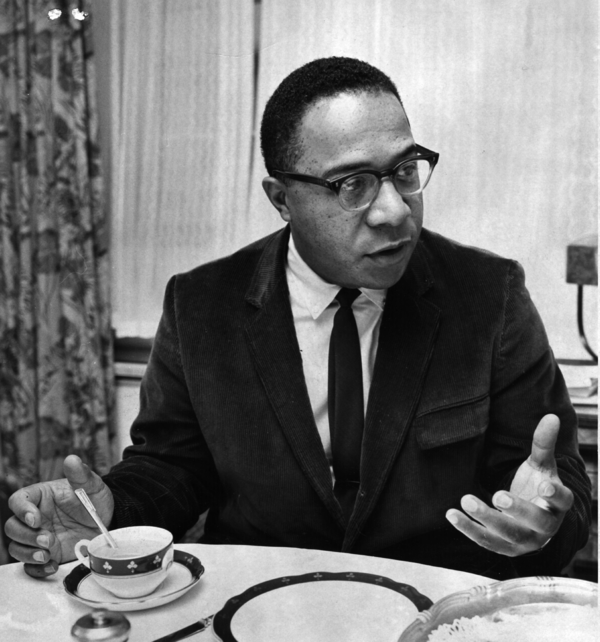
There was a time when a book could shake the world and on Aug. 17, 1976, a book titled “Roots: The Saga of an American Family” by Alex Haley arrived on bookstore shelves and immediately began to fly off those shelves and into apartments and homes across the country, starting a cultural rumble and sparking national conversations about race and slavery.
Excitement had been building quietly for weeks. Then came the reviews, carried in daily newspapers and fueling the fanfare. Writing in the New York Times, James Baldwin began his review with, “I cannot guess what Alex Haley’s countrymen will make of his birthday present to us during this election and bicentennial year,” and went on to tell us what he had made of it, writing, “Alex Haley’s taking us back through time to the village of his ancestors is an act of faith and courage, but this book is also an act of love, and it is this which makes it haunting.”
Before publication, a TV deal had been struck, and within the first six months, 1.5 million hardcover copies were sold (587 pages priced at $12.50). Publisher Doubleday had to play catch-up, since it had an initial print run of only 200,000 copies, and scrambled to meet the demand with 14 subsequent printings. The book would eventually sell more than 8 million copies, win a National Book Award, a Pulitzer Prize Special Citation and an NAACP Spingarn Medal.
The book spent 22 weeks at No. 1 on the New York Times Best Seller list, was translated into more than 35 languages, began to find its way onto the reading lists in high school and college classrooms, and saw amateur genealogists pouring into libraries, county courthouses and dusty archives.
It made a star of Haley, who was a bespectacled 20-year veteran of the Coast Guard, where he taught himself to write. He then worked as an editor for Reader’s Digest and later created the esteemed series of Playboy interviews, conducting the first with musician Miles Davis and also probing in print Muhammad Ali, Sammy Davis Jr., Rev. Martin Luther King Jr., and American Nazi Party leader George Lincoln Rockwell.
In 1965, he collaborated with the subject on “The Autobiography of Malcolm X,” which became a bestseller. He then devoted more than a decade researching and traveling and writing “Roots,” Haley’s story of his family’s passage from an ancestral home in Africa to slavery in America and, finally, to freedom.
Then, of course, came the ABC miniseries “Roots,” which aired over eight consecutive nights in January 1977 on ABC and smashed audience records. It attracted an estimated 130 million to 140 million total viewers, which meant an astonishing 85% of American homes with televisions tuned in to watch.
It was generally savaged by critics, among them Bill Granger in the Sun-Times, who wrote of its “puerile” writing and “caricatures,” describing it as “so transparently bad at times that I was filled with embarrassment.” The Tribune’s Gary Deeb wrote of it in a column headlined “’Roots’ TV version falls prey to big bucks, super hype, and prime time,” calling it a “vulgar trivialization of (the book) … and cameo appearances by such notables as O.J. Simpson are devastating to the production’s credibility.”
Still, Vernon Jordan, executive director of the National Urban League, called “Roots” “the single most spectacular educational experience in race relations in America.” And the miniseries won nine Primetime Emmy Awards, out of 37 nominations, a Golden Globe Award for best TV series and a Peabody Award,
I have to assume that many of you reading this did not encounter “Roots,” the book or the miniseries, the first time around. Five decades is a long time, and so I reread the book, available in many fashions, and rewatched the series, which can be had on a couple of streaming services.
The series is more melodramatic than I remembered, but filled with some fine performances (in particular LeVar Burton, John Amos, Ben Vereen and Cicely Tyson). The book holds up. Haley could write and the story is compelling, though I could not shake some of the shadows that have attended it for a long time.
Shortly after the book was published, criticism came loudly, most focusing on the book’s historical inaccuracies and genealogical fabrications. Though it was marketed as nonfiction, historians and journalists pointed out that Haley embellished family lore, relied too heavily on an unreliable oral historian in Africa, and, most damningly, stole from Harold Courlander’s novel “The African.”
Courlander sued for plagiarism in 1978. Though Haley claimed he had never read Courlander’s book, he agreed to pay a $650,000 settlement, surely tarnishing the book’s reputation and diminishing its impact.
But there are many who don’t care about that, and one of them can be found in the current issue of Time magazine, an intriguing essay by Anne Haley.
“Alex Haley was my father’s older brother … I adored him,” she writes. “How does a single book at once condemn and captivate a nation? Fifty years ago this August, ‘Roots’ did just that.”
She addresses the trouble, writing, “Not long after Roots’ publication, Uncle Alex was challenged by critics who questioned the accuracy of his timeline and suggested the griot told him what he wanted to hear. But as many historians pointed out, to focus on specific dates or dialogue is to miss the larger truth. … As my uncle told one journalist, ‘Neither you nor I know exactly what happened. But I stand by ‘Roots’ as a symbol of the fate of my people.’”
Haley would write one book after “Roots.” He bought a lot of houses, owning nine at one time. He was married three times, had four children and died in 1992. He was roughly $1.5 million in debt, and creditors, mortgage claims and family settlements forced a public auction of his personal belongings. Among the items offered was his 1977 Pulitzer Prize. It fetched $50,000.
©2026 Chicago Tribune. Visit at chicagotribune.com. Distributed by Tribune Content Agency, LLC.









Comments