UChicago trauma surgeon has seen gun violence up close. His book calls for solutions
Published in Books News
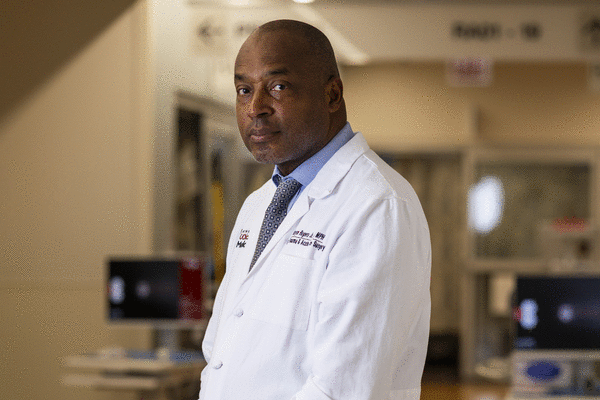
CHICAGO -- At the end of a particularly difficult shift in the University of Chicago Trauma Center, Dr. Selwyn Rogers Jr. came home, put some Miles Davis on and started to write.
During that shift in the summer of 2022, Rogers and the team of trauma surgeons he leads at UChicago Medicine had treated two teenage boys who were each shot multiple times and died from their injuries. The surgeons and other staff met with each of their families in a “sterile, eggshell-colored box of a room” — a place where people have experienced such intense reactions to trauma that hospital staff has considered bolting the chairs to the floor. There, they told the families their boys had died.
The notes-app reflection Rogers wrote after that shift first became a 2023 article in the New England Journal of Medicine and now a book, called “Healing the Gun Violence Epidemic,” which was released on July 7.
As head of one of Chicago’s busiest trauma centers, Rogers has played a critical role in responding to Chicago’s gun violence epidemic. Now, he is calling for research and investment to aggressively combat gun violence as a public health problem.
“Gun violence is complex,” Rogers said. “But by the same token, we figure out a lot of complex things. We figure out receptors for glucose in the stomach. We figure out receptors for insulin, we figure out receptors for breast cancer. The fact that things are complex and we can’t figure it out — it’s that we haven’t applied the same degree of rigor that we do for some scientific or health issues.”
In the book, Rogers tells the stories of shooting victims themselves, along with those of the people around them whose lives were changed as a result of injury or death. It spends time with the health care professionals who greet patients in the University of Chicago trauma bay and who sometimes remain involved in their lives well after they’re discharged from the hospital.
And it makes an argument that relationships, one person at a time, can ultimately drive down firearm injuries and deaths, from suicides to the roughly 85,000 people who survive gunshot injuries every year.
The book delves into some of the factors that lead to gun violence, including the widespread availability of guns; the psychological injuries that persist even after medical providers treat the physical wounds; and the effects of structural racism that run through so many discussions of violence in Chicago and beyond. It draws on Rogers’ past experiences as a trauma surgeon in Massachusetts, Pennsylvania and Texas, as well as the years he’s spent at the helm of the University of Chicago’s trauma center, which reopened in 2018 after 27 years.
Rogers’ time leading the trauma center has coincided with the rising awareness and public investment in community violence intervention as a path out of harm’s way for the people who face the highest likelihood of gunshot injuries or deaths. That means street outreach, conflict resolution and workforce development opportunities on the preventative side, as well as counseling and logistical support after shootings occur. The book argues for greater commitments to violence intervention as a way to foster the relationships that can make the difference for people who are at the greatest risk.
Chicago, Cook County and Illinois have put millions into “peacekeeper” programs and different violence interrupter programs across the city, but Rogers, a board member of the anti-violence organizations Chicago CRED and the Institute for Nonviolence, would like to see much more, particularly when stacked up against the roughly $2 billion allocation for the Chicago Police Department.
“Budgets are moral documents,” he said. “I am not a defund the police guy. Police are part of our (nonviolence) team. However, community violence intervention should be part of a public safety team as well.”
Speaking to the Tribune, Rogers said he believes the general understanding of gun violence and the collateral damage it inflicts is “poor, unless you have been directly impacted by it.”
Mass shootings draw intensive media attention and often characterize public perceptions of gun violence, even though they make up a tiny slice of the shootings that occur in America every year. And because so much community gun violence tends to be concentrated among young Black and brown men from poor neighborhoods, he said, “people think this is some other person, other community, that neighborhood, those people” who are shouldering the costs of the injuries and deaths.
“People don’t think it’s their problem until it happens in their backyard,” he said. “The reality is, this is happening in everyone’s backyard.”
The idea behind the book, Rogers said, was to argue against public perceptions of gun violence as intractable or inevitable, to offer a more accurate picture of everyday forms and consequences and to bring more people into the generations-old fight against it.
Speaking at an event in Garfield Park recently, Rogers asked everyone to share in that “pathological optimism” at the height of of the summer, the busiest season for trauma surgeons, anti-violence workers, police and everyone else who works in and around neighborhood public safety.
“It is possible, not just in Chicago but in America, for gun violence to become something that we used to talk about,” he said. “We used to talk about the moon … and we actually figured out how we get to it. So dreams are possible, if you have the will.”
©2026 Chicago Tribune. Visit chicagotribune.com. Distributed by Tribune Content Agency, LLC. ©2026 Chicago Tribune. Visit at chicagotribune.com. Distributed by Tribune Content Agency, LLC.









Comments