Review: Like 'The Secret History,' 'Lucien' is an unnerving campus tale
Published in Books News
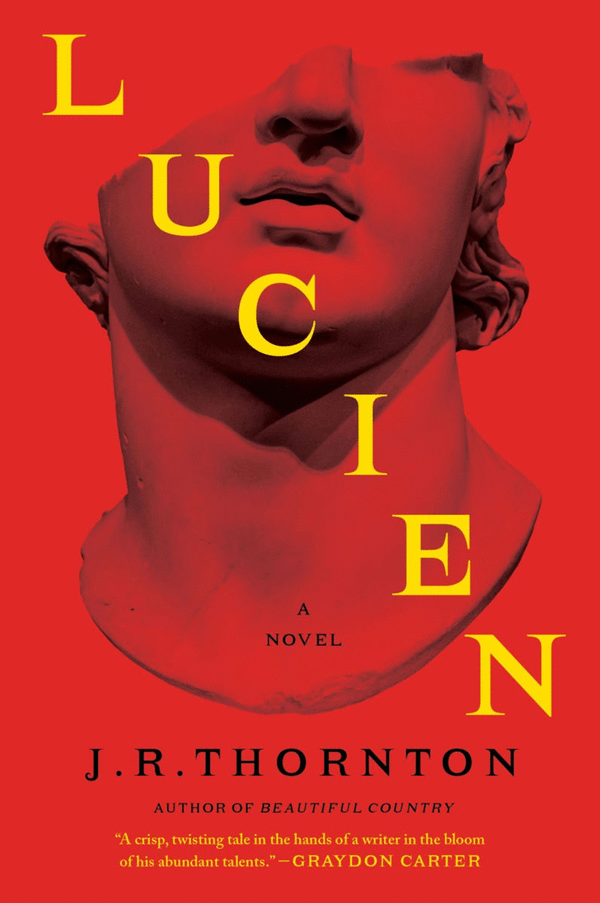
If a character is compared to Icarus early in a book, it’s not going to go well for them.
Soon after Christopher, the main character and narrator of “Lucien,” arrives at Harvard University, a fellow student sees one of his paintings. It includes an angel the classmate assumes is Icarus, so he asks Christopher if he’s familiar with the mythological character:
“I shook my head.
“‘He flew too close to the sun and the wings melted off his back.’”
How much you wanna bet that Christopher is about to fly too close to the sun?
Another figure in Greek mythology also figures in “Lucien,” in which Christopher’s new roommate Lucien immediately decides Christopher should be called Atlas. It seems like a cool nickname until, many pages later, Christopher meets a young woman named Harriet who prefers to call him by his actual name because “Atlas wasn’t very intelligent, you know.”
Novelist J.R. Thornton, who also attended Harvard, probably doesn’t need to pile the ominousness quite so high. It’s clear from the moment Christopher meets Lucien that the latter is manipulative and unscrupulous, character traits that become especially problematic when Lucien learns that Christopher is a talented artist with a knack for forgery. Before you can say, “He’s in way over his head,” Christopher is.
“Lucien” fits neatly into the genre of campus novel, alongside such classics as Curtis Sittenfeld’s “Prep,” Donna Tartt’s “The Secret History” (especially) and John Knowles’ “A Separate Peace,” with its depiction of a bumpkin trying to fit in with all the prep school elites whose families own private planes and have tutors on speed dial for when academic emergencies arise.
Thornton captures the college scene with witty ease. Christopher and Harriet’s first meeting is a comic gem, as the two awkwardly flirt while joking about Arthur Miller’s “Death of a Salesman,” E.B. White’s “Charlotte’s Web” and TV comedy “Arrested Development.” It’s no mystery why they fall for each other, or why kind Harriet is wary of Christopher’s connection to the title character.
In the same way that the title character is not the protagonist of “Lolita,” “Lucien” is really about Christopher. Lucien is devious and clever in not-especially-fresh ways but Christopher’s naked need for acceptance into Lucien’s world is easy to relate to, with the bonus entertainment value of both a criminal scheme that’s bound to go sideways and a sneak peek at the fascinating world of forgery. While Christopher gets an education in how to fake provenance and age canvases, so do we.
Readers won’t be surprised that things end badly in “Lucien” but they may be surprised by what Christopher takes away from that ending, by Christopher’s enduring affection for Lucien and by what “Lucien” has to say about how friendships, even toxic ones, work.
____
Lucien
By: J.R. Thornton.
Publisher: Harper, 310 pages.
©2026 The Minnesota Star Tribune. Visit at startribune.com. Distributed by Tribune Content Agency, LLC.











Comments