In 2013, Chicago Public Schools tried to ban a book. It didn't go well. A new graphic novel tells the tale
Published in Books News
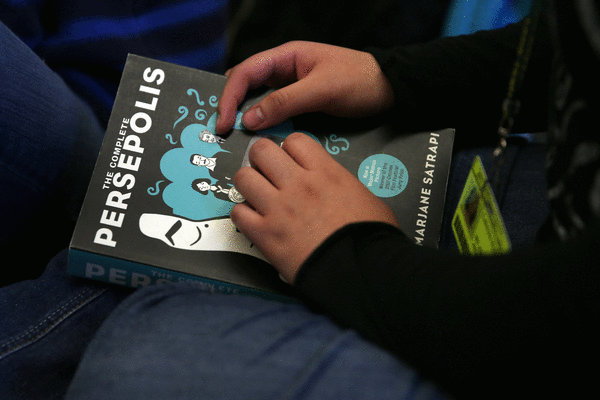
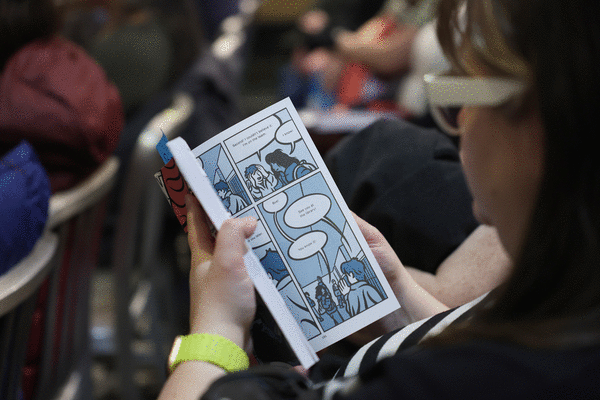

CHICAGO — Thirteen years ago, at Lane Tech College Prep High School on Addison Street, a school administrator approached an English teacher and told her that he needed all of her copies of “Persepolis,” the widely beloved, best-selling 2000 graphic novel from Marjane Satrapi about her childhood under the oppressive regime in Iran during the Islamic Revolution. The teacher didn’t understand the demand at first: Wait, are you confiscating “Persepolis”?
The administrator made it clearer: He needed EVERY copy, now.
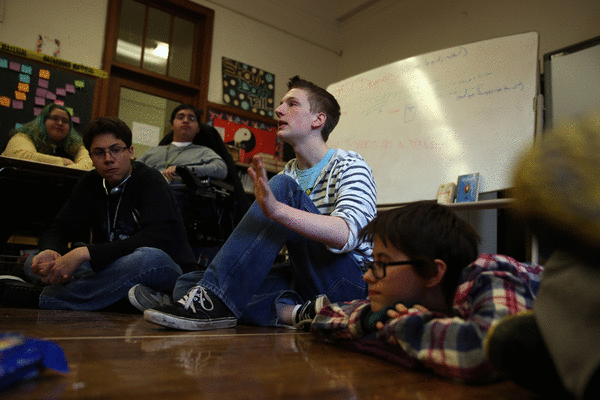
Turns out, as often happens with a case of book banning, a single person had a problem with a single page in a book — in this case, a drawing of the torture of political prisoners. Students caught wind of the confiscation and quickly rallied a sizable protest outside the school. Barbara Byrd-Bennett, head of CPS at the time (later jailed on bribery charges), claimed she had nothing to do with the removal. Alas, here was an extremely rare instance of a book banning in Chicago.
It made headlines for a few days. Chicago Public Schools swore it was a case of miscommunication. With a handful of exceptions, mainly for younger students, “Persepolis” was soon returned to CPS classrooms.
The world moved on.
Except Jarrett Dapier.
He still remembers where he was when he heard about the ban:
“I was a librarian at Evanston Public Library, working on the teen desk. When the news of the ban started filtering through Twitter, I was working alone that night and I found myself waving my arms in anger, all hysterical and alone. I was totally outraged, but also pretty pumped that these teens were protesting right away and wouldn’t let it slide.”
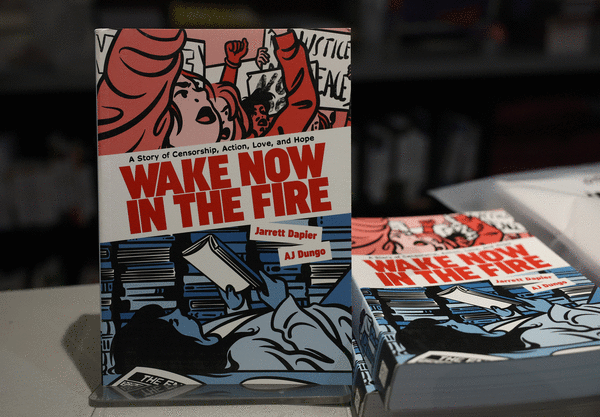
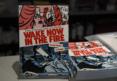
Thirteen years later, as a way of honoring those students, while also laying out exactly how the banning incident happened and why it “foreshadows our current moment,” Dapier turned the Lane Tech controversy into “Wake Now in the Fire: A Story of Censorship, Action, Love and Hope,” a sweeping 463-page graphic novel with art by A.J. Dungo. The book’s primary characters are fictional, but many names (CPS, Bennett) are not, and the narrative itself weaves in actual texts and emails that flew between real participants. The book is also partly an adaption of a thesis paper that Dapier wrote a decade ago as a graduate student of library sciences at University of Illinois. He interviewed teachers, principals, librarians, many students involved in the protests. A year after the banning, he was still discovering fresh insights — a case of persistence that later led to an intellectual freedom award from the American Library Association.
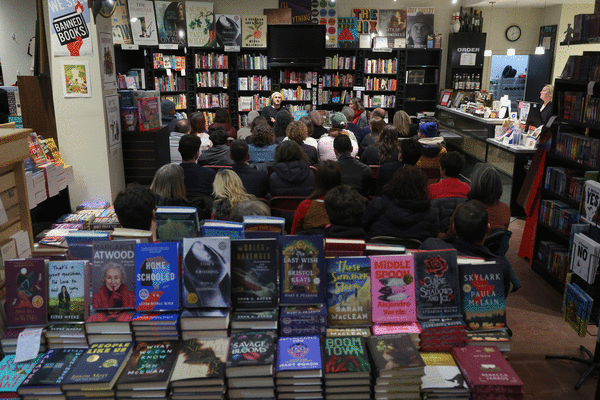
Jarrett Dapier speaks with Chicago Teachers Union project organizer and former teacher Nora Flanagan about his graphic novel, “Wake Now in the Fire,” at The Book Cellar on Feb. 3, 2026, in Chicago. (John J. Kim/Chicago Tribune)Before a recent book-launch party for “Wake Now” at the Book Cellar in Lincoln Square, down the street from Lane Tech, he met with Nora Flanagan, one of the librarians at the center of the banning. In fact, the copies of “Persepolis” pulled from that initial classroom were put there years earlier by Flanagan herself, who bought them with her own money when she taught at Lane Tech. At the time of the ban, she was at Northside College Prep on Kedzie Avenue in the North Park neighborhood.
They curled into chairs in a corner of the store, watching a crowd filter in.
“A year after the ban, I was in a graduate class and I was looking at how censorship affects teen reading. I remember how dissatisfied I still felt about the outcome,” Dapier said. “Within a week of the protests, CPS had managed to just sweep it under the rug.”
“They walked it back so hard they fell into traffic,” Flanagan said.
Across her knuckles were tattooed letters spelling: “READ MORE.”
As they chatted, the room filled with ghosts of 2013, former students and school librarians and writers who remembered the chill set off by the banning inside the Chicago literary community. There was Levi Todd, who founded a Lane Tech club for readers of banned books; he graduated years ago. And there was Beth Hetland, cartoonist and teacher at the School of the Art Institute of Chicago; she was out of high school by 2013, but had marched alongside the students. Dapier himself met Flanagan around that time because of the ban, when he started reaching out to students and teachers who were involved. “I remember the teacher who had my copies of ‘Persepolis,’ 25 or 30, texted me right away,” Flanagan said. “She feared for her job.”
“In my book, when the (teacher) says, ‘These are personal copies, you can’t have them,’ and the (principal) is ‘Uh … you can’t … wait …,’ he’s following orders,” Dapier said.
“He’s trying to impress a boss, who is trying to impress their boss,” Flanagan said, “because that’s what happens when a big-city school system becomes a business. But really what Jarrett found here, after he FOIA’d the school, was basically incompetence.”
About a year after the ban, Dapier submitted a Freedom of Information Act request to CPS, asking for any communications about the “Persepolis” incident. When the ALA made its own FOIA request, it got back scant details, mainly redacted. “So when I sent my FOIA, I didn’t expect much,” he said. “I got back 42 pages of emails. My son was a baby and he was sitting in his highchair, so I’m watching him and flipping through pages on my phone, which are almost entirely redacted, but I also notice every time I flip a page, the redactions are gone for like a split second. So I’m like ‘Wait a second …’ I opened a review app and was able to highlight the black highlighter, and then, in a few keystrokes, there were 42 pages of emails, the whole chain of decision-making about the banning, all unredacted. I heard the person who sent me the FOIA was gone soon after, but I like to think that she was on her way out and giving a finger to the whole system.”
He learned that the spark of the ban, the initial outrage, didn’t come from a parent but a CPS network chief, a middle-manager and administrator in charge of one of CPS’s many clusters of schools, of which there are more than 600 elementary and secondary schools. He learned, though Bennett had denied being involved, that she was on all 42 pages of emails: “When the person who wanted ‘Persepolis’ removed brought it up, she almost immediately agrees, then figures, while they’re at it, get it out of every school.”
He learned CPS wanted to know who approved the book, which had been a part of its curriculum then for eight years. He learned that other books were suggested for removal.
Flanagan rolled her eyes.
“I taught English for 25 years and had parents object to books twice. One time, a parent flipped open ‘My Bloody Life’ (the autobiography of a former member of the Latin Kings street gang in Chicago), and they saw a sex scene, so I met with my principal, who was supportive about it and I remember he started the meeting: ‘So I hear you’re teaching porn?’ The other time was a book of Greek mythology; the parent had religious reasons. I don’t even think they wanted the book banned, they just didn’t want their kid reading it. See, you don’t want to pick this fight in Chicago. We have structures in place to deal with it.”
Since that incident over “Persepolis,” Flanagan left teaching to become a project organizer for the Chicago Teachers Union, specializing in academic freedom and combating censorship challenges. Dapier, who had been in Evanston five and a half years, is now a school liaison and youth librarian for the Niles-Maine District Library.
Part of the confusion with the ban was that “Persepolis” could still be checked out of the Lane Tech library, and when CPS brought back the book, it was often unclear which students were allowed to read it. Flanagan — who described the reinstatement as “convoluted at best” — noted the best result of the incident was: “Now we have a solid process for curriculum challenges, so someone can’t just storm into a school-board meeting to demand a book pulled. There’s an order of steps, starting at the school, not top down. It’s a big school system, a big teachers union. We’re not a soft target.”
That said, soon after the ban, then-Mayor Rahm Emanuel announced the closing of 50 schools; and soon after that, he announced the implementation of a new funding formula, Student-Based Budgeting, which Flanagan characterized as: “Each school receives a certain dollar amount for each student and that’s used for toilet paper and it’s used for teachers and when a school librarian needs a minimum of a masters degree, they become some of the first pushed out. You don’t have to ban books at all when you just fire the school librarians and claim that you are doing the fiscally responsible thing.”
“A lot of schools now have old libraries being used as storage rooms,” Dapier said.
Flanagan nodded. “I used to think it was weird when a school didn’t have a library, and now I’m pleasantly surprised these days when a school in Chicago has a library at all.”
Thirteen years ago, CPS had several hundred school librarians. Today, according to the Chicago Teachers Union, there are 77 librarians for 600 schools, with plans, as a part of the latest teachers’ contract, to add another 90 librarians by 2028.
“Persepolis” is still being taught in CPS.
Book bans themselves remain a unicorn in Chicago. After a wave of attempts in 2022 to remove certain books from libraries in Chicago suburbs and small Illinois towns — often led by groups like Moms for Liberty, which characterizes itself as reclaiming “parental rights” — the state passed legislation to protect Illinois libraries from book bans, the first legislation of its kind in the country.
But the truth, Dapier said, “is it’s almost impossible to track (all challenges), or if a library is not ordering certain books to avoid a challenge.”
According to a study last fall by PEN America, the nonprofit free-expression advocacy group, book challenges in the United States are almost normal now: “Never before in the life of any living American have so many books been systematically removed from school libraries across the country.” In 2013, the ALA knew of 307 challenges to reading materials in American libraries — both public and school libraries. During the 2024-25 academic year, PEN America recorded 6,870 book challenges in school libraries alone.
As if on cue, the Chicago-based YA author Jessie Ann Foley leaned in to say hello.
“Banned author!” Dapier exclaimed.
Indeed, Foley’s first novel, “The Carnival at Bray,” about a Chicago teenager who moves to Ireland, was removed from schools in 10 states. “Ten that I know of,” Foley admitted. “They said it was without literary merit, since there were two sex scenes. The funny thing is, when it was being banned, I was published by a tiny press that was folding, and because the ban renewed interest, it got reissued by a way larger press, HarperCollins.”
She took a place at the back of the crowded room and the party started.
Flanagan called out: “Raise your hand if you are or have been a CPS librarian.”
A cheer went up.
She looked relieved.
©2026 Chicago Tribune. Visit at chicagotribune.com. Distributed by Tribune Content Agency, LLC.






Comments