Connecticut officials are reporting the spread of West Nile virus across state. Here's where it's been detected
Published in News & Features
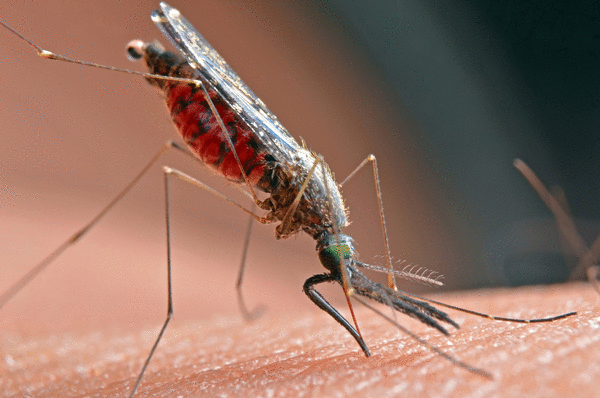
HARTFORD, Conn. — A high amount of rainfall and humid conditions have created ideal conditions for mosquitoes in Connecticut as state officials say the West Nile virus has now been detected in 22 cities and towns and is spreading.
According to Dr. Phil Armstrong, chief scientist with the state’s mosquito trapping and testing program at the Connecticut Agricultural Experiment Station, wet and humid conditions are creating a higher population of mosquitos. Mosquitoes thrive in the wet conditions and high humidity that follows rainstorms. Rain leaves behind standing water in puddles and containers, which female mosquitoes use to lay eggs. Populations often surge three to seven days after a storm.
“This has been a very wet summer and with that it’s driving up the numbers of mosquitos creating more breeding sites,” Armstrong said. “The weather is also creating optimal conditions with high humidity. So the hot and wet weather is definitely increasing reproduction of mosquitos and we are seeing that in our traps throughout the state.”
The mosquito trapping and testing program, coordinated by the Connecticut Agricultural Experiment Station, started on June 1 and lasts until the end of October. From mid-August to the end of September is considered peak mosquito season, according to the CAES.
Last year, West Nile virus was detected in 230 mosquito samples from 37 towns in six counties in Connecticut. The majority of West Nile virus activity occurred in urban and suburban regions in Fairfield, Hartford and New Haven counties, according to the CAES. Six human cases of West Nile virus-associated illness were reported with dates of onset from Aug. 10 to Sept. 18 in 2025.
This year, the areas with the highest levels of virus activity in mosquitoes are New Haven and Fairfield counties, according to Armstrong.
Cities and towns found with positive West Nile virus mosquitos include Branford, Bridgeport, Cheshire, Danbury, Darien, East Haven, Fairfield, Greenwich, Manchester, Meriden, Milford, Montville, New Britain, New Haven, North Branford, North Haven, Norwalk, South Windsor, Stamford, Stratford, West Haven and Westport, according to the CAES West Nile virus activity map.
West Nile virus occurs every summer in the Northeast and has become the main cause of mosquito-borne illnesses in this region, according to Armstrong. So far this season, there are no reported human cases of the West Nile virus.
“We generally see the most cases in Fairfield and New Haven counties and it’s related to habitat,” Armstrong said. “The mosquito that transmits West Nile virus is found in densely populated areas and more urban and suburban locations. This mosquito is more associated with human disturbance including containers left out in people’s backyards will draw them. Tires, pools, bird baths and feeders, catch basins, buckets and containers that collect water are all places they will reproduce.”
West Nile virus is spread to people by mosquitoes from the Culex genus. The main species that carry the virus in the United States are Culex pipiens or the Northern common house mosquito. Armstrong said the mosquito’s primary host it feeds on is birds, and that the virus is spread primarily from birds to the insect before infecting a human.
“The mosquito will occasionally feed on people, but they prefer birds as their primary host,” he said. “The birds are what carry the virus and are the ultimate source of infection in the mosquito are maintained in the bird to mosquito transmission cycle. Unfortunately, someone might have a mosquito feed on them after feeding on an infected bird.”
About 80% of people who catch the West Nile virus have no signs or symptoms, according to the Centers for Disease Control and Prevention. About 20% of people get mild, flu-like symptoms. Less than 1% of people infected get very sick with long-term brain or nerve problems.
EEE virus was not detected in the state during 2025. EEE is a rare but serious illness in humans with approximately 40% mortality. The last major outbreak occurred in 2024, involving 19 human cases nationally with 13 of the cases reported in each of the New England states other than Connecticut, and two each in New York and New Jersey.
“So far we have not detected any EEE virus in our mosquito collection program,” Armstrong said. “I have also not heard of any EEE virus activity in our general region near our state.”
“We recommend taking protection measures against mosquitoes like covering up skin, wearing repellent and staying indoors between the periods of dusk and dawn,” Armstrong said. “Mosquitoes that are the primary vectors of West Nile are most active during the hours of dusk and dawn. If you need to be outside during that time, it is important to take precautions. They really do make a big difference.”
_____
©2026 Hartford Courant. Visit courant.com. Distributed by Tribune Content Agency, LLC.





Comments