US, Japan, South Korea hold talks after North Korean missiles
Published in News & Features
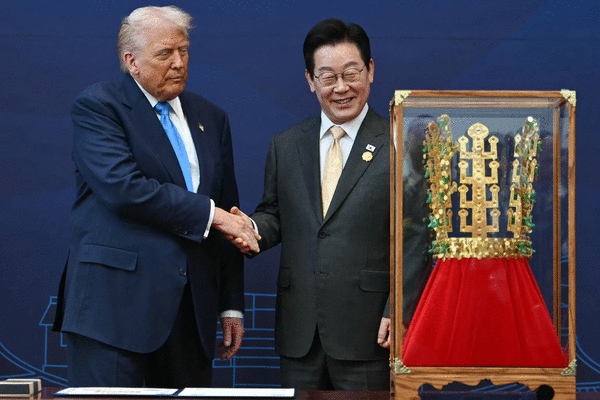
The U.S., Japan and South Korea held a three-way call to discuss the barrage of short-range ballistic missiles launched by North Korea, coordinating their response after Pyongyang dismissed President Donald Trump’s overtures to revive dialogue.
North Korea launched about 10 ballistic missiles from Pyongyang on Thursday that flew roughly 300 kilometers, South Korea’s Joint Chiefs of Staff said. Japan’s coast guard earlier said a suspected North Korean missile appeared to have fallen outside Japan’s exclusive economic zone, according to the nation’s public broadcaster NHK.
Officials from the U.S., South Korea and Japan held a phone call on Friday and urged North Korea to stop “provocations that threaten the peace and security of the region and the international community,” Japan’s Foreign Ministry said in a statement.
The call comes as tensions on the peninsula simmer amid mixed signals over the prospects for dialogue. The launches came shortly after Pyongyang cast doubt on Trump’s suggestion that high-level communication between the two countries’ leaders had been revived. North Korea also shrugged off Washington’s decision earlier this week to scale back its joint military drills with South Korea, saying it was “uninterested.”
Pyongyang said that despite the “excellent” relationship between Trump and its leader, Kim Jong Un, America’s hostile policy toward the North remained unchanged.
South Korean President Lee Jae Myung nevertheless welcomed Trump’s move to curtail the exercises as a potential opening for renewed diplomacy.
“The latest message from President Trump strikes me as a major decision reflecting deep consideration of how to move beyond hostility and confrontation and build peace on the Korean Peninsula,” Lee said in a late-night X post on Wednesday.
The missile launches came just hours after South Korea’s defense minister said North Korea may possess as many as 120 nuclear weapons, more than twice the 57 warheads cited by Trump. Earlier, U.S. Pacific Command said in a statement that the launches “do not pose an immediate threat to US personnel or territory, or to our allies.”
“The numbers appear to be somewhat different,” Defense Minister Ahn Gyu-back told lawmakers when asked about Trump’s assessment that Kim has “57 very powerful nuclear weapons.”
“We usually look at around 80 to 120,” Ahn said, referring to South Korea’s estimates.
Ahn later clarified that he was citing an assessment by a South Korean research institute. “As for the military’s own assessment, there are considerable limitations on what I can disclose here,” he said.
The latest weapons test marks North Korea’s third missile launch this month, underscoring the scale of the challenge confronting Trump as he tries to resurrect the personal diplomacy with Kim that defined his first term as president.
“I know Kim Jong Un very well, and he’s going to be fine. As long as we have a smart president, he’s going to be fine,” Trump has said.
Despite Trump’s confidence, Kim’s expanding arsenal complicates US effort to revive diplomacy. Trump and Kim met three times during the US leader’s first term, but the talks failed to curb North Korea’s nuclear ambitions.
(Iain Marlow and Cat Barton contributed.)
©2026 Bloomberg L.P. Visit bloomberg.com. Distributed by Tribune Content Agency, LLC.






Comments