Iran says Hormuz talks ongoing after Trump calls off strikes
Published in News & Features
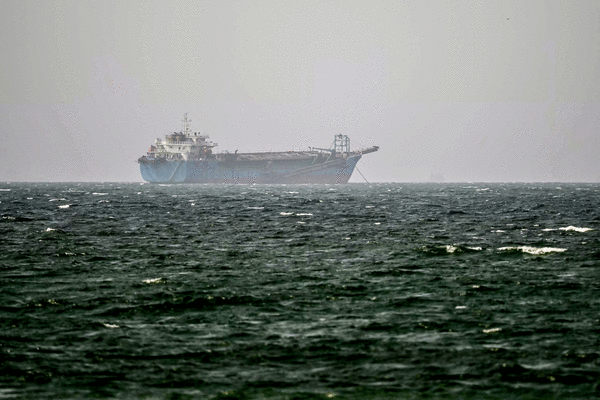
Iran suggested negotiations with Oman to get more ships moving through the Strait of Hormuz are making progress, but President Donald Trump expressed renewed frustration after calling off what he said was a major attack on the Islamic Republic.
Oil fell on Monday, with Brent crude down about 4.6% to just over $83 a barrel, after Iran’s foreign minister, Abbas Araghchi, said discussions between Tehran and Muscat over management of the strait are in the final stages.
The discussions with Oman are about a “temporary” route to ensure the safety of ships, Esmail Baghaei, an Iranian foreign ministry spokesman, said on Monday. “We are not currently negotiating with the United States.”
That elicited an angry response from Trump, who called the Iranian leadership “incredibly duplicitous.” He said talks had taken place and more are scheduled, without providing any details. “Whether Iran wants to admit it or not, we are, in fact, talking of a solution,” he wrote on social media.
Iran has shown no sign of allowing vessels free passage through the Strait of Hormuz, which Trump has demanded. Instead, Iran said it’s talking to Oman about a new route and not about whether the strait as a whole will be open or closed.
Last week, Bloomberg reported that Muscat and Tehran were discussing reopening the so-called middle passage through Hormuz. It has, however, been mined by Iran, according to people familiar with the matter, and could have to be cleared before vessels use it on a regular basis.
The choke point, a vital conduit for supplies of oil, liquefied natural gas and other commodities such as fertilizers, remains all but shut. Hardly any ships are sailing through, at least with their transponders turned on. Most that do are going on a northern route close to Iran’s shores with Iranian permission, or on a southern one nearby Omani territory.
Trump, early on Sunday Iran time, said he had canceled strikes — the likes of which he claimed have “not seen since World War II” — after lobbying from Iran and Middle Eastern countries. He later said Saudi Arabia, the United Arab Emirates and Qatar had all urged him to give diplomacy more time.
Saudi Arabia’s Crown Prince Mohammed bin Salman held a call with Trump over the weekend. The kingdom’s de facto leader “stressed the need to prioritize dialogue to reduce escalation and the importance of making every possible effort to achieve calm,” according to the main Saudi news agency.
Gulf Arab states are allies of the U.S. but have become exasperated by the continuation of the war, now in its sixth month. They are concerned that any escalation would see Iran lash out by firing more drones and missiles at them, damaging their infrastructure and hurting their economies.
Iran has regularly attacked the likes of Kuwait and Bahrain in the past two months, during skirmishes with the U.S. Saudi Arabia, the UAE and Qatar have suffered less, but have seen their ships hit near Hormuz. Saudi Arabia has also been attacked by Iran-backed militias in Iraq and by the Houthis, based in Yemen, in the past two weeks.
Trump signaled he wouldn’t wait long for a diplomatic resolution and urged mediators and Iran to “rapidly make a deal.” It must include, he said, the “immediate, complete, and total opening” of the strait, as well as “an end to Iran’s nuclear threat.”
The U.S., he said, remains “locked and loaded.” He suggested the weekend strikes would have been carried out with Israel, which isn’t known to have struck Iran since a first ceasefire deal in April.
U.S. embassies across the region on Saturday had warned Americans to be prepared for flight cancellations and airspace closures.
The president previously said he would step up the intensity of bombing until Iran reopened the strait. He threatened to eventually hit the country’s civilian infrastructure and power plants, something Tehran has warned it would retaliate against fiercely.
Israel, which launched the war alongside the U.S. but wasn’t party to an initial Washington-Iran peace deal in June, is waiting out the latest diplomatic push, according to a member of Prime Minister Benjamin Netanyahu’s security cabinet, Zev Elkin.
There’s “some kind of vector toward an agreement between Iran and Oman,” he told local Army Radio on Sunday.
_____
©2026 Bloomberg L.P. Visit bloomberg.com. Distributed by Tribune Content Agency, LLC.






Comments