After an 11-year-old stabbed a stranger, Minnesota's new juvenile justice law faces an early test
Published in News & Features
MINNEAPOLIS — The first significant test of a new Minnesota law making it illegal to charge children under 13 with a crime came this month when an 11-year-old stabbed an 18-year-old multiple times in the entrance to a St. Cloud grocery store.
The victim and store patrons held the 11-year-old down until police arrived and took the boy to St. Cloud Hospital.
The attack came three days after a law known as “Raise the Age” went into effect on Aug. 1. Previously, children under 10 years old could not be charged with a crime in Minnesota. Now it’s children under 13. The law — which passed the Legislature in 2024 — makes no exceptions for the severity of crime committed and designates the child who committed the crime as being in need of state protection or services.
St. Cloud Police Chief Jeffrey Oxton said his department had been working closely with Stearns County Human Services and the County Attorney’s Office to implement the law change, and he praised the county’s response to the stabbing, especially since it happened so soon after the law went into effect.
But Oxton said the law remains worrisome for police. He said he does not want 10- to 12-year-olds held in juvenile detention for indefinite periods of time, but the Legislature has not provided the support needed to make alternatives work.
“We’ve been making this known; there’s no resources for these kids in the state,” Oxton said. “There’s no beds. There’s no detention places that can hold kids that are at risk ... absent a juvenile detention facility, which will only take a kid charged with a crime. There is no place. We can work as well together as possible, we can be as innovative as we can, but if there’s no place, what do you do?”
Sarah Davis, the director of the Children and Families Division of the Hennepin County Attorney’s Office, worked extensively to get Raise the Age passed. While she agreed resources are lacking, she argued it’s a need that has been neglected by the state for years and didn’t change the necessity of the law.
“We do need the state to invest in the resources that our communities need to provide support to children with complex behavioral and mental health needs,” she said. “To the degree that our child protection system has been using a juvenile detention center and the delinquency system and correctional facilities as a backstop for elementary age children, it’s not appropriate and it doesn’t work.”
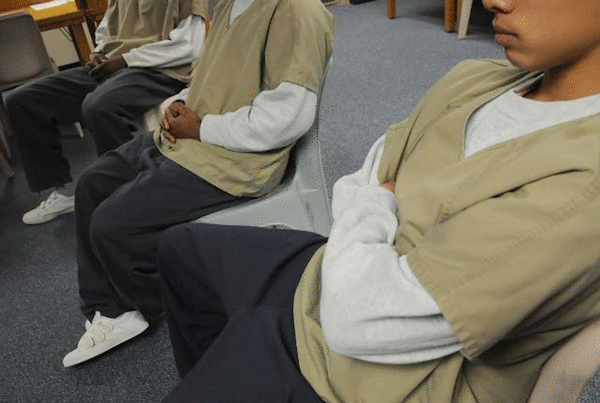
Previously, children ages 10 to 12 who committed a crime could be held in a juvenile detention facility while juvenile courts processed their case.
Now, after a crime is committed, police will first try to return the child to their parent or guardian. If that is not an option — because of the danger the child poses or the parent’s abilities to care for the child — the county will need to place the child somewhere like a hospital, group home or foster care facility.
The availability to place children in those facilities has been a consistent challenge in Minnesota. The Minnesota Star Tribune reported in 2024 that, while the number of kids entering the juvenile justice or social services systems with complex needs had grown in recent years, the number of licensed residential treatment facility beds for children had shrunk by more than a third since 2005.
“The people that are going to be most affected by this are health and human services,” said Greg Klinefelter, vice president of the Minnesota Police and Peace Officers Association and a sergeant with St. Cloud police. “There’s going to be significant challenges in our first 24 hours of response, basically saying, ‘When we get these juveniles without secure detention where are we going to take them?’”
As the law went into effect, the Minnesota Department of Children, Youth and Families (DCYF) sent out guidance for county agencies on how to deal with the change.
It said agencies should consult with their county attorney’s office when a delinquency referral is initiated after a child under 13 commits a crime and they can begin a child welfare assessment. The goal is to prevent the child from being removed from their home and the county should work to “support families so that they can meet their children’s needs on their own and in partnership with support systems.” That support will focus on specific cultural needs and could include access to mental health and substance use services or supporting families to better build relationships.
Still, because every child under 13 who now commits a crime will be considered a child in need of protection or services, that child’s well-being is the “paramount consideration” for state officials.
Counties will have the ability to create multidisciplinary teams, including law enforcement officials, to consider next steps for the child and a petition could be filed to determine if the child needs to be removed from their home.
Statewide data shows that, from 2013-2024, children between 10 to 12 were charged with an average of 755 crimes per year, mostly misdemeanors, and 73% of the cases were ultimately dismissed.
Davis said most children under the age of 13 are found incompetent to face charges in court, not because they aren’t smart but because children don’t have the capacity to understand their constitutional rights.
In the past, that meant young children and their families could be dramatically impacted by a criminal allegation that ultimately went nowhere.
Tamara Frazee experienced that process in 2018 when her son Trystan was arrested and detained after he slammed a classroom door on the hand of his teacher. Trystan had just turned 10. He hid from police and hit them when they tried to arrest him.
Trystan is autistic and when he was younger he would have occasional outbursts that can be common for autistic children.
“They strapped him on a gurney,” Tamara said. “And shipped him to Mankato.”
At the time, they were living in Janesville, Minn. Tamara grabbed Trystan’s medications and his diagnostic assessment and raced to the hospital where staff told her that Trystan said he felt really bad and that “he doesn’t want you to give up on him.”
She thought he would come home after the hospital, but police took him to a detention center.
Photos of Trystan at the time show a blonde haired, stocky boy with a sweet smile. In one he stands beaming next to the Vikings mascot. In another he’s building a gingerbread house, being squeezed by his mom.
He suffers from severe sensory issues and while he was in the detention facility the clothes were so irritating that he stripped naked. He plugged the sink and it started to overflow. Staff let him play video games to calm down, then put him in his room for the night. He rang the intercom every five minutes, asking what time it was and making sure he hadn’t been forgotten.
He was held for two days.
“It wasn’t an extreme amount of time,” Tamara said. “But it was still extremely impactful.”
When Trystan came home, he was terrified to leave the house or go to school. Tamara open-enrolled him at a school in Mankato and he slowly rebuilt his trust with staff members. She said anytime the school called her, her heart sank into her stomach.
She said one day they called to let her know the school resource officer had entered the room and Trystan did not hide under his desk.
“They just really wanted to make sure that I knew that he was recovering,” she said.
Meanwhile her relationship with police in the town deteriorated after she filed a civil lawsuit over how her son was treated.
Ultimately Trystan was found incompetent to stand trial, but the court waited a year to dismiss his charges. On the day they did, Tamara put their home up for sale. It was the only place Trystan had lived, but she no longer felt safe there. They moved to Austin when he was 11. She said by the time Trystan was 13, his violent outbursts had stopped.
Tamara supported the law change not just because of what happened to her son, but because of what she knows about children in general who act out violently at that age and are “too young, really, to comprehend the magnitude of the situation.”
“What is going on with that [child]?” she asked. “Are they having unmet mental health needs? Are they having unmet needs in their home? Is there abuse happening? Neglect happening? There’s a reason, typically, when kids are that age that they act out. I think getting to the core of that and then figuring out what is the best way forward, once you know, is a better solution.”
Davis said the new law creates better solutions for children that should not be in jail, regardless of the crime they have committed.
“It’s about how are we holding the adults accountable to make sure that this child has access to the support, resources and interventions that they need, if they need them,” Davis said. “That’s the whole point of what we’re trying to do here.”
She said the new law will create controversial moments and that children in this age range have carried out serious crimes in Minnesota in the past, including killing people. “You’re not going to hear me say that’s never happened,” Davis said.
She said the public needs to understand that the criminal justice system has never been a good tool for fixing the issues that lead young children to commit crimes and, in the past, it often just delayed county agencies from getting involved that could potentially help.
“The way the law has been up to this point was that we had to wait for a finding of ‘not competent’ before we could try and get child protection to intervene,” Davis said. “Now, because of the change in the law, the change in the statutory language, child protection has the ability to intervene much more quickly.”
Klinefelter said, while state law enforcement and county attorney agencies were against Raise the Age, it was largely over concerns about the lack of placement options for these children and how that could jeopardize the safety of the child or the community.
“Where does the accountability come in?” Klinefelter asked. “The juvenile justice system, when they do secure detention, it’s not so much about being locked up as it is about getting the process started to be able to get the right help for some of these kids that need it.
“I think what the legislators don’t get is the secure detention aspect of all this,” he continued. “All it does is buy us time. It buys us time to get that person in a safe environment that gives them a moment of accountability.”
Everyone interviewed for this story agreed on one thing: with a law change of this magnitude, only time will reveal how well it is working.
©2026 The Minnesota Star Tribune. Visit at startribune.com. Distributed by Tribune Content Agency, LLC.





Comments